

The area is shrinking…
The provinces of Long An, Kien Giang, and Ca Mau were once vibrant sugarcane growing areas, but now all the sugar factories in the region have closed, and the area planted with sugarcane has almost disappeared. Ten years ago, sugarcane was the main crop for farmers in Ben Luc district and some communes in Thu Thua district (Long An province), with a total area of up to 11,000 hectares.
To date, most of the land previously used for sugarcane cultivation has been converted by farmers to growing lemons, dragon fruit, guava, etc. Without raw materials, the Hiep Hoa Sugar Factory in Long An province operated intermittently for many years, accumulating tax debts and unpaid wages to workers, leading to complaints. The factory has now officially closed.
Five years ago, Cu Lao Dung district (Soc Trang province) had nearly 10,000 hectares of sugarcane cultivation; now it's less than 3,000 hectares. Similarly, in Tra Cu district (Tra Vinh province), from 4,000 hectares in 2015, it's now only about 1,100 hectares… Many farmers in the Mekong Delta say the main reason they are turning away from sugarcane is the unstable price of sugarcane.
Mr. Thach Det (Luu Cu 1 hamlet, Luu Nghiep Anh commune, Tra Cu district, Tra Vinh province) said that his family has been involved in sugarcane cultivation for generations, but from 2015 to the present, he has converted all 10,000 square meters of sugarcane land to rice cultivation because sugarcane farming has resulted in losses for many consecutive years.
"This situation arises because the factory doesn't have an agreement or contract with farmers to estimate the price and volume of sugarcane they will purchase at the beginning of the season, while the local authorities are uninvolved. When it's time for harvest, the factory forces farmers to sell at whatever price they demand," Mr. Det shared.
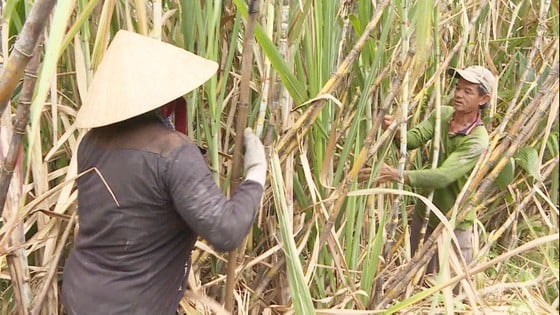 |
Farmers in Tra Vinh province harvest sugarcane. |
In Phung Hiep district (Hau Giang province), a major sugarcane growing area in recent years with nearly 7,000 hectares, the area planted with sugarcane has now decreased by almost two-thirds. Most farmers in this locality grow sugarcane to sell in bundles (traders buy and resell to beverage processing plants or sugar refineries), and do not place their hopes on sugar factories.
Farmer Hai Cuong, from Cay Duong town, Phung Hiep district, shared: “The advantage of selling sugarcane in bundles is that traders hire their own laborers to cut it, saving us the effort and harvesting costs. Not to mention, there are many traders buying it; if we can't sell it to one, we can sell it to another, so we're not forced to accept low prices.”
Faced with this situation, on October 23, the Board of Directors of Phung Hiep Sugar Factory (the largest sugar factory in the Mekong Delta, with a crushing capacity of 2,500 tons of sugarcane per day) had to issue a notice to cease operations for the 2023-2024 crop year. “When the factory ceases operations in the 2023-2024 crop year, the unit will incur a loss of 26.5 billion VND for costs related to factory depreciation, severance pay for laid-off personnel, maintenance, security, etc. However, this loss is only one-third of the loss incurred if operations were continued,” a representative of the Board of Directors of Phung Hiep Sugar Factory stated.
We need to strengthen production chain linkages.
Mr. Huynh Ngoc Nha, Director of the Department of Agriculture and Rural Development of Soc Trang province, acknowledged that there are many reasons for the shrinking area of sugarcane in the province, but the main one is the lack of linkage between farmers and sugar companies in production and product distribution. Recognizing this problem, the agricultural sector and authorities at all levels in Soc Trang province are strengthening and promoting their role as a "bridge" to connect farmers and sugar companies into the production chain.
In the near future, the locality will organize more meetings between businesses, companies, and sugar factories with sugarcane farmers. The aim is for these entities to better understand their partners' operations, find common ground, and reach agreements and contracts for production and product distribution, thereby reducing the likelihood of price manipulation. Simultaneously, by participating in these meetings, the government and the agricultural sector will also listen to the opinions of the farmers and sugarcane companies, providing timely support and resolving difficulties in the production chain.
According to Mr. Huynh Van Thao, Head of the Agriculture and Rural Development Department of Tra Cu district (Tra Vinh province), in the 2022-2023 sugarcane crop season, farmers earned a profit of 30-40 million VND/hectare. However, this is only the second profitable sugarcane crop season after five consecutive seasons of heavy losses. The common difficulty for sugarcane cultivation currently is that mechanization in production and harvesting has not been applied uniformly; most of the work is done manually, leading to increased costs.
To expand the area of sugarcane cultivation in the locality, in the coming time, the locality will plan a transportation system to serve production, reorganize production, establish cooperatives, and organize production teams to reduce costs and increase income for sugarcane growers.
Mr. Tran Ngoc Hieu, General Director of Soc Trang Sugar Corporation (Sosuco), stated that the situation of "competitive buying and selling" among sugar factories still occurs frequently. In particular, the practice of "price undercutting" leads to unstable and unsustainable linkages between farmers and businesses. "Unless the government finds a thorough solution to this situation, the sugar industry will find it very difficult to develop," Mr. Hieu said.
Source










![When forestry is a 'weakness' for Nghe An?: [Part 3] Forest owners worry about the challenge of financial self-sufficiency](https://vphoto.vietnam.vn/thumb/402x226/vietnam/resource/IMAGE/2026/06/01/1780328200116_pu-hoat-014846_425-223223.jpeg)



![Transforming from Resolution 57: [Part 1] 'Digital Field' in the Heart of the City](https://vphoto.vietnam.vn/thumb/402x226/vietnam/resource/IMAGE/2026/06/01/1780313803412_2848-htx-nong-nghiep-tuan-ngoc-8-173833_249-173836.jpeg)









![[Photo] Reception to welcome General Secretary and President To Lam and his wife on their State visit to the Philippines](https://vphoto.vietnam.vn/thumb/1200x675/vietnam/resource/IMAGE/2026/06/01/1780295488620_vna-potal-chieu-dai-chao-mung-tong-bi-thu-chu-tich-nuoc-to-lam-va-phu-nhan-tham-cap-nha-nuoc-toi-philippines-8798060-7855-jpg.webp)































































Comment (0)