3 hand-sown seeds are equivalent to 2 machine-sown seeds.
Mr. Nguyen Van Cac stands in the middle of a rice field in Yen Cuong commune, Ninh Binh province, bending down to pick a clump of ripe golden rice and separating each ear to compare. On one side is the field sown using the traditional method of his family, and on the other side is a field sown in rows using a machine in the low-emission rice model implemented by the International Rice Research Institute (IRRI).
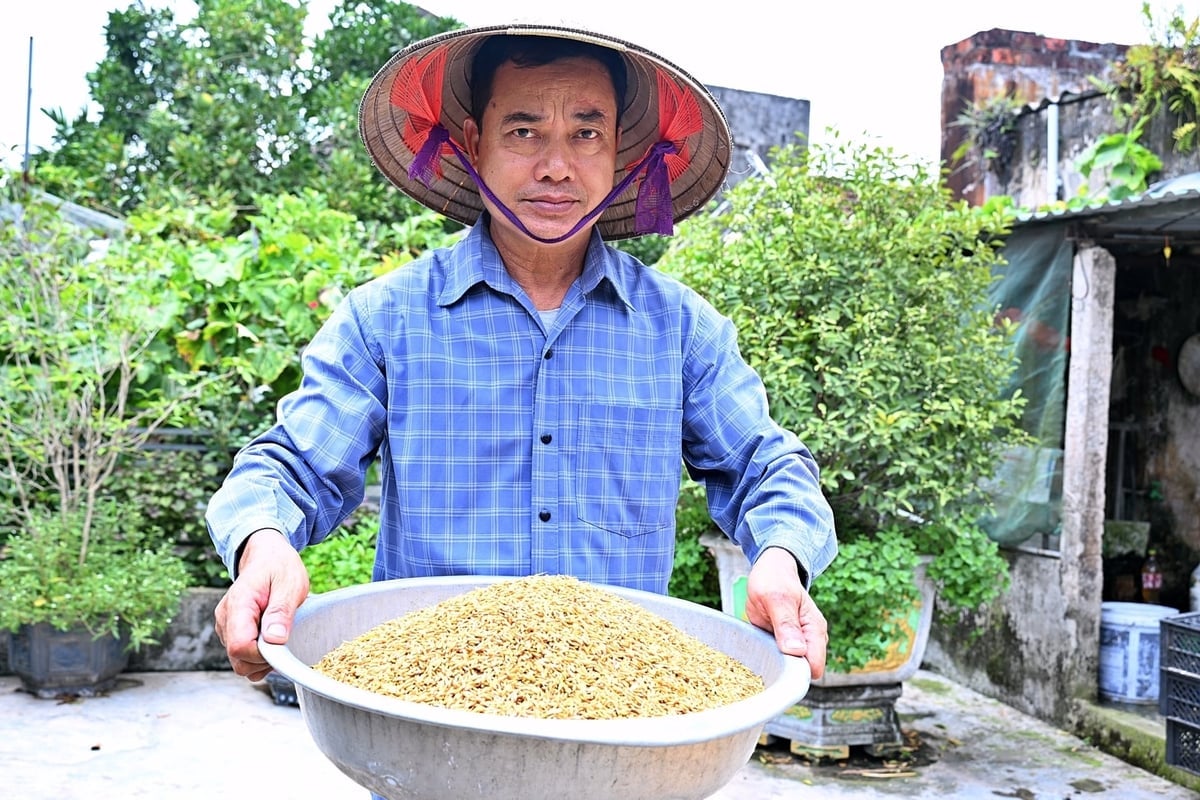
Mr. Nguyen Van Cac stands beside the fruits of his low-emission rice farming model. Photo: Bao Thang.
 Rice cultivation is booming with reduced emissions.
After a few seconds of silence, he said that even with the naked eye, the difference was noticeable. The hand-sown rice had a thicker layer of green, more ears of grain, but the ears were shorter, the seeds sparser, and the plants softer. Meanwhile, the machine-sown rice had significantly more spaced-out rows, but the ears were longer and firmer. "Three ears of grain from the hand-sown rice are only equal to two ears from the machine-sown rice," he calculated after counting the seeds.
This observation probably contradicts the rice-growing practices of most farmers in Northern Vietnam. In Ninh Binh – one of the largest rice granaries in the Red River Delta – dense sowing has long been considered a surefire way to ensure a good harvest. Farmers often increase the amount of seed because sparse plants result in fewer ears of grain and less rice. One sao (360 m2) can use up to 2.5 - 3 kg of seed. The greener and denser the field, the more reassuring it feels.
However, the low-emission rice model implemented in Yen Cuong this spring started with reducing the amount of seed by almost half. Previously, Mr. Cac's field required about 2.5-2.7 kg of seed per sao (approximately 1000 square meters), but with the row planter combined with burying fertilizer in the low-emission rice model, the amount of seed used was reduced to only about 1.2-1.5 kg.
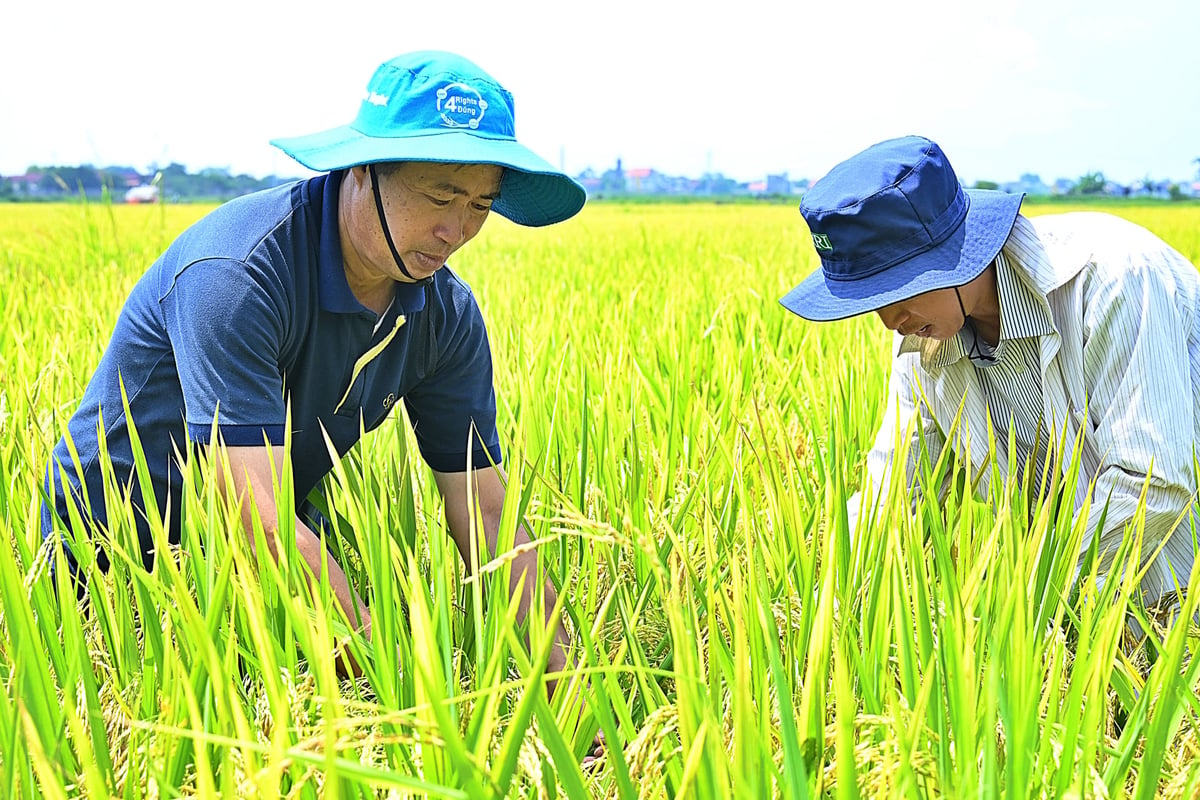
Mr. Nguyen Van Du, Chairman of the Board of Directors of Nam Cuong Agricultural Cooperative (left), and IRRI experts inspect the model rice field. Photo: Bao Thang.
The rice field, after sowing, looked sparse, with patches of pale gray mud visible amidst the young rice seedlings. Each time they passed by, the neighbors seemed to slow down a little. Some bent down close to the field, looked for a while, and then asked Mr. Cac if he had made a mistake when sowing the seeds. Others remained silent, gazing with concern for a few seconds before continuing on their way. But the next day, they stopped by again. What bothered everyone wasn't necessarily that the rice field looked bad, but simply that it didn't resemble what they had been used to seeing for decades.
Mr. Cac himself wasn't entirely sure. Despite his determination to participate in the model with all four plots of land, he only noticed the difference when the rice plants began to tiller and flower. "The rice ears sown by machine have more grains. The plant density is suitable, so sunlight gets through," he said. According to his family's preliminary calculations, the yield from machine-sown fields could be about 20-30% higher than from hand-sown fields.
However, what surprised him even more was that the machine-sown rice fields hardly needed any replanting. In the old method, after broadcasting, many rice plants sprouted unevenly or died due to waterlogging, requiring manual replanting. For the low-lying fields in Yen Cuong, the labor cost for replanting alone was a significant expense.
Mr. Nguyen Van Du, Chairman of the Board of Directors of Nam Cuong Agricultural Cooperative, acknowledged that many fields previously required 1-2 man-hours of labor per sao (approximately 300,000 VND) for replanting, equivalent to about 300,000 VND in labor costs. "With a row planting machine, replanting is basically unnecessary," Mr. Du said enthusiastically.
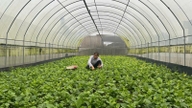

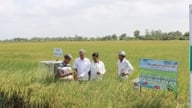

A rice transplanter combined with fertilizer application is used in Mr. Cac's rice field at the beginning of this year's spring planting season. Photo: Bao Thang.
Yen Cuong is a long-standing rice-growing area, but it is also a place where the agricultural workforce is aging rapidly. Young people go to work in factories, leaving mostly older people at home. Many farming tasks are becoming increasingly difficult to find workers for. "Labor is very expensive now; hiring someone to transplant rice costs around 700,000 to 800,000 VND per sao (a unit of land measurement)," Mr. Du calculated. That's why the first thing the cooperative saw in the low-emission farming model wasn't selling carbon credits, but the potential for mechanization.
The project's machine simultaneously sowed the seeds and buried the fertilizer in the soil. It only took about two hours to complete the entire rice field belonging to Mr. Cac. Furthermore, farmers no longer had to spread fertilizer multiple times as before. In contrast, traditional rice fields typically required 2-3 applications of fertilizer, totaling about 25kg per sao (approximately 1000 square meters), double the amount used in the model.
Persuading farmers from the root.
I was fascinated by what I heard from the locals, but seeing firsthand how the rice plants reacted to the new method was truly amazing.
As harvest time approached, Mr. Cac still maintained the old farmer's habit of bending down to count the grains on each rice stalk. But his perspective on the field had changed. No longer concerned with dense, lush green fields, he now paid more attention to aeration, stem strength, and the length of the rice panicles.
No one doubts the effectiveness of rice cultivation in reducing emissions anymore.
Having cultivated rice for more than half his life, Mr. Cac said that hand-seeded rice fields are usually dark green when fertilizer is first applied, then gradually fade as the fertilizer is "absorbed," requiring further fertilization. The rice plants in the field seem to develop in stages, with tender leaves and soft stems. Meanwhile, machine-seeded fields maintain a stable green color almost throughout the season. "It stays uniformly green until flowering. It feels like there's no fertilizer shortage midway," Mr. Cac happily remarked. Towards the end of the season, when the panicles begin to fill with grain, the field gradually turns yellow, more uniformly, instead of turning yellow prematurely at the base of the leaves.
Visiting Mr. Cac's rice fields in early June – the time when the rice is ready for harvest – reveals why farmers are so impressed. The fields are dry and airy. Most fields only require one application of fungicide to protect the flag leaves before heading, and almost no additional treatment is needed for other pests and diseases such as brown spot, blast, or planthoppers.
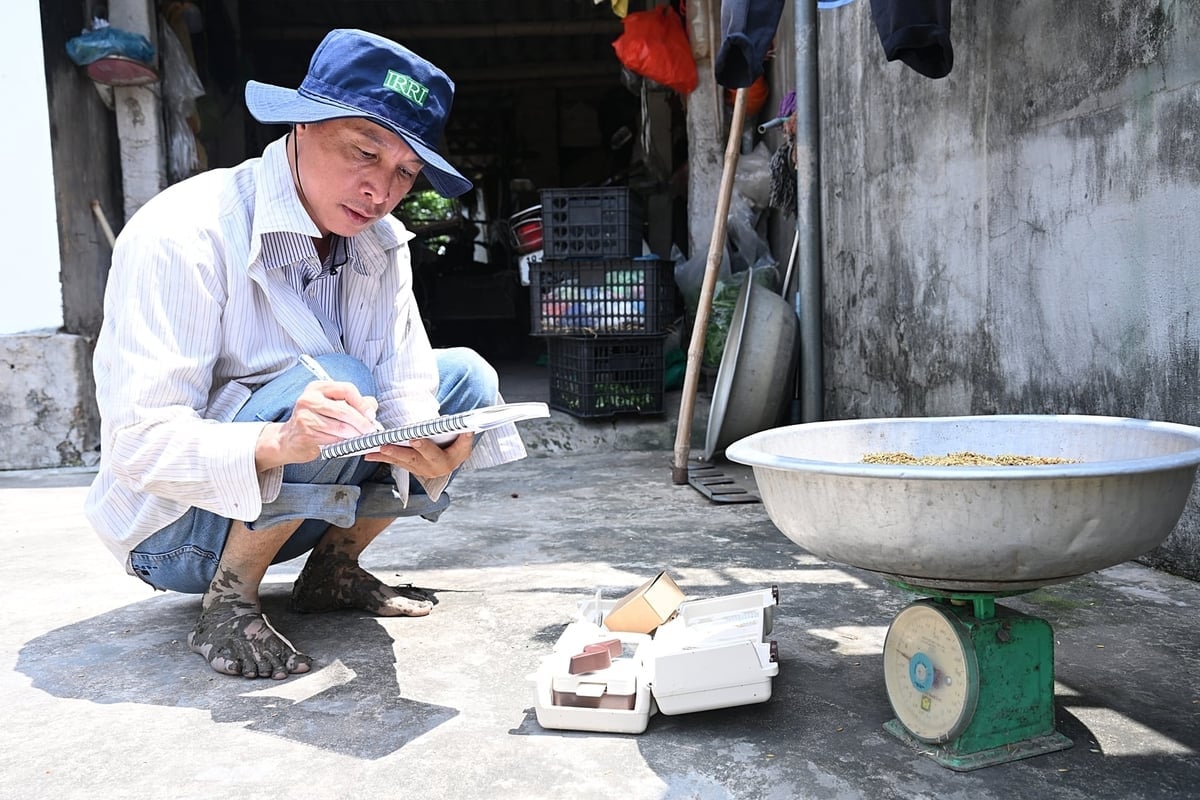
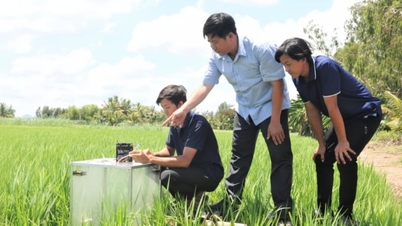
Mr. Nguyen Van The carefully takes notes to calculate rice yield in the emission reduction model. Photo: Bao Thang.
Rice sown in rows has stronger stems from the tillering stage. Older leaves gradually turn yellow from the base upwards, while the stem and flag leaves retain their firmness, resulting in a healthy plant from the base upwards.
Behind these changes lies a technical process that farmers in the region had previously rarely applied. According to Ngo Duc The, a technical officer of IRRI in Vietnam, the model in Yen Cuong uses a row planting method combined with burying fertilizer and water management based on the principle of alternating flooding and drying. Mid-season water drainage helps the roots grow deeper, making the rice plants stronger and less prone to lodging, while also reducing anaerobic conditions that produce methane gas.



"Not only does it reduce emissions, but the rice plants are also more resistant to lodging," Mr. The said, acknowledging that the most difficult aspect of reducing emissions in rice cultivation in the Red River Delta is leveling the fields and ensuring the irrigation system is functioning properly. The fields in the North are small, uneven, and have varying elevations. In many places, drainage is slow. If the field surface is not level enough, the row-planting machine will have difficulty operating effectively.
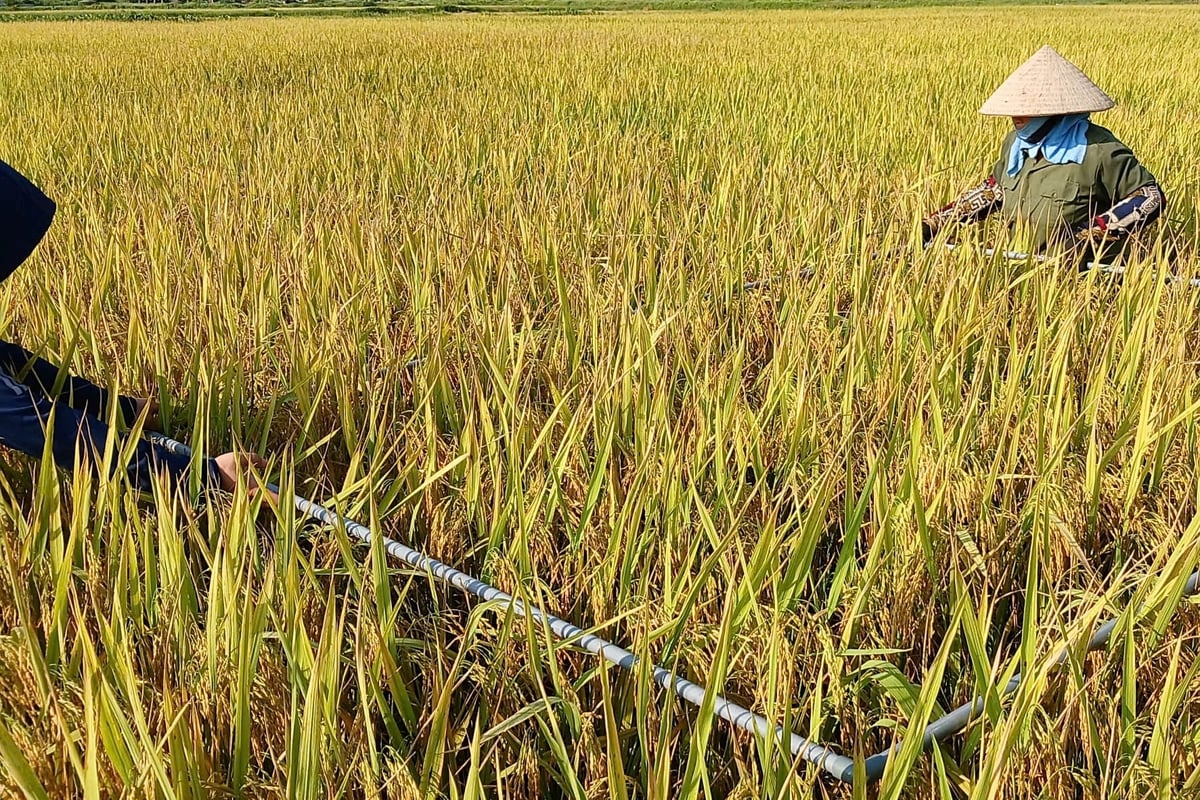
Farmers harvest rice at yield assessment points in an emission reduction model. Photo: Bao Thang.
That's also why the Nam Cuong Agricultural Cooperative chose the lowest-lying and most difficult-to-cultivate rice paddies to implement the model. "If it can be done on this land, then it can be done on other rice paddies as well," said Nguyen Van Du, Chairman of the Board of Directors of the Cooperative.
This model is not just about reducing emissions, but also an experiment in a different way of organizing production. Instead of each household doing things differently, each plot of land is operated more synchronously, with the same planting schedule, the same machinery, and the same irrigation and fertilization process. This is something that agriculture in Northern Vietnam has wanted to achieve for many years but has struggled to implement due to the fragmentation of land.
Source: https://nongnghiepmoitruong.vn/cay-thua-thua-thoc-cay-day-coc-duoc-an-d815461.html