More than just a space for experiencing the technique, the lacquer workshop has become a conversation exploring contemporary art and the core values of tradition. There, the artists truly "touched" the art of lacquer with patience, sweat, and the lacquer stains on their skin.
In the workshop, the pungent, characteristic smell of lacquer (lacquer tree resin) mingled with hushed discussions about color, composition, and techniques, and the rhythmic tapping of hammers on eggshells, creating a unique artistic atmosphere. The participants were established, experienced artists with defined styles and mastery of modern materials like acrylic, oil paint, and digital painting; yet, faced with the dark canvases and thick jars of lacquer, they all suddenly became "newbies."
 |
| Artist Truong Van Linh (far left) guides participants through the steps of creating a lacquer painting. |
Diligently applying layers of gold leaf to the details of her painting, artist Tran Thi Dao shared: “The early days were really difficult. Lacquer painting requires a great deal of meticulousness and skill. You can't turn on the fan, because even a strong breath can blow away the gold leaf or thin silver flakes, making the details imperfect. This is truly a hobby that brings a lot of comfort and enjoyment, and it's also a direction for my future creative work.”

Choosing a small corner in his studio, artist Nguyen Van Phu, an art teacher at Le Dinh Chinh Primary School (Quang Phu commune), said this was his first time working with the materials used to create a lacquer painting. The creative process of lacquer painting is completely different from that of a general painting. This allows artists to gain more experience and knowledge, and to better convey this traditional art form to their students.
To complete a lacquer painting, the artist must go through many stages: underpainting, applying materials (gold, silver, eggshell), applying lacquer/brown lacquer, curing in moisture, and polishing with water. Particularly challenging for the artists is the "fickle" nature of the environment and the harshness of the material, as the lacquer can cause allergic reactions and redness on the skin. Furthermore, lacquer cannot be dried by machine or fan; it only dries in a high-humidity environment. Some paintings require a month or more of waiting for favorable conditions before they can be completed.
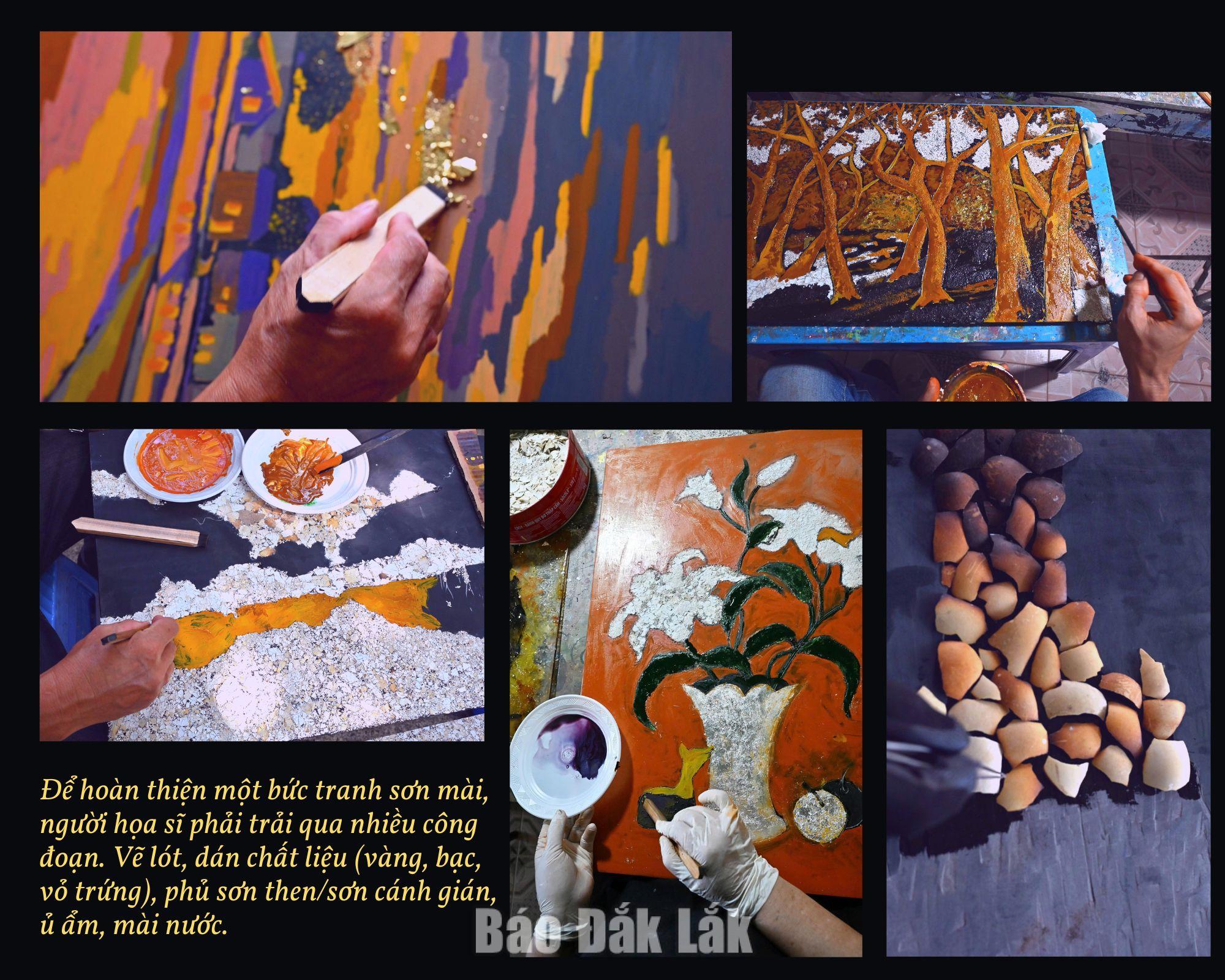 |
| The steps involved in creating a lacquer painting. |
With joy shining in his eyes, artist Truong Van Linh, passionate about traditional materials, shared: "The greatest purpose of the workshop is not to create lacquer artisans, but to sow in the hearts of artists a seed of heritage that needs to be spread and developed. Lacquer art is not about imposing our will on the painting, but about rediscovering the hidden beauty within through time and water."
Using traditional materials passed down from their ancestors, each artist participating in the workshop has breathed new life into the art of lacquer painting. The heritage comes alive with diverse expressions; each artist creates a finished lacquer artwork bearing their personal mark, and above all, they have once again deeply experienced the proud and vibrant flow of Vietnamese lacquer painting.
Thuy An
Source: https://baodaklak.vn/van-hoa-du-lich-van-hoc-nghe-thuat/van-hoc-nghe-thuat/202606/cham-vao-nghe-thuat-son-mai-fda7a9b/
![[Image] Ho Chi Minh City: Ma Lang area, Chicken-Rice Market about to change its appearance](https://vphoto.vietnam.vn/thumb/1200x675/vietnam/resource/IMAGE/2026/06/25/1782377698627_ndo_br_m1-jpg.webp)


![[Photo] General Secretary and President To Lam receives Palestinian Ambassador Saadi Salama](https://vphoto.vietnam.vn/thumb/1200x675/vietnam/resource/IMAGE/2026/06/25/1782365384740_a1-bnd-9423-8322-jpg.webp)

![[Image] Schools organize meetings and introduce teaching models to students admitted to grade 10.](https://vphoto.vietnam.vn/thumb/1200x675/vietnam/resource/IMAGE/2026/06/25/1782368077271_ndo_br_z7970052192242-1ec8daeb77a6eed1a4e9f58c564ddd3e-jpg.webp)



![[GALLERY] Voidling Bound takes Steam by storm with 94% positive reviews.](https://vphoto.vietnam.vn/thumb/402x226/vietnam/resource/IMAGE/2026/06/25/1782396892878_tua-1-png.webp)