

Currently, livestock farmers in the province are preparing to restock their herds to meet the food demand during the year-end holiday season. Although livestock and poultry prices have risen again, they remain unstable, and concerns about disease outbreaks mean that many farmers are still hesitant to invest.
Concerns about disease outbreaks and market fluctuations are causing many livestock farmers to hesitate in restocking their herds on a large scale.
Reluctance to make large investments
Despite building a well-organized, enclosed poultry farm with a capacity of several thousand chickens per batch, for more than a year now, Mr. Vu Hai Ly from Dong Trung commune (Tien Hai district) has only maintained about 2,000 chickens. Investing in an incubator system, Mr. Ly both raises laying hens and hatches chicks for sale. Mr. Ly shared: The price of chicks sold in bulk is about 10,000 VND/chick, and ducklings from 12,000 - 13,000 VND/chick, much lower than the same period in 2022. From the beginning of 2023 until now, the price of animal feed has also been adjusted down five times. However, the atmosphere of restocking is not vibrant, even though it is the end-of-year breeding season to create a food supply for Tet (Lunar New Year).
According to poultry farmers, the price of broiler chickens is currently quite high, ranging from 50,000 to 85,000 VND/kg depending on the type of chicken. At this price, farmers are making a profit. However, fear that prices could drop at any time, and the high risks associated with year-end farming, many are still hesitant to invest in restocking their flocks.
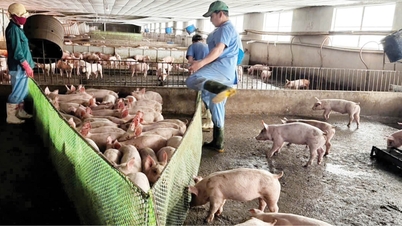
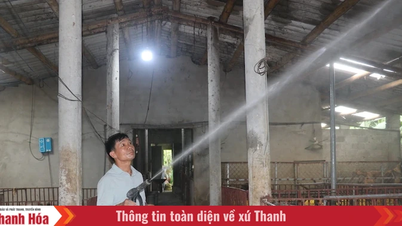
Not only chicken farmers, but pig farmers are also hesitant to restock on a large scale. Having just sold nearly 10 tons of live pigs at 60,000-65,000 VND/kg, earning a profit of about 100 million VND, Mr. Pham Van Duong from Vu Tien commune (Vu Thu district) is cleaning his barns to restock to meet the increased demand for food during the year-end season. From raising 200-300 pigs per batch, after several instances of low pig prices, he is now raising only 70-80 pigs per batch. He shared: "This is the most suitable time for households to raise a new crop, 'catching' the year-end market. Although feed prices have decreased slightly, what we worry about most is the instability of output prices." In just a few days, the price of pork dropped from 65,000 VND/kg to 60,000 VND/kg. Even with the same batch of pigs ready for sale, I had to pay two different prices, so I didn't dare risk making a large investment.
Focus on disease prevention.
Currently, livestock and poultry farmers in the province are preparing breeding stock and restocking to meet the demand for the Lunar New Year. However, this is also a time when the weather is unfavorable, the resistance of livestock decreases, and various viruses easily attack. Therefore, farmers need to be cautious in preventing and controlling diseases.
According to the report from the Department of Livestock and Veterinary Medicine, the disease situation among livestock has been under control since the beginning of the year. Local authorities are implementing the second phase of the sanitation, disinfection, and disease prevention campaign for livestock and poultry (from September 15th to October 15th), while also administering vaccines for the autumn-winter season. The agricultural sector has collected 1,176 samples for proactive surveillance of avian influenza virus and African swine fever, and 560 pig serum samples from 15 farms for testing for African swine fever virus to support animal quarantine work. The Cau Nghin Animal Quarantine Station has inspected 661 vehicles transporting animals and animal products, contributing to preventing and controlling disease outbreaks in livestock and poultry in the province. A summary of the vaccination results for livestock and poultry during the recent spring-summer season shows a high vaccination rate, even for vaccines not subsidized by the province. This indicates that livestock farmers have improved their awareness of disease prevention and control.
The Department of Livestock and Veterinary Medicine advises livestock farmers not to increase their herds indiscriminately, but to base their operations on the actual conditions of their farms, focusing on biosafety practices, ensuring quality, and developing a linked chain from breeding to slaughtering, preliminary processing, processing, and product consumption.
Mr. Pham Thanh Nhuong, Head of the Department of Livestock and Veterinary Medicine, said: The specialized agency recommends that livestock farmers regularly carry out sanitation and disinfection of the livestock environment. Local authorities need to proactively secure sources of chemicals and lime powder, and encourage farmers to purchase these chemicals and lime powder themselves to disinfect barns and the surrounding environment to prevent and control diseases; and to effectively control the transportation, trading, and slaughter of animals according to the management hierarchy. The authorities also advise people to report sick livestock and poultry to the specialized agency for timely handling...

Administering all necessary vaccines is an effective solution for preventing and controlling disease outbreaks in livestock.
Ngan Huyen
Source
![[Photo] General Secretary and President To Lam presides over the meeting to approve the draft report on the results of the second inspection by the Politburo of the Standing Committee of the Hanoi City Party Committee.](https://vphoto.vietnam.vn/thumb/1200x675/vietnam/resource/IMAGE/2026/05/26/1779789811432_a2-bnd-4430-9620-jpg.webp)






































































Comment (0)