


In Hai Phong, through a rice ration contract, Mr. Bui Ngoc Cuong was able to sell rice grown in shrimp ponds and fields at a good price to farmers even before the rice plants bloomed.
In early May, gazing at the lush green rice fields along the Thai Binh River in Tan Lien commune, Vinh Bao district, 30-year-old Bui Ngoc Cuong expressed his joy at the good rice crop, which is expected to yield a high harvest. Over the past two years, this field has supplied approximately 50 tons of rice to the Goose Rice Project that Cuong developed.
As the son of a renowned farmer in An Lao district, Cuong chose to study Animal Husbandry and Veterinary Medicine at the Vietnam Academy of Agriculture . After graduating, feeling that "the knowledge gained in school still lagged behind that of farmers," Cuong decided to pursue further studies in the Netherlands.
In his early days studying abroad, Cuong explored agricultural models and modern machinery with the goal of applying them in Vietnam. However, the more he learned, the more he realized that the agricultural production system in Vietnam had not yet formed a sustainable chain, and there was a significant gap between farmers and consumers, leading to problems such as bumper harvests resulting in price drops and a lack of control over product quality.
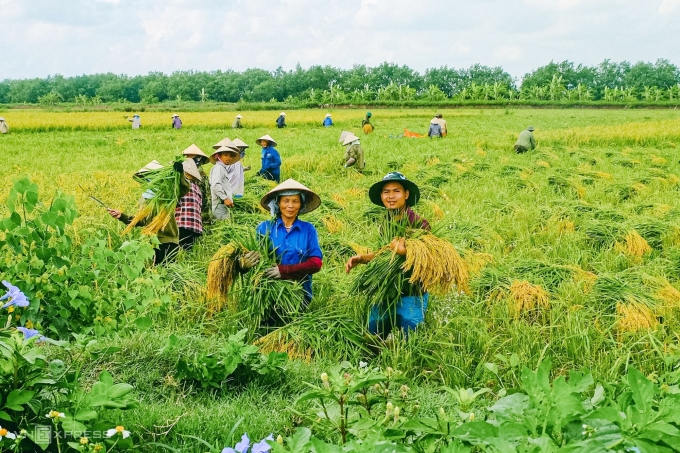
Cuong and other farmers from Tien Minh commune, Tien Lang district, harvested rice in a field inhabited by earthworms in 2022. Photo: Provided by the subject.
The student from Hai Phong realized that even after graduating from university, his knowledge lagged far behind that of his younger classmates. Students there often spend their final years doing practical training. They even come to Vietnam, combining tourism with gaining further knowledge related to their field of study.
Following his friends' example, in 2017, Mr. Cuong returned to Vietnam and traveled across the country by motorbike to visit and work directly on many farms. In Hoi An, he encountered an interesting model that generated multiple sources of income for farmers through tourism and educational activities around the fields. "That model was close to the ideas I was nurturing, so I stayed there for several months," Mr. Cuong recalled.
After two years of fieldwork, Mr. Cuong returned to Hai Phong to develop a project selling organic agricultural products, with rice grown in paddy fields as the main product, naming it "Goose Rice." "The word 'goose' contains the word 'delicious' representing quality, the word 'agricultural' representing farmers and agricultural products, and the word 'eccentric' representing youth, with a tilde signifying experience, innovation, and acceptance of difficulties to bring quality agricultural products to customers," he explained.
In fact, rice grown in fields inhabited by earthworms (also known as earthworm rice) is not a new agricultural product. In the earthworm-infested areas of Hai Phong, Hai Duong, and Thai Binh, farmers still take advantage of the months from January to April in the lunar calendar when the fields are left fallow to grow rice. Because they need to maintain a clean environment for the earthworms, they do not use chemical fertilizers or pesticides when cultivating rice. Therefore, earthworm rice is clean and purely natural.
"My father also grew rice in the rice paddies. At times, we had tons of rice at home, but it was very difficult to sell. The whole farm, with dozens of people, couldn't eat it all, so we had to cook it for the chickens, ducks, and geese," Cường recounted.
To find the best solution for his project, Mr. Cuong initially acted as a rice trader. After more than a year of struggling and using every advertising method, he realized that buying rice from farmers, storing it, and then selling it involved many risks such as inventory buildup and tied-up capital, making it difficult for businesses to commit to purchasing the product from farmers, driving up the price of rice (market price 50,000-70,000 VND/kg). This resulted in losses for farmers, customers, and businesses alike, with excessive costs incurred by intermediaries. "I also lost more than one billion VND," he said.
Based on his initial experience, Mr. Cuong developed a model connecting farmers with customers using a rice ration book. This red book, which he designed and decorated with many images and slogans commonly seen during the subsidy era, serves as a contract for the purchase of rice between customers and farmers, coordinated through Mr. Cuong's company and the local agricultural extension unit.
Customers who purchase rice through a rice ration book will pay in advance at a discounted price, 22-35% lower than the retail price. Specifically, customers buying through a rice ration book will pay 42,000 VND/kg for 60 kg, 39,000 VND/kg for 100 kg, and 36,000 VND/kg for 200 kg. Mr. Cuong even offers a 500 kg ration book for organizations and schools at a price of 33,000 VND/kg.
Mr. Cuong's company will deliver rice to customers according to their registered schedule. The rice is always milled, packaged, and delivered to customers within one to five days to ensure freshness. Customers are advised to only take enough rice for one month. When the rice in their account runs out, customers will be given a new account without worrying about price changes.
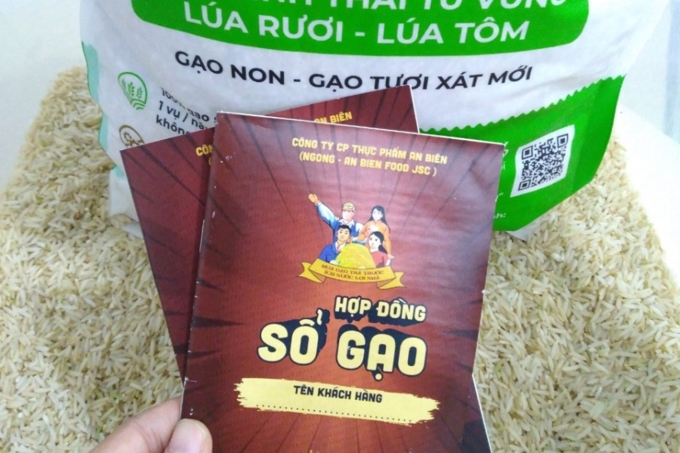
The rice ration book was invented by Mr. Cuong to connect customers with farmers. Photo: Le Tan
To help customers better understand the quality of the rice and the cooperation method, Mr. Cuong organized a "Goose's Journey" tour for customers to visit the fields and chat with farmers. "Customers trust us and will recommend us to their relatives and friends. That's how I promote the product at the lowest cost, thereby lowering the selling price," Mr. Cuong said.
Based on the quantity of rice ordered by customers, Mr. Cuong signs contracts with farmers and buys fresh paddy directly from the fields, ensuring no adulteration. Thanks to the advance payments from customers, farmers feel secure in their production and are more responsible for the products they produce. In a few cases where the delivered product did not meet the standards, Mr. Cuong proactively terminated the contract.
Since Mr. Cuong himself wasn't under too much financial pressure, he started expanding into other clean products. He also sold eggs and fruits as a "beer and peanuts" deal, offering discounted prices to customers who already had a rice ration book. This helped farmers sell their products while providing customers with delicious food at the best possible price. To date, Mr. Cuong has developed 1,000 Goose rice ration books, consuming 500 tons of ST25 rice grown in his shrimp and prawn ponds annually.
To ensure supply, in addition to Hai Phong, Mr. Cuong has connected with 200 farming households in communes in Thai Binh, Kien Giang, and Ca Mau provinces. Mr. Trieu, who owns 2 hectares of rice paddies and has participated in the Goose Rice project for two years, said: "In the first year, I only planted on a portion of the land. Seeing that the soil had improved and the selling price to Mr. Cuong was higher than elsewhere, this year I planted on the entire area."
In various localities, Mr. Cuong also collaborates with numerous agricultural extension centers to manage raw material areas and provide professional training for farmers. Working alongside Mr. Cuong since 2019, Mr. Nguyen Van Tuan, Head of the Agricultural Extension Station in Vinh Bao district, assesses that the Goose Rice model has the potential for expansion due to its close linkages and the participation of farmers, the government, businesses, and customers. Farmers can sell their rice steadily, without worrying about market outlets or price fluctuations. Customers, on the other hand, get to eat delicious, clean rice with a clear origin.
Building on the success of Goose Rice, Mr. Cuong is developing a plan to apply it to other agricultural products, aiming to create a supply chain of high-quality, safe, and beneficial agricultural products for the community, ensuring market access for farmers and protecting the natural environment.
Le Tan
Source link












![[Photo] National Assembly Chairman Tran Thanh Man working with the National Assembly Committees](https://vphoto.vietnam.vn/thumb/1200x675/vietnam/resource/IMAGE/2026/02/24/1771915679930_bnd-7209-2157-jpg.webp)































Comment (0)