

The porridge cooked with freshwater perch by tapping it through a bamboo basket piqued the curiosity of many at the Hanoi Autumn Festival 2023.
Ung Hoa, a suburb of Hanoi, is famous for its Van Dinh grass-fed duck, but not many people know about the unique "cháo gõ" (a type of porridge) that has been a part of the childhood of many generations of people in Cau Bau village, Quang Phu Cau commune.
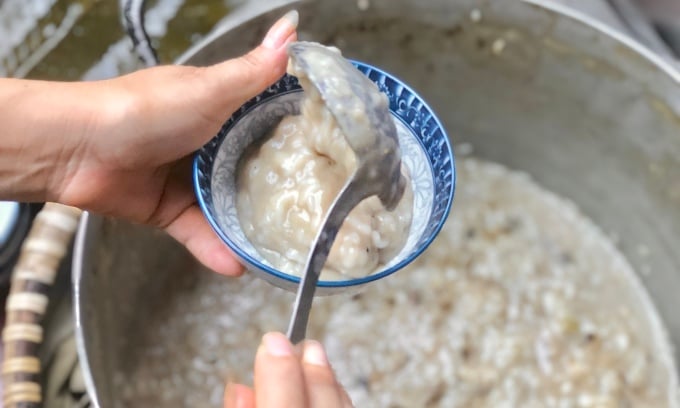
"Cháo gõ" is a childhood treat for people in Ung Hoa district, Hanoi.
"Cau Bau's 'cháo gõ' (a type of Vietnamese rice porridge) seems unfamiliar to many people in Hanoi," according to Ms. Nguyen Thi Minh (Hanoi), an artisan invited by the Vietnam Culinary Culture Association to participate in the Hanoi Autumn Festival 2023, which will take place at the Hanoi Children's Palace from September 29 to October 1.
She said that in Cau Bau village, there are currently only two artisans preserving the flavor of "cháo gõ" (a type of Vietnamese rice porridge) because of the elaborate preparation method, even though it only uses two ingredients: rice and freshwater fish. To cook one pot of "cháo gõ," Ms. Minh uses 3 kg of rice and 2 kg of fish.
The rice used for making "cháo gõ" (a type of Vietnamese porridge) is Khang Dân rice, commonly used in popular dishes such as rice rolls, rice cakes, pho noodles, and regular noodles. According to Ms. Minh, Khang Dân rice has slender, long, firm grains that break less during cooking and have a naturally sweet taste. The rice is soaked for about 3-4 hours to allow the grains to absorb water and become plump, then drained.
Next comes the preparation of the fish broth. The best fish is fresh, naturally caught in the rice fields of Ung Hoa district. The fish is scaled, gutted to prevent the broth from being fishy and bitter, then boiled until cooked through with crushed fresh ginger. After the fish is cooked, the meat is separated, and the bones are crushed, filtered through a cloth to extract the liquid, and then mixed with water and added to the filtered fish meat. According to Ms. Minh, this method can utilize almost all the sweetness of the fish meat and bones, but requires the cook to have special techniques to completely remove the fishy smell.
Rice is added to a pot of broth made from freshwater perch and simmered over low heat until it boils gently. Using a ladle, the mixture of rice and fish broth is poured into a bamboo sieve and continuously tapped to allow the mixture to pass through the gaps. The name "tapped porridge" (cháo gõ) comes from this unique cooking method. The cook continuously taps and filters until the mixture reaches the desired consistency.
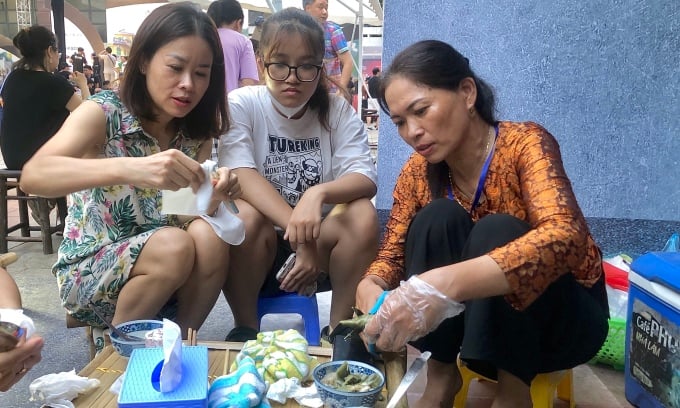
Ms. Minh (on the right) is one of two people who preserve the traditional flavor of "cháo gõ" (a type of Vietnamese porridge) in Ung Hoa district, Hanoi.
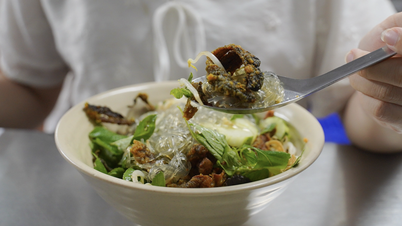
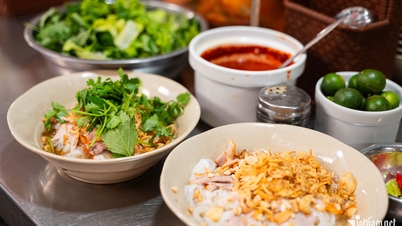
When finished, the "cháo gõ" (a type of Vietnamese porridge) is neither too watery nor too thick, smooth and creamy like pork rib porridge made with rice flour. The bowl of porridge still contains soft rice grains and small lumps of flour, which are the mixture of meat, fish, and rice flour that have clumped together during the filtering process through a bamboo sieve. This is what distinguishes Cầu Bầu's "cháo gõ" from other porridges commonly found in Hanoi.
The sweetness of Khang Dan rice blends with the sweetness of the freshwater perch broth, subtly flavored with fresh ginger, creating a fragrant, chewy, and sweet rice porridge. Ms. Minh explained that while some MSG is added, 90% of the sweetness comes naturally from the rice and the freshwater perch broth.
Served alongside the rice porridge is "bánh khúc," a popular cake in the Northern Delta region. Bánh khúc is made from crushed "rau khúc" leaves mixed with glutinous rice flour for the outer layer, filled with pork and pork fat, wrapped in banana leaves into a flat rectangular shape, and steamed. Once cooked, bánh khúc has a green outer layer from the "rau khúc" leaves, the fragrant aroma of glutinous rice, and a rich, savory meat filling.
The rice cake, cut into bite-sized pieces and placed on top of the bowl of "cháo gõ" (a type of porridge), attracts many customers passing by Ms. Minh's stall, including Ms. Hoa (54 years old, Hanoi). Trying "cháo gõ" and "cháo khúc" from Ung Hoa for the first time, Ms. Hoa was surprised, saying, "I thought the small pieces of dough in the porridge were just ordinary rice grains, but I didn't expect there to be meat from the freshwater fish," but she didn't detect any fishy smell. However, she noted that the "cháo khúc" was "a bit hard compared to the softness of the porridge and had a little too little meat filling."
After hearing Ms. Minh's explanation of how to make the "cháo gõ" (a type of Vietnamese porridge), Ms. Thuy and Mr. Vinh's family, along with their 6-year-old son, each enjoyed a bowl. According to them, the price of 10,000 VND is quite cheap considering the effort put into preparing this porridge, especially since there's a generous amount of meat and fish in it.
"Cháo gõ" (a type of rice porridge) is a simple treat that can be enjoyed year-round, but winter is when it sells best. Every day, Ms. Minh cooks two pots of "cháo gõ," one in the morning and one in the afternoon. "Each pot sells out in about 1-2 hours," she says. Although there are still people who love "cháo gõ," the image of grandmothers and mothers sitting in wood-fired kitchens cooking porridge, with children gathered around the pot slurping it up, is no longer seen.
To enjoy "cháo gõ" (a type of Vietnamese porridge), visitors can go to Cau Bau village, Quang Phu Cau commune, Ung Hoa district, Hanoi, about 40 km from the center of Hanoi.
Text and photos: Quynh Mai
Source link



































































Comment (0)