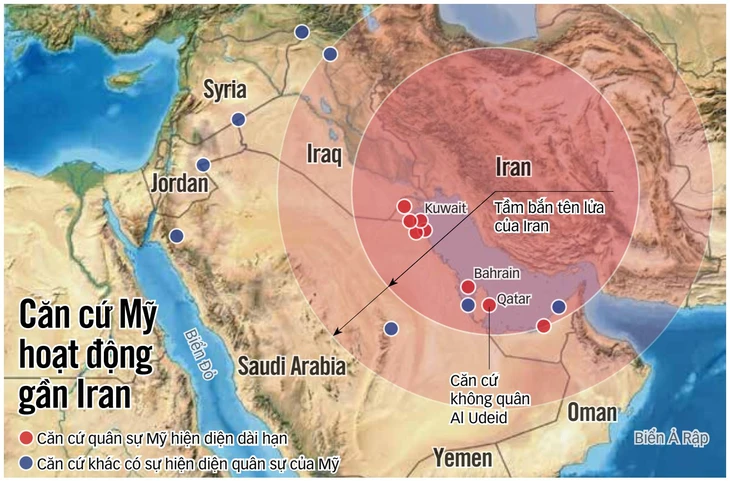
Source: Alhurra - Data: THANH BINH - Graphics: N.KH.
The US and Iran have been continuously engaging in tit-for-tat actions in recent days, with neither side completely stopping, but also not escalating to a full-scale war.
Notably, Iran's missile and drone attacks on several Gulf countries have sparked outrage in the region.
Kuwait and Bahrain were attacked.
Over the weekend, countries in the region such as Egypt, Qatar and Jordan condemned Iran's attacks on Kuwait and Bahrain.
They argued that this was a blatant violation of the sovereignty of the two Gulf nations, a threat to regional security, and a dangerous escalation that undermined efforts to restore stability.
Iran launched seven ballistic missiles toward Kuwait and Bahrain, six of which were shot down and one fell before reaching its target, just hours after US forces shot down four Iranian attack drones launched toward the Strait of Hormuz on June 5.
The Iranian Foreign Ministry stated that the latest US airstrikes were "hostile and provocative acts," a blatant violation of the ceasefire agreement.
Kuwait and Bahrain are both allies of the United States. Bahrain – home to the U.S. Navy's Fifth Fleet – condemned Iran's latest attacks as "blatant aggression," while Kuwait called them a "dangerous escalation."
When Iran attacks these countries, they argue that the target is American forces. According to Tasnim News Agency, the Iranian Islamic Revolutionary Guard Corps (IRGC) targeted the Ali Al Salem air base in Kuwait and key facilities of the US Navy's 5th Fleet in Bahrain with ballistic missiles.
Iran's attacks on the territories of these neighboring countries appear to be aimed at sending a warning to them about cooperating with the US and also at pressuring Washington to quickly end the conflict.

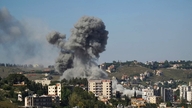

In a statement issued after the attacks, the Iranian Foreign Ministry "strongly calls on countries in the region to uphold the principle of good neighborliness and respect the fundamental principles of international law, which do not permit aggressors to use their territory and infrastructure to plan or carry out hostile acts against the Islamic Republic of Iran."
However, the tit-for-tat attacks over the weekend risk escalating tensions in the region, just days after a civilian was killed and dozens more injured at Kuwait International Airport following a barrage of missiles and drones launched by Iran.
The $24 billion bottleneck
At the negotiating table, efforts to transform the US-Iran ceasefire into a lasting peace agreement have stalled.
According to Bloomberg, negotiations appear to be stalled due to Tehran's demand for the release of approximately $24 billion in Iranian assets frozen by the United States.
Mohsen Rezaei, a military adviser to Iran's Supreme Leader, said that a potential peace deal between the U.S. and Iran depends on whether the Trump administration agrees to release these frozen assets.
Washington is reportedly considering using the money to repair the damage caused by Iranian attacks on its Gulf allies.
A source familiar with U.S. Treasury Secretary Scott Bessent's views said the department would use all available tools to ensure Iranian assets can be used to support Gulf allies in rebuilding and repairing the damage caused by Iran.
According to the Associated Press, Miad Maleki, a research fellow at the Foundation for Defense of Democracy (FDD) and a former expert on Iran sanctions at the U.S. Treasury Department, believes that Washington's signaling that it may allow Gulf states access to a portion of the $24 billion in Iranian assets frozen abroad is a noteworthy move.
Allowing Gulf states to use frozen Iranian assets would help strengthen relations between the U.S. and countries in the region.
This move would also send a clear message that Washington stands with its partners as they suffer attacks and the consequences of war.
It cannot be ruled out that Iran will attack Gulf countries again in retaliation. Mr. Maleki noted that some Gulf nations may hesitate to use this money due to concerns about potential retaliation from Iran.



The Lebanon-Israel conflict continues.
The situation in Lebanon is similar to what's happening between the US and Iran: both sides continue to attack each other despite a ceasefire agreement.
On June 7, the Israeli military announced that it had intercepted two flying objects launched from Lebanon into Israeli territory. Earlier, three Lebanese soldiers were killed in an Israeli attack on a military vehicle in southern Lebanon.
Iran views a ceasefire between Israel and the Hezbollah militant group in Lebanon as one of the conditions for any peace agreement with the United States.
Source: https://tuoitre.vn/chao-lua-trung-dong-them-nong-2026060800021162.htm







































![[Image] Ho Chi Minh City: Ma Lang area, Chicken-Rice Market about to change its appearance](https://vphoto.vietnam.vn/thumb/1200x675/vietnam/resource/IMAGE/2026/06/25/1782377698627_ndo_br_m1-jpg.webp)