

Novaland "rescues" the VN-Index.
The stock market on July 26th was predicted to be a crucial session as the VN-Index approached the strong resistance level of 1,200 points. Selling pressure from large-cap stocks caused the VN30-Index to be in the red at several points.
Before the ATC session, strong tug-of-war continued. However, fortunately for the VN-Index, towards the end of the session, stronger buying pressure emerged, helping the VN30-Index regain its positive momentum, thus enabling the VN-Index to successfully conquer the 1,200-point mark.
At the close of trading on July 26th, the VN-Index rose 4.94 points, or 0.41%, to 1,200.84 points; the VN30-Index increased 3.42 points, or 0.29%, to 1,201.43 points. Across the entire exchange, 213 stocks gained, 64 remained unchanged, and 246 declined. It's clear that the number of declining stocks still outnumbered those gaining, indicating that the VN-Index's strength remains heavily reliant on blue-chip stocks.

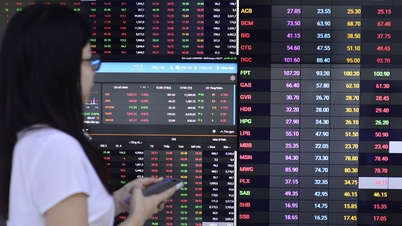
The July 26th stock market session saw Asian markets engulfed in a "sea of fire." Meanwhile, the VN-Index might have followed suit in Asia if it weren't for Novaland's "rescue." (Illustrative image)
In the July 26th stock market session, Vietcombank 's VCB shares continued to play a key supporting role. VCB increased by 1,700 VND/share, equivalent to 1.9%, to 93,400 VND/share. However, besides VCB, another blue-chip stock also played a "rescue" role for the VN-Index: Novaland's NVL shares.
During the July 24th trading session, NVL attracted attention by hitting the ceiling price with a sudden surge in trading volume, reaching 96 million units. Subsequently, on July 25th, NVL temporarily calmed down, closing at the reference price.
At the start of the July 26th trading session, NVL even traded at a negative price. However, by the end of the session, NVL nearly hit the ceiling price, rising 1,000 VND/share, equivalent to 6.2%, to 17,200 VND/share, just 100 VND/share below the ceiling price. With a very high trading volume of over 73 million units, NVL contributed significantly to helping the VN-Index surpass the important 1,200-point mark.
Despite the VN-Index successfully conquering the 1,200-point mark, the July 26th trading session still had a less optimistic aspect: a significant decrease in liquidity. On the Ho Chi Minh City exchange, 912 million shares, equivalent to 17,952 billion VND, were successfully traded. The VN30 group saw 267 million shares, equivalent to 6,818 billion VND, change hands.
During the July 26th stock market session, the Hanoi Stock Exchange was not as fortunate as the Ho Chi Minh City Stock Exchange, with all indices falling into the red.
At the close of trading on July 26, the HNX-Index fell 0.73 points, or 0.31%, to 236.2 points; the HNX30-Index fell 1.28 points, or 0.27%, to 466.93 points.
Liquidity on the Hanoi Stock Exchange fell to very low levels during the July 26th trading session. Only 75.9 million shares, equivalent to 1,282 billion VND, were successfully traded.
Asian stocks plunged into a "sea of fire".
The VN-Index was one of the few indices that successfully weathered the storm in the stock market on July 26th. Most markets in the Asia-Pacific region were engulfed in a "sea of fire."
Asian-Pacific markets were mostly lower as investors prepared for the US Federal Reserve's interest rate decision on Wednesday.
The Fed is expected to approve its 11th interest rate hike since March 2022.
Markets are pricing in absolute certainty that the Fed will approve a quarter-percentage-point increase, which would bring the agency's benchmark lending rate to its target range of 5.25% - 5.5%. That would push the upper limit of the federal funds rate to its highest level since January 2001.
In Australia, official S&P/ASX 200 data showed that Australia's annual inflation rate rose 6% in the sixth quarter, slower than the 7% seen in the first quarter.
South Korea's Kospi led losses in the region, falling as much as 2%, dragged down by technology and consumer services stocks.
Ultimately, the index ended the day down 1.67% at 2,592.36, while the Kosdaq saw a larger loss of 4.18%, ending at 900.63.
In Japan, the Nikkei 225 index edged lower, extending losses from Tuesday to close at 32,668.34, while the Topix also fell 0.1% to finish at 2,283.09.
Hong Kong's Hang Seng index retreated from Tuesday's rally and edged down 0.52%, while mainland Chinese markets also declined. The Shanghai Composite fell 0.4%, while the Shenzhen Component lost 0.5%.
Source


![[Photo] Prime Minister Pham Minh Chinh presides over a meeting on private sector economic development.](/_next/image?url=https%3A%2F%2Fvphoto.vietnam.vn%2Fthumb%2F1200x675%2Fvietnam%2Fresource%2FIMAGE%2F2025%2F12%2F20%2F1766237501876_thiet-ke-chua-co-ten-40-png.webp&w=3840&q=75)
![[Photo] Prime Minister Pham Minh Chinh presides over the conference announcing the establishment of the International Finance Centre in Vietnam.](/_next/image?url=https%3A%2F%2Fvphoto.vietnam.vn%2Fthumb%2F1200x675%2Fvietnam%2Fresource%2FIMAGE%2F2025%2F12%2F21%2F1766309817714_ndo_br_dsc-3400-jpg.webp&w=3840&q=75)


































































































Comment (0)