

A massive rift, known as the East African Rift, is slowly splitting Africa, the world's second-largest continent.
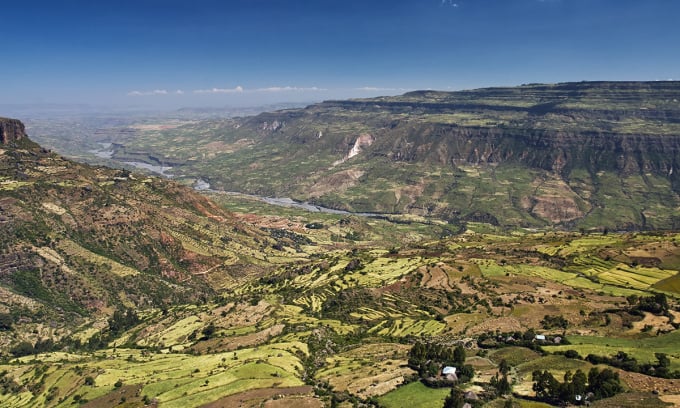
Fields in Ethiopia's Great Rift Valley, part of the East African Rift Zone. Photo: LuCaAr
Could Africa be completely split apart in the future, and if so, when? First, let's consider tectonic plates—the outer plates of the Earth's surface that can collide with each other, forming mountains, or move apart, creating vast basins.
The East African Rift is a network of valleys stretching approximately 3,500 km from the Red Sea to Mozambique, according to the Geological Survey of London (GSL). Along this massive rift, the Somali tectonic plate is being pulled eastward, separating from Africa's larger and older Nubian plate, according to NASA's Earth Observatory. The Nubian plate is also known as the African plate.
The Somali and Nubian plates are also separating from the Arabian plate to the north. These tectonic plates intersect at Afar, Ethiopia, forming a Y-shaped rift system.
The East African Rift Zone began forming between the Arabian Peninsula and the Horn of Africa approximately 35 million years ago, Cynthia Ebinger, chair of geology at Tulane University, told Live Science on June 17. This rift zone expanded southward over time, reaching northern Kenya around 25 million years ago.
The rift zone consists of two parallel sets of fault lines in the Earth's crust. The eastern fault runs through Ethiopia and Kenya, while the western fault arcs from Uganda to Malawi. The eastern branch is arid, while the western branch lies on the boundary of the Congo rainforest, according to NASA's Earth Observatory.
Ebinger said that the existence of eastern and western fault lines, as well as the discovery of offshore earthquake and volcanic zones, suggests that Africa is slowly separating along several fault lines at a rate of only about 6.35 mm per year.
The East African Rift Zone likely formed due to heat rising from the asthenosphere—the hotter, weaker, uppermost part of the Earth's mantle—between Kenya and Ethiopia. This heat caused the upper crust to expand and rise, leading to the brittle continental rocks stretching and fracturing.
There are several scenarios for what would happen if Africa splits in two. According to one scenario, the majority of the Somali tectonic plate would separate from the rest of the African continent, creating a sea between them. The new landmass would include Somalia, Eritrea, Djibouti, and parts of eastern Ethiopia, Kenya, Tanzania, and Mozambique. "Another scenario is that only eastern Tanzania and Mozambique would break off," Ebinger said.
Ebinger suggests that if the African continent were to split, the rift between Ethiopia and Kenya could separate to create the Somali plate within the next 1-5 million years.
However, Africa may not split in two. According to Ebinger, the geological forces driving the rift may be too slow to separate the Somali and Nubian plates. A prominent example of a failed rift is the Central Continental Rift, which meanders approximately 3,000 km through the Upper Midwest region of North America. According to GSL, the eastern branch of the East African Rift is a failed rift. However, the western branch remains active.
Thu Thao (According to Live Science )
Source link









































































































Comment (0)