


Gia Hoi Street during the French colonial period (Historical archive photo)
Interesting anecdote
First, on Chi Lang Street, there is the Tho Xuan Palace. Tho Xuan Vuong was the third son of Emperor Minh Mang. He was famous for his poetry and witty repartee. Anecdotes recount that in 1842, Tho Xuan Vuong accompanied Emperor Thieu Tri to the North for the investiture ceremony. On the main day of the ceremony, the Qing envoy rode in a palanquin directly to the Chu Tuoc Gate. The officials who were receiving him could not stop him, but Tho Xuan Vuong sternly ordered him to stop. Only then did the Qing envoy dismount and leisurely enter. Upon returning to Hue , he was given a jade pendant by Emperor Thieu Tri, inscribed with the four characters "Dac di quyen huu," meaning special love and protection.
On Chi Lang Street is the residence of Quang Bien Quan Cong. He was the 51st son of Emperor Minh Mang, a renowned poet and knowledgeable in medicine, who once diagnosed Emperor Tu Duc.
In addition, Chi Lang Street also houses the residence of Hoa Thanh Vuong, the 37th son of Emperor Minh Mang. During the time when the patriotic Emperor Thanh Thai was falsely accused of "rebellion" by the French colonialists and their collaborators in the Hue court, and was under house arrest on Bong Doanh Island in Tinh Tam Lake, Hoa Thanh Vuong was entrusted with the responsibility of arranging for court officials to take turns serving Emperor Thanh Thai well, thus earning the Emperor's great respect.
On Chi Lang Street, there is also the Thoai Thai Vuong Palace. Thoai Thai Vuong was the fourth son of Emperor Thieu Tri. As a child, he was exceptionally intelligent, and as he grew older, he excelled in poetry, earning the affection of his father. An anecdote recounts that Emperor Tu Duc, proud of his own talent, had to admit, when comparing himself to Thoai Thai Vuong: "I am ashamed that I am not his equal / Because I am four years older, I am his elder brother." Thoai Thai Vuong was the father of Emperor Duc Duc. His grandson and great-grandson were Emperor Thanh Thai and Emperor Duy Tan. Emperor Duc Duc only reigned for less than three days. Emperors Thanh Thai and Duy Tan, due to their patriotism and resistance against the French, were exiled to Réunion Island (Africa).
If we compare them, the legends of Chi Lang Street are just as interesting as those of Duong Lam Ancient Village ( Hanoi ), a place that attracts many tourists every year. For example, Duong Lam Ancient Village is the birthplace of King Ngo Quyen and King Phung Hung, hence it is called "the land of two kings," while Chi Lang Street is the residence of Thoai Thai Vuong, whose descendants include three kings: Duc Duc, Thanh Thai, and Duy Tan.
A forgotten "gold mine"

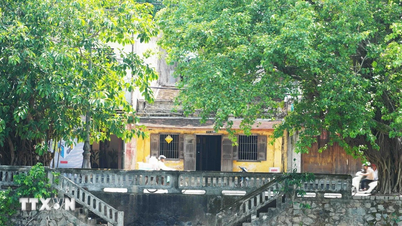
The ancient charm is still evident on Chi Lang Street.
The current Chi Lang road is 1,850m long and runs parallel to the Perfume River bank in the Gia Hoi and Phu Hau wards (Phu Xuan district, Hue City).
Chi Lang Street was formed in the early 19th century, at the same time as the construction of the Hue Imperial City under Emperor Gia Long. In the late 19th and early 20th centuries, with the development of commercial activities by both Vietnamese and Chinese people, the street quickly became an important transportation hub in the eastern part of the imperial city. In 1908, the street was named Rue Gia Hoi (Gia Hoi Street). In 1956, the street was renamed Chi Lang, after a northern border pass (Chi Lang Pass).
The Chinese were very skilled in business and trade, and had abundant sources of goods from China. Furthermore, the Nguyen dynasty's "closed-door" policy (prohibiting trade with the West but prioritizing trade with China) led to a growing number of Chinese merchants coming to Hue. Chi Lang Street became the area with the largest Chinese community in Hue. The Chinese architectural structures along this street are as beautiful as those in Hoi An's Old Town. From the Chieu Ung Temple, Ba Pagoda, and Quang Dong Pagoda to the Chaozhou Assembly Hall, Fujian Assembly Hall, and Quang Trieu Assembly Hall, all were meticulously constructed. In the 1930s, the famous Nhi Thien Duong oil, owned by Chinese businessman Vi Thieu Ba, had its main branch in Hue at 18 Rue Gia Hoi.
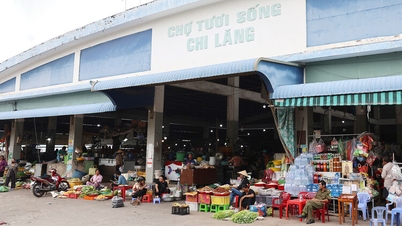
There is a rather famous landmark on this road called Dinh Market. According to researcher Nguyen Dac Xuan, this area was a military camp during the Nguyen dynasty. Chinese people came here to trade, so the area where the troops were stationed was called Dinh. During the Nguyen dynasty, Dinh Market consisted of eight rows: Gia Thai, Hoa My, Phong Lac, Dinh Ninh, Hoi Hoa, My Hung, Thuy Lac, and Tam Dang, collectively known as the eight rows along the river (Duyen Giang Bat Hang).

Thanh Binh Ancestral Temple was classified as a national historical and cultural relic in 1992.
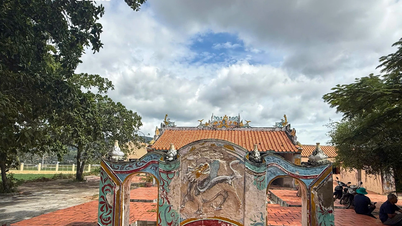
More specifically, Chi Lang Street is a route lined with many spiritual architectural structures of the Vietnamese people. First is Thanh Binh Tu Duong, dedicated to the ancestors of the traditional Vietnamese opera (hat boi) and those who contributed to the theatrical profession nationwide during the Nguyen Dynasty. It was classified as a national historical and cultural relic in 1992. In recent years, in addition to the annual ancestral worship ceremony for the hat boi profession, Thanh Binh Tu Duong has also hosted two famous theatrical troupes: the Song Huong Cai Luong troupe and the Ngoc Khanh traditional opera and Cai Luong troupe.

Traditional opera at Thanh Binh Ancestral Temple
Next is the ancient Truong Xuan Pagoda, built during the Nguyen Lords' era. This ancient pagoda was established during the reign of Lord Nguyen Phuc Khoat (17th century) with the original name Ky Vien Am. During the Nguyen Dynasty (1804), it was renamed Xuan An Tu. Interestingly, the pagoda's altar does not worship Buddha but instead worships the Jade Emperor, the Holy Mother, and Quan Cong.
Finally, there is the house of an Indian Hindu family. This is the only building of this type in Hue.
Currently, Chi Lang Street also has traditional craft villages. The most prominent is the village that makes lanterns for the Buddha's Birthday season at alleys 399 and 401 on Chi Lang Street, Phu Hau Ward.
It is thought that, with proper attention and investment in tourism and conservation, Chi Lang Road would undoubtedly be a "gold mine" for elevating Hue's tourism./.
Nguyen Van Toan
Source: https://baolongan.vn/chi-lang-con-duong-luu-giu-dau-an-thoi-gian-a200291.html















































































Comment (0)