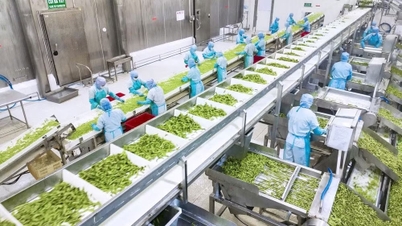
Focusing on shaping a "green" strategy linked to protecting brands in the digital space for businesses, a reporter from the Vietnam News Agency (TTXVN) had an exchange with Ms. Phan Thi Thanh Xuan, Vice President and General Secretary of the Vietnam Leather and Footwear Association (LEFASO), and Mr. Than Duc Viet, General Director of May 10 Corporation.

Ms. Phan Thi Thanh Xuan - Vice President and General Secretary of the Vietnam Leather and Footwear Association (LEFASO)
For the footwear and handbag industry, the pressure to shift towards sustainable development, low emissions, and a circular economy is extremely intense due to the nature of its high use of raw materials and chemicals. Implementing ESG strategies and green transitions has now become a matter of survival, a mandatory new rule of the game, as major markets like the EU and the US continuously apply strict technical barriers regarding digital product passports and supply chain scrutiny.
Greening is no longer just a way to enhance one's reputation, but a mandatory passport for businesses to participate in global supply chains. Businesses cannot stand aside or merely implement greening measures, because without the capacity for greening and a genuine commitment to social responsibility, we will immediately face order cuts and be excluded from the global value chain.
Therefore, building a transparent supply chain with strict controls from the origin of leather raw materials to the waste treatment process is fundamental for businesses to establish a sustainable brand. Major markets like the EU and the US are extremely strict in controlling the transparency of the supply chain, requiring businesses to communicate responsibly, meaning being truthful and honest about carbon emission reduction indicators, the percentage of circular materials used, or the origin of eco-friendly leather.


In the context of digital consumers with extremely sensitive and demanding "filters," the concept of responsible communication must be prioritized and linked to practical actions at the factory. Throughout the digital space, risks of media crises or accusations of "greenwashing" are always present if businesses overstate their capabilities in their communication. In the digital age, protecting a brand online is a life-or-death battle because information spreads at breakneck speed; even a single suspicion of "greenwashing" or a lack of transparency in labor practices can cause a business to have orders canceled immediately by consumers and international brands on online platforms.
To protect their brand in the digital environment, businesses need to focus on digitizing and transparently sharing their supply chain information, being willing to honestly share their greening journey, including both the efforts and the challenges they face. When businesses are steadfast in their commitment to transparent governance and know how to use certifications and real data to communicate, it will be the optimal solution to help them overcome the stringent filters of the market and firmly protect their brand reputation in cyberspace.
Mr. Than Duc Viet - General Director of May 10 Corporation

In the digital age, green transformation and the implementation of ESG strategies are no longer a cost burden or a trendy choice, but have become core competitiveness and a mandatory passport for textile and garment businesses to integrate deeply into the global supply chain.
With consumers increasingly concerned about social responsibility, low emissions, and the circular economy, businesses are forced to change their management mindset, shifting from a passive response to an active approach in creating a transparent production ecosystem. In this context, responsible communication based on genuine supply chain transparency, supported by clear data and international certifications, is the best shield for sustainable brand positioning and protecting the reputation and brand image of businesses against the scrutiny of consumers and the risks of information crises in the digital space.
To protect and enhance its brand value, May 10 has proactively translated its ESG commitments into concrete actions. From replacing coal-fired boilers with biomass pellet boilers and expanding its rooftop solar power system to investing in modern production equipment, the company is gradually restructuring its production platform according to sustainable development criteria. One notable highlight is the installation of two biomass wood pellet boilers with a capacity of 4 tons of steam per hour, replacing four old coal-fired boilers.
May 10 focuses on building a clean production foundation through strict control of waste, water sources, and input materials. Waste collection and sorting systems are organized synchronously, especially for hazardous waste. The company cooperates with legally qualified units for transportation and treatment in accordance with regulations, while establishing a complete system of records, documents, and control procedures. Simultaneously, May 10 introduces product lines made from organic and recycled fibers, optimizing the circular economy model and reducing emissions.
In the digital space, the best way to protect a brand is not through avoidance or emotional arguments, but by using a "shield of truth." Today's digital consumers are very smart and have the tools to verify information, therefore responsible communication at May 10 adheres to the principle of doing ten things but only saying seven or eight, absolutely never doing one thing and claiming ten. We don't use empty slogans to "greenwash" but speak with real data and independent third-party certifications such as LEED green building standards, OEKO-TEX natural material and recycled fiber certifications, GRS, or SA8000 social responsibility standards.



At the same time, May 10 doesn't aim for flashy advertising but focuses on interactive communication, helping consumers understand the green journey of a product from fabric-saving 3D design to environmentally friendly production processes. When the supply chain, from raw materials to production, is transparent and clearly digitized, businesses will have a solid foundation for honest dialogue with the public, turning transparency into the most powerful self-defense weapon against any rumors or media crises in cyberspace.
Source: https://baotintuc.vn/kinh-te/chia-khoa-bao-ve-thuong-hieu-so-20260618081805947.htm
![[Photo] Overview of the renovation and upgrading of the Ho Chi Minh Museum - Ho Chi Minh City Branch](https://vphoto.vietnam.vn/thumb/1200x675/vietnam/resource/IMAGE/2026/06/24/1782287051250_ndo_br_01-jpg.webp)
![[Image] Paris's oldest bridge goes viral after transforming into a giant cave.](https://vphoto.vietnam.vn/thumb/1200x675/vietnam/resource/IMAGE/2026/06/24/1782283441197_ndo_br_dsc05314-jpg.webp)

![[Photo] Opening Ceremony of the 13th National Congress of the Ho Chi Minh Communist Youth Union](https://vphoto.vietnam.vn/thumb/1200x675/vietnam/resource/IMAGE/2026/06/24/1782286753905_ndo_br_1-8510-jpg.webp)