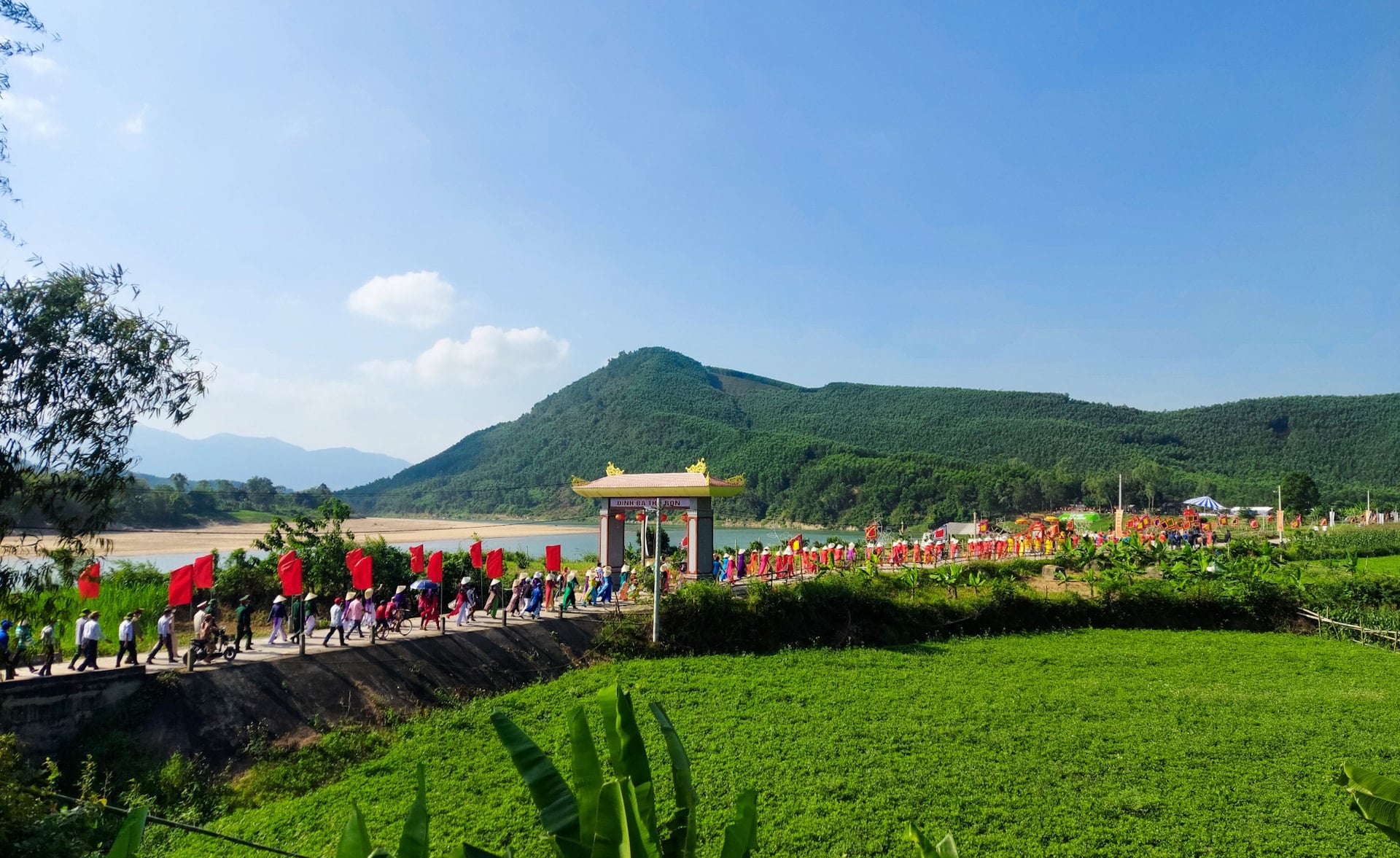
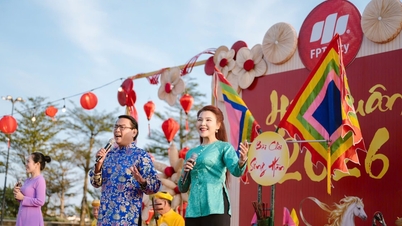
Village festival by the river. Photo: NGO HOA
The names of rivers like Cu De, Tuy Loan, Thu Bon, Vu Gia, Truong Giang, Tranh River, Tam Ky, Ben Van… originate from the “six source routes” that the ancients described in the mountain and river system of Quang Nam province: “ Huu Bang near Tra My mountain / Chien Dan source is in the interior / Thu Bon is a winding stretch / O Gia is on the Con River / Lo Dong near Cao Son mountain / Cu De is near Hai Van island… ”.
Delta alluvial deposits
In his poem "Quang Nam Province Poem," scholar Tran Dinh Phong (1847-1920) described both the shape and color of the landscape of the rivers:
"The two streams of the Sai Giang River originate from Ta Trach."
Several branches of the Ky Thuy River flow down to the An Hoa estuary.
The Yangtze River is a stretch of flat, sandy plain, winding through several bends.
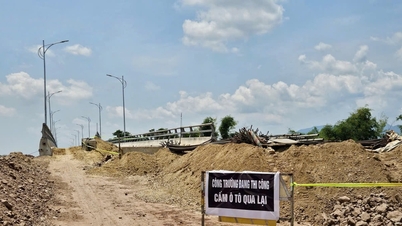
Vinh Dien is a newly dug river by the construction project.
Australian tea plantations with clear blue rivers.
Cam Le River, deep and rippling.
The lotus flowers grow lush and vibrant along the Ha Lam River, filling the air with their fragrant scent.
"The egrets often wade along the Hoa Vang River, their white feathers shimmering in the sunlight…".
Carrying with them the vicissitudes of Quang Nam's history are the countless historical changes of the region. Among them, the Thu Bon River, the "mother river," gave birth to the alluvial delta region spanning over 10,000 square kilometers, making it one of the largest inland rivers in Vietnam. Perhaps because of this, the landscape and culture of the Thu Bon River are representative of a land rich in historical sediment, flowing from the towering Ngoc Linh, the highest point of the Southern Truong Son Mountains, down to Cua Dai and Cua Han, reflecting the images of countless villages, temples, fortresses, ancient capitals, and old towns...
The Thu Bon River is not only the lifeblood that shaped the agricultural civilization of Quang Nam province, but also an important trade route connecting the port city of Hoi An with the highlands, bearing the traces of the "salt road," the "pottery road," and the "silk road"...
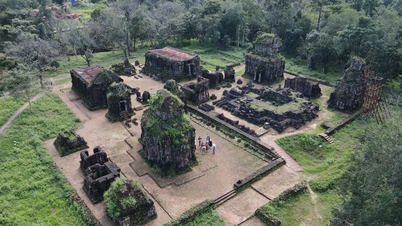
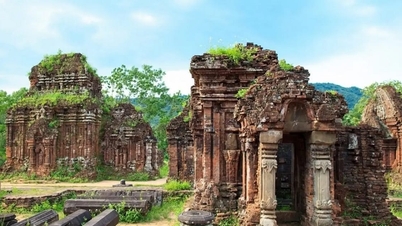
Since ancient times, merchant ships have traveled upstream along the Thu Bon River to Chiem Son, Tra Kieu, Giao Thuy, then connecting to Vu Gia via Ben Dau, Hoi Khach, and even Ben Giang, to trade goods. Major historical sites such as the My Son Sanctuary, Tra Kieu Imperial City, Ma Chau weaving village, Thanh Chiem Citadel, Thanh Ha pottery, Kim Bong carpentry, and Hoi An ancient town are all located along the Thu Bon River, as if the culture of this region was formed from the water and the alluvial soil of the delta.
The sacred spirit echoes
Going further back in the history of Quang Nam province, the riverine culture didn't just form after the founding of the nation with Dai Viet. Thousands of years ago, ancient peoples from Bau Du and Sa Huynh settled on this land, leaving behind a rich collection of burial jars along the Thu Bon, Vu Gia, and Truong Giang rivers, among others. These artifacts bear witness to a system of riverside and coastal trade. The early trade between the two regions, both upstream and downstream, was evident in numerous excavations conducted by archaeologists, bringing to life the echoes of the ancients, the resounding song of "young jackfruit sent down, flying fish sent up."
Mysteriously, in the Sa Huynh burial jars, glass, agate, and beads of a type brought from Burma and India have been discovered, showing traces of the ancient "ceramic-glass trade route" across the East Sea connecting to the Indian Ocean. At sites like Lac Cau (along the Truong Giang River), Lai Nghi, Go Dua (Thu Bon), and even Nong Son… ancient jewelry has been found, used in burials and carrying sacred beliefs.
From the Sa Huynh people to Champa, history continues along sacred rivers and mountains, as the late Professor Tran Quoc Vuong discovered. The Amaravati kingdom stretched along a West-East axis: My Son - Nui Chua/Nui Rang Meo - Thu Bon River - Tra Kieu Holy City - Champa Port/Hoi An and the Cham Islands. Thien Ya Na - Ba Chua Ngoc - Ba Phuong Ranh - Ba Thu Bon - Ba Cho Duoc, are incarnations of the Mother Goddess, worshipped in religious sites along the rivers of Quang Nam province.
Today, every year, the people of Quang Nam province have the custom of offering sacrifices to the land, celebrating peace and prosperity, and holding spring and autumn festivals along the riverbanks. From the source to the sea, the sound of prayers for a peaceful river and calm seas can be heard. Even when the river rages with floods, people still give thanks to the river gods, saying: "We respectfully invite the gods of natural disasters, seasonal disasters, the gods of the twelve time periods, the gods of the year, the gods of the month, the gods of the day, the thirty-six categories of gods, the gods of the five directions, and the gods of the five lands."
Mountains and rivers are beautiful - A journey across the sea.
Manifesting merit - Pitying the spirits
Protecting the nation and governing the people - Relying on the Emperor's grace.
The preservation of resources ensures peace for the people and benefits the people.
"To promote peace throughout the world…"
Mountains and rivers nurture beauty. The journey of great rivers and seas is to bring "peace to the people and benefit to nature," as implied in the prayer to "mountains and rivers nurture beauty." And it is no coincidence that Emperor Minh Mạng early on standardized the rituals of worshiping the river and mountain gods for the "famous mountains and great rivers" throughout the country.
Rivers are not only sacred in festivals and in prayers offered to the river god and water goddess at the riverbank, but they also play a long role in trade, opening up economic opportunities and enriching culture.
Then, all the clay from the river, from earth, water, and fire, was fired to make bricks and pottery, building temples, ancient streets, communal houses, even the imperial city and thousand-year-old burial grounds.
Then, all sorts of livelihoods, from silkworm farming, rice cultivation, fishing, to long-distance trading by boat, connected all regions via these rivers.
Carried along the river is the rich history of this land.
Carried along the river are the memories of a lifetime's alluvial soil…
Source: https://baodanang.vn/cho-theo-doi-song-3312313.html


![[Image] "Journey of Hope" promotes the organ and tissue donation movement in Vietnam.](https://vphoto.vietnam.vn/thumb/1200x675/vietnam/resource/IMAGE/2026/05/20/1779294400833_1-8910-jpg.webp)
![[Photo] General Secretary and President To Lam works with the Party Committee of the Ministry of Health on the work of Vietnamese traditional medicine.](https://vphoto.vietnam.vn/thumb/1200x675/vietnam/resource/IMAGE/2026/05/20/1779294323718_a1-bnd-2978-3319-jpg.webp)





















































Comment (0)