

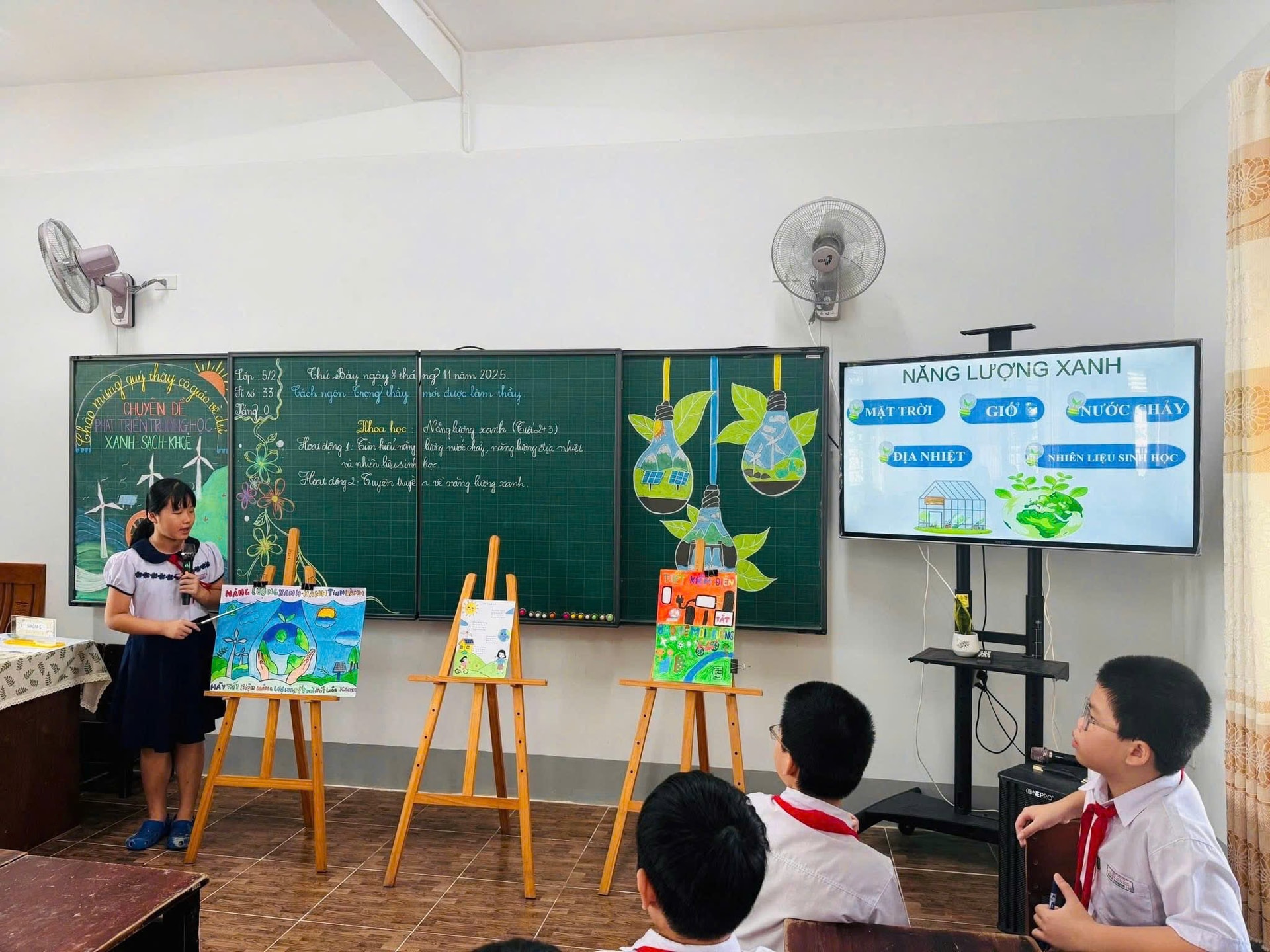
When the classroom becomes an experiential space.
In mid-March, at Le Dinh Chinh Primary School (Hoa Cuong Ward) and the Ban Thach Ward People's Committee Hall, hundreds of primary school teachers participated in a training course on the "Learning Through Play" (LTP) method organized by the City Department of Education and Training.
This activity is a continuation of the results of the iPLAY project - a collaborative program between the Vietnamese education sector and the Flanders region (Kingdom of Belgium), aimed at integrating learning through play into primary school teaching.
After the project ended in 2023, this method continued to be maintained and expanded by the Da Nang education sector in all primary schools.
The distinguishing feature of the HTQC method lies not in "turning learning time into playtime," but in designing learning activities with a game element to encourage students to actively explore knowledge. Five core elements are emphasized: fun, active participation, meaningfulness, experimentation, and interaction.
In such a classroom, students not only listen to lectures but also discuss, experiment, solve problems, and collaborate with their peers. Seemingly simple activities like matching flashcards, role-playing, deciphering puzzles, or designing educational games become "gateways" that help students approach the lesson naturally.
According to Ms. Mai Thi Thu Hang, Principal of Nguyen Thai Hoc Primary School (An Hai Ward), introducing play-based learning methods into schools has helped teachers change their perspective on lessons.
"Previously, many teachers thought that the classroom had to be very orderly, with students sitting quietly and listening. But when we implemented the Learning Quality Management System, we realized that enthusiasm, laughter, and discussions are signs that learning is taking place," Ms. Hang shared.
At Nguyen Thai Hoc Primary School, teachers have experimented with many creative classroom organization methods. During Vietnamese language lessons, students can participate in word-matching games to create short stories; in Math lessons, they solve problems through a "treasure hunt" game; and in Social Studies, students play the role of young scientists to observe and record their findings.
According to Ms. Hang, the most important thing is for teachers to design activities that are both fun and achieve the learning objectives. "Playing should not deviate from the educational goals. Each game must help students understand the lesson more deeply and develop skills," she emphasized.
Enhancing teacher capacity
From a professional management perspective, Ms. Ton Nu Thuy Trang, a specialist in the Primary Education Department of the City's Department of Education and Training, stated that these training courses were designed with a practical focus.
"Teachers not only listen to theory but also directly design lesson plans, build learning games, and practice teaching to provide feedback and learn from each other's experiences," Ms. Trang said.
According to her, this is a way to help teachers understand the true nature of the teaching and learning system, avoiding the application of superficial methods or turning lessons into aimless recreational activities.
One of the program's goals is to help teachers develop the ability to organize flexible classrooms, in line with the requirements of the 2018 General Education Program, which focuses on developing students' qualities and competencies.
"We want teachers to not only teach knowledge but also create opportunities for students to explore, experiment, and collaborate. When students are involved in the learning process, they will remember longer and understand more deeply," Ms. Trang said.
Mr. Vo Van Khanh, Head of the Primary Education Department of the City Department of Education and Training, believes that learning through play is one of the approaches that aligns with modern educational trends.
According to Mr. Khanh, many studies around the world have shown that children learn best when they experience and interact. Incorporating games into the classroom helps stimulate students' curiosity, creativity, and cooperative spirit.
"Educational reform is not just about changing textbooks or curricula, but also about changing the way learning activities are organized. When teachers are bold and creative in their teaching methods, the classroom will become more lively and effective," Mr. Khanh remarked.
He also stated that, following the pilot phase and initial implementation, the city's education sector is encouraging primary schools to continue applying and developing play-based learning models that are suitable to the specific conditions of each school.
Towards a happy classroom
In fact, many primary schools have shown that when teaching methods are reformed, the classroom atmosphere also changes. Students become more open, confident, and enthusiastic about coming to school.
One teacher who attended the training shared that what surprised her most was the students' creativity. When given autonomy, they were able to come up with very unique solutions to problems.
Such lessons not only help students master knowledge but also cultivate communication, collaboration, and critical thinking skills—important competencies in modern society.
From training sessions to specific lesson plans, the spirit of innovation is gradually spreading throughout the city's primary schools. These aren't dramatic changes, but rather sustained movements in the mindset and actions of teachers.
And as the classroom becomes a place where students can learn with joy, actively explore, and boldly experiment, primary education is moving closer to the goal of building happy classrooms, where every day at school is truly a joyful day.
Source: https://baodanang.vn/cach-tiep-can-moi-o-bac-tieu-hoc-3327712.html


![[Photo] General Secretary and President To Lam receives Amazon's Senior Vice President David Zapolsky](https://vphoto.vietnam.vn/thumb/1200x675/vietnam/resource/IMAGE/2026/05/22/1779466547770_a1-bnd-3513-6601-jpg.webp)































































Comment (0)