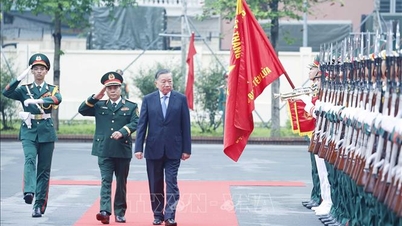
The directives issued by General Secretary and President To Lam during his recent working session with the education sector regarding preparations for the new school year are not merely guidelines for a sector, but essentially a long-term national development strategy.
By emphasizing the need for a strong shift from a "management of education" mindset to a "management of educational development" mindset, and affirming that education must be one step ahead in preparing high-quality human resources for the country, the head of the Party and State has set forth a momentous requirement: Education must become the pioneering force in shaping the future.
 |
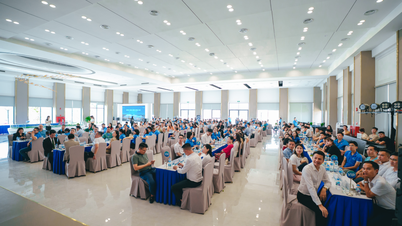
Over the years, Vietnamese education has achieved significant accomplishments. (Illustrative image: VNA) |
Education is placed within the overall context of the requirements for rapid, sustainable, self-reliant, and self-strengthening national development in the new era. Therefore, education is no longer seen as merely a field providing public services or fulfilling the task of training human resources to meet immediate needs. Education must be considered a driving force for development, a strategic resource that determines national competitiveness. A country that wants rapid development must have a high-quality workforce. A country that wants sustainable development must have citizens equipped with the knowledge and skills to adapt to the changes of the times. A country that wants self-reliance and self-strengthening must have a team of experts, scientists , engineers, and workers capable of mastering technology, knowledge, and their own future.
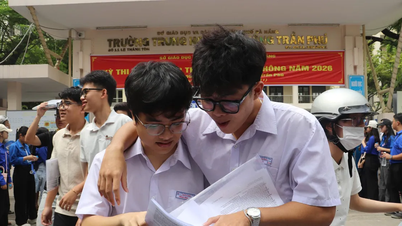
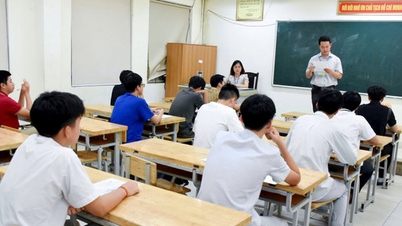
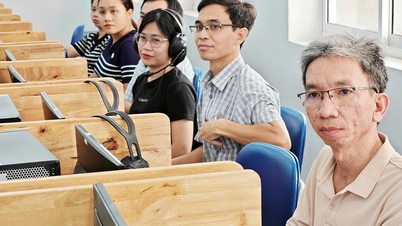
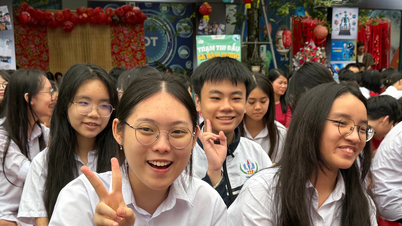
Over the years, Vietnamese education has achieved significant accomplishments. The scale of training has continuously expanded, the percentage of the population with access to education has steadily increased, and the quality of general education has been internationally recognized. However, the rapid changes in science and technology are posing entirely new demands. While previously a profession could have a stable, long-term existence, today the lifespan of many professions is only a few years. The emergence of artificial intelligence is profoundly changing the global labor market. Many repetitive jobs will be replaced by machines and algorithms. Simultaneously, a host of new professions are constantly emerging, from data engineers, artificial intelligence specialists, cybersecurity experts, virtual reality designers, to fields related to the green economy , clean energy, and biotechnology.



Therefore, the directive from the General Secretary and President that education must grasp the trends in training for new professions that will emerge and those that will disappear in the future is of strategic significance. Education must transcend traditional training thinking. Instead of merely meeting current needs, education must be able to predict future needs. Instead of training what currently exists, education must prepare for what is to come. This requires a radical transformation of the education system, from curriculum content and teaching methods to governance mechanisms and connections with the labor market.
One of the breakthroughs in this new way of thinking is the shift from "educational management" to "educational development governance." Management is often associated with operation, control, and the implementation of regulations. Meanwhile, development governance requires strategic vision, forecasting ability, and the capacity for innovation. This means that the education sector should not only focus on running schools, developing curricula, or organizing exams, but also answer bigger questions: What kind of human resources will the country need in the next 10 years? What skills will determine national competitiveness? Which technological fields will create breakthroughs in development? And what preparations does education need to make today to meet these requirements?
The reality is that many successful nations have chosen education as their priority. South Korea invested heavily in education before becoming a technological powerhouse. Singapore built a future-oriented education system before becoming a leading financial and innovation hub in Asia. Finland, despite lacking abundant natural resources, possesses a high-quality workforce thanks to its long-term education strategy. These lessons demonstrate that every developed nation must invest in the future, and education is the path to that.
In the digital age, the most important thing is no longer rote memorization of knowledge, but the capacity for lifelong learning. Artificial intelligence can provide information in seconds, but it cannot completely replace human creativity, critical thinking, problem-solving skills, and social responsibility. Therefore, modern education must shift its focus from knowledge transmission to competency development. Learners need to be equipped with the ability to learn independently, conduct their own research, adapt, and continuously update their knowledge. These are essential skills for survival in a world where technology changes daily.
The directives of the General Secretary and President also demonstrate a strategic vision regarding the relationship between education and science and technology. Fields such as artificial intelligence, innovation, digital transformation, semiconductor technology, biotechnology, and green energy are not only new economic sectors but also areas that will determine the nation's future position. To participate in the global value chain at a higher level, Vietnam cannot rely solely on simple labor. We need generations of citizens capable of creating new knowledge, mastering new technologies, and generating new values. This task begins with education.
In the context of Vietnam's goal of becoming a high-income developed country by 2045, education must be considered a top national priority in the truest sense. Investing in education is not an expense, but an investment in the future. Every school today is where engineers, scientists, entrepreneurs, technology experts, and citizens who will shape the country's future are being trained. Every innovation in education today will create a competitive advantage for the nation in the future.
However, realizing this vision requires decisive steps. Training programs must be regularly updated to meet practical needs. The link between schools and businesses needs to be strengthened. Vocational education must be upgraded to meet the demands of modern industrial development. Universities need to become centers for research, innovation, and technology transfer. At the same time, a favorable environment must be created to attract talent, encourage scientific research, and develop cutting-edge technologies.



Looking at it more broadly, the directives of the General Secretary and President are not just a matter for the education sector, but a call to action for the entire society. Education is not solely the responsibility of each school. Families, businesses, communities, and management agencies all have a responsibility to participate in preparing human resources for the future. A learning society, a nation that invests heavily in education, and an open and flexible education system will be the foundation for Vietnam's breakthrough in the new era.
The message from the General Secretary and President's directive is very clear: To move quickly, we must prepare our people; to go far, we must invest in education; to master the future, we must master knowledge. In the increasingly fierce global competition, a nation's greatest advantage lies not in natural resources or investment capital, but in the quality of its human resources. Therefore, education must be one step ahead, not only to meet the demands of the present, but also to pave the way for the future. This is the path to building a rapidly developing, sustainable, self-reliant, strong, and powerful Vietnam in the 21st century.
Source: https://www.qdnd.vn/giao-duc-khoa-hoc/cac-van-de/chuan-bi-con-nguoi-cho-tuong-lai-dat-nuoc-1044663