

Border forests, which serve as natural boundaries, often stretch across mountain ranges and streams, characterized by complex terrain and difficult access. This makes patrolling and monitoring challenging. Many individuals exploit this geographical isolation to illegally log timber, hunt wild animals, or practice slash-and-burn agriculture. In recent years, communes throughout the province have signed cooperation agreements on the management and protection of border forests; inter-agency teams and community forest protection teams have been established to conduct regular patrols.
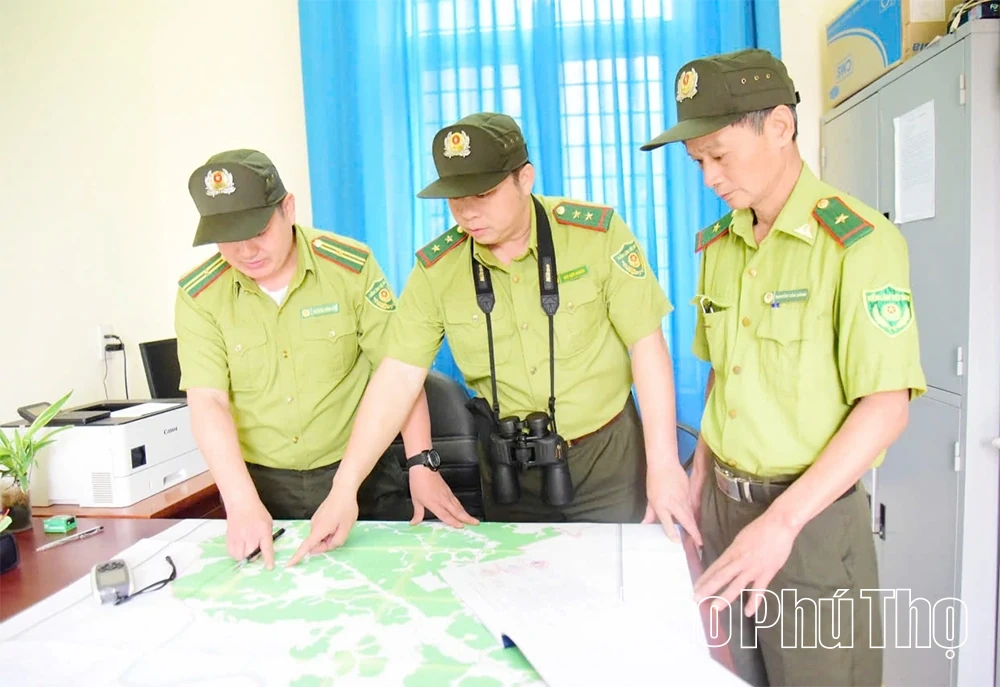
Provincial forest rangers discuss plans to protect the forest.
Typically, at Xuan Son National Park, the unit annually collaborates with the Xuan Son National Park Forest Ranger Station, Tan Son Forest Ranger Station, Da Bac Forest Ranger Station, and the Forest Ranger Station of Region V (Son La province) to sign cooperation agreements covering areas such as: organizing patrols, inspections, raids, and handling illegal deforestation, hunting, trapping, and capturing of forest animals; monitoring forest changes; exchanging information in both directions; engaging with people in border areas to disseminate, educate, share, and guide scientific and technical knowledge in production; and encouraging community participation in combating and reporting violations of forest protection regulations in the area. Whenever signs of deforestation or forest fires are detected, information is immediately reported through the internal communication system, ensuring timely action. Thanks to this mechanism, in recent years, violations of the Forestry Law have decreased, and many violations have been prevented early on.
Not only relying on forest rangers and authorities, the nationwide movement to protect forests has also proven effective. Households living near forests, especially the Muong and Dao ethnic minorities, have been encouraged to sign commitments to protect the forests, linking responsibility with long-term benefits. In some areas, "village agreements for forest protection" have been formed, considering forest preservation as a common community rule. Simultaneously, projects supporting sustainable livelihoods for people in border areas have been implemented. Instead of clearing forests for slash-and-burn agriculture, people are encouraged to cultivate medicinal plants under the forest canopy, develop livestock farming on hillsides, or collaborate in planting large timber trees. Many households participate in cinnamon and acacia tree cultivation models, providing stable income and reducing dependence on natural forest exploitation. The policy of payment for forest environmental services also contributes to increased income and encourages people to participate in forest protection more effectively.
A notable point is the application of science and technology in managing border forests. The Provincial Forestry and Forest Protection Department has implemented a satellite-based monitoring software system using drones and AI-integrated cameras to monitor forest fires. This allows for the rapid and accurate detection of hotspots and affected areas. Furthermore, regular and continuous training and professional development for forest rangers, specialized forest protection forces, and local communities ensures that these forces possess the necessary skills to handle various situations.
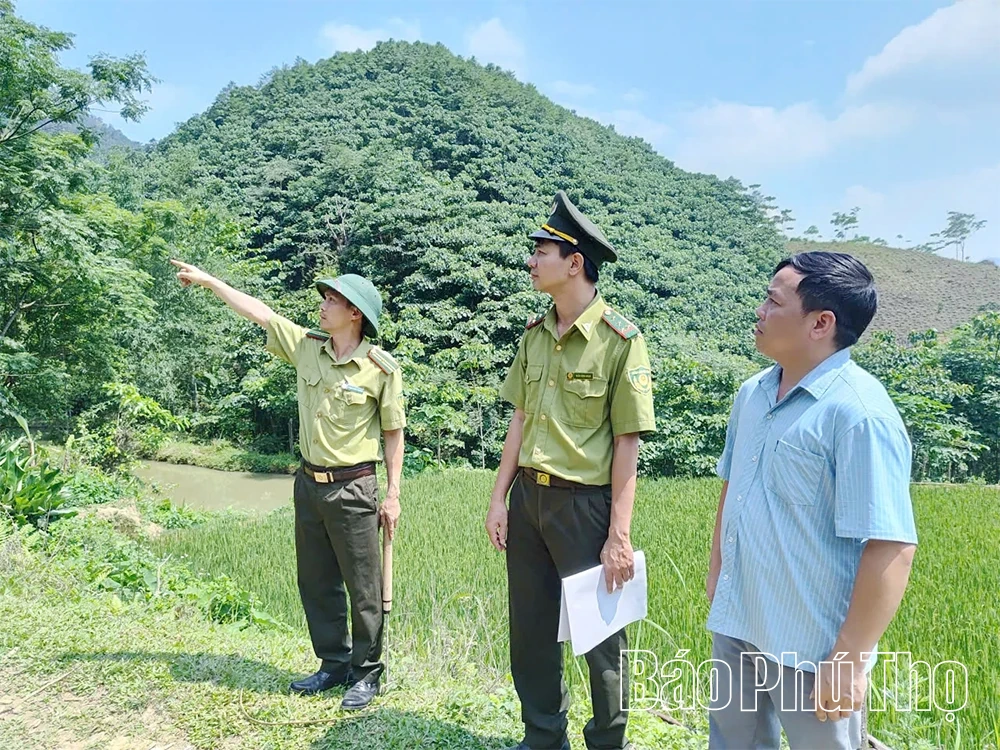
Officers from the Tam Cuu Forest Ranger Station discuss forest protection efforts in the border area with local residents.
Nevertheless, protecting the border forests remains challenging. Some residents still secretly enter the forest to harvest firewood and small timber for a living; the terrain is rugged, patrol routes are long, and the force is thin. Especially during the dry season, the risk of forest fires is high; even a single careless spark can cause significant damage. Local authorities and forest rangers are intensifying efforts to educate and guide residents on clearing undergrowth, constructing firebreaks, and preparing adequate firefighting equipment, while maintaining a 24/7 watch during peak periods.
It can be said that working together to protect the border forests is not only a task of resource management, but also a responsibility to preserve the ecological environment, ensure livelihoods, and maintain security and order in the highlands. The results achieved so far are proof of the coordinated efforts of the entire political system and the people. The joint efforts and solidarity between the forest rangers, the government, and the local people have become a key factor in preserving the green forests and protecting the "lungs" of the province.
Hoang Huong
Source: https://baophutho.vn/chung-suc-giu-rung-giap-ranh-240519.htm

























![[Video] Sunset at Lap An Lagoon – Where the sun sets over the fishing nets](https://vphoto.vietnam.vn/thumb/340x192/vietnam/resource/IMAGE/2026/05/31/1780192137701_beach-landscape-sea-water-nature-grass-745871-pxhere-com.jpeg)





![[Photo] The General Secretary, President and his wife lay flowers at the Ho Chi Minh Monument in Manila.](https://vphoto.vietnam.vn/thumb/1200x675/vietnam/resource/IMAGE/2026/05/31/1780219759477_anh-man-hinh-2026-05-31-luc-16-29-07.png)











































































Comment (0)