


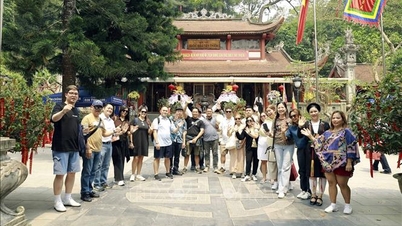
International tourists visit and experience local culture at Hung Lo communal house (Van Phu ward).
Reporter: Comrade, every spring, Phu Tho welcomes millions of visitors from all over the country who come to worship and visit. What creates the special appeal of this ancestral land in the hearts of Vietnamese people? Could you please share more about the province's cultural heritage system?
Comrade Duong Hoang Huong: Phu Tho is the cradle of the Vietnamese nation, a place closely associated with the era of the Hung Kings who founded the country. It is this profound history, culture, and rich heritage that have created a special and enduring attraction for domestic and international tourists, especially during the spring season.
As of July 2025, the province has 2,778 historical and cultural relics; of which, 979 have been classified, including 6 special national relics, 176 national relics, and 797 provincial relics. In addition, Phu Tho currently possesses 6 national treasures along with thousands of valuable artifacts and antiques preserved at the Hung Vuong Museum, private museums, and historical and cultural sites throughout the province.
Regarding intangible cultural heritage, Phu Tho has nearly 2,000 heritage items, including 5 recognized by UNESCO. Specifically, two heritage items are recognized as subjects: the Hung King worshiping belief in Phu Tho and Xoan singing in Phu Tho; along with three other heritage items where Phu Tho is a region of influence in multinational dossiers: the Tug-of-War ritual and game, Ca Tru singing of the Vietnamese people, and the Tam Phu belief practice of the Vietnamese people. In addition, the province has 41 intangible cultural heritage items included in the National List of Intangible Cultural Heritage.
PV: Comrade, what is the significance of the Hung Kings worship belief in the spiritual life of the Vietnamese people? Besides that, how do you assess the value and current role of Phu Tho Xoan singing – another unique heritage?
Comrade Duong Hoang Huong: In the consciousness of the Vietnamese people, Hung Vuong is the founding king of the nation, the ancestor of the community. Therefore, the worship of Hung Vuong has been deeply ingrained in the hearts of every Vietnamese person for generations. The practice of worshipping Hung Vuong takes place regularly throughout the year, extending across the country, but is most concentrated in the spring. During this time, tens of millions of people participate in religious practices at communal houses, temples, and shrines in villages and communes throughout the country, with the largest ceremony being the Hung Vuong Ancestor Commemoration Day, which takes place on the 10th day of the 3rd lunar month at the Hung Vuong Temple historical site on Nghia Linh mountain. The community practices the belief with offerings, worship rituals, performances, and traditional folk cultural activities that have been maintained, preserved, and passed down from generation to generation through oral tradition. Currently, the forms of transmission have been documented by central and local cultural agencies for preservation, in order to guide and support the community in organizing and implementing them. From the Vietnamese community in Phu Tho, this belief has expanded nationwide, becoming a custom of Vietnamese communities both domestically and abroad.
Phu Tho Xoan singing is a cultural heritage belonging to the folk performing arts category, closely associated with the Hung Kings worship belief – a belief originating from the Vietnamese people's ancestor worship practices. It is a precious intangible cultural heritage of the ancestral land in particular and of the Vietnamese national cultural heritage in general. Xoan singing also reflects the Hung Kings worship belief and the traditional rice-worshiping belief of the Vietnamese people. Therefore, Xoan singing is a creative process of the community and possesses strong vitality within the community. Xoan singing has united the community through members performing together in rituals and customs at villages with communal houses and temples associated with Xoan singing.
Over a decade after being inscribed by UNESCO as a Representative Intangible Cultural Heritage of Humanity, Xoan singing has increasingly affirmed its value and role in community life.
Xoan singing affirms profound historical, religious, and artistic values. A heritage closely associated with the Hung King era, Xoan singing is a unique form of temple singing, expressing the principle of "drinking water, remembering the source," honoring ancestors, and praying for national peace and prosperity, vividly reflecting the soul of ancient Vietnamese people. This heritage endures alongside the history of the formation and development of the midland region of the ancestral land in particular, and of the Vietnamese nation in general.
The community plays a decisive role in the sustainable vitality of the intangible cultural heritage of Xoan singing. The community here is primarily the owner, the practitioner, and the subject of the cultural heritage, specifically the four Xoan wards: Phù Đức, Thét, Kim Đới, and An Thái (Vân Phú ward). They participate in identifying the heritage, promoting its value in their spiritual lives, and maintaining meaningful heritage practices. The regular annual teaching, practice, and performance activities in the Xoan wards have fostered community cohesion and a shared commitment to protecting the heritage.
PV: Comrade, what role do the folk festivals held at the beginning of spring in Phu Tho play in preserving the national cultural identity? In recent years, what solutions has the province implemented to link heritage preservation with sustainable tourism development?
Comrade Duong Hoang Huong: The folk festivals at the beginning of spring in Phu Tho play an important role in preserving the national cultural identity, becoming an indispensable need in the cultural life of the community.
Traditional festivals in Phu Tho are very diverse. Preliminary statistics from 2025 show that Phu Tho has more than 800 traditional festivals, spread across communes and wards, held throughout the year. These festivals recreate agricultural activities, historical events, and captivating rituals and performances, becoming an important element in the spiritual life of the local community. Many festivals have become symbols of Vietnamese national culture and spirituality, such as: the Hung Temple Festival (10th day of the 3rd lunar month) - a major national holiday, symbolizing the spirit of national unity; the Au Co Mother Temple Festival - associated with the legend of Mother Au Co giving birth to a hundred eggs; the Tro Tram Festival - still preserving the original fertility rituals; the Tay Thien Festival associated with the Tay Thien National Mother (15th day of the 2nd lunar month); and the Ngu Doi Temple Festival, associated with the water procession ritual of the agricultural community. The Mộ Chu Hạ rice cake pounding festival – a manifestation of community spirit, linked to the legend of King Hùng choosing his successor. Other festivals include the Bạch Hạc boat race, the Đào Xá elephant procession, the Vân Luông net-throwing festival, the Kim Đức - Phượng Lâu Xoan singing festival, the Gầu Tào festival of the Hmong people, the Xên Mường festival of the Thái people, the Khai Hạ Mường Bi festival… Each festival is a vibrant living museum of folk culture, preserving rituals, performances, performing arts, indigenous beliefs, and community life.
In recent years, Phu Tho province has implemented many solutions to link cultural heritage preservation with sustainable tourism development, focusing on building and exploiting unique tourism products associated with heritage values.
Firstly, the province is gradually developing cultural and spiritual tourism products – characteristic festivals of the ancestral land; organizing spaces for folk cultural performances, experiencing traditional rituals and performances in spring festivals. The Hung Kings worship and Xoan singing are prioritized for preservation and promotion in conjunction with tourism development; folk festivals of ethnic minorities are selectively restored, ensuring harmony between preservation and tourism development.
Secondly, it is necessary to strengthen propaganda, education, and digital transformation. Phu Tho is promoting awareness among officials, the public, and tourists about the value of cultural heritage; applying digital technology in inventorying and digitizing festival documents, and promoting the image of traditional festivals on media platforms, thereby expanding accessibility while still maintaining good control over content and presentation.
Thirdly, enhance the effectiveness of state management and environmental protection during festivals. Coordination among the cultural, tourism, agriculture, and environmental sectors, as well as local authorities, will be strengthened; emphasis will be placed on ensuring security and order, environmental hygiene, and safety for tourists during the festival season, contributing to building an image of Phu Tho festivals as civilized, friendly, and sustainably developed.
Fourth, the province emphasizes the leading role of the community in preserving and promoting heritage values. The province identifies the local community as the center of conservation efforts; many folk festivals are entrusted to the community for direct practice, management, and transmission. Artisans and those knowledgeable about customs and rituals are honored and provided with funding to participate in teaching, performing, and serving festivals and tourism. This approach ensures the authenticity of heritage while contributing to sustainable livelihoods for local people.
Hanh Thuy (compiled)
Source: https://baophutho.vn/hanh-trinh-ve-mien-que-di-san-248659.htm

































































Comment (0)