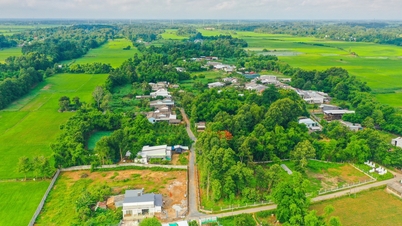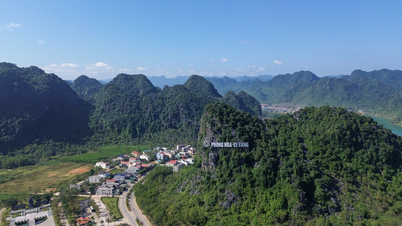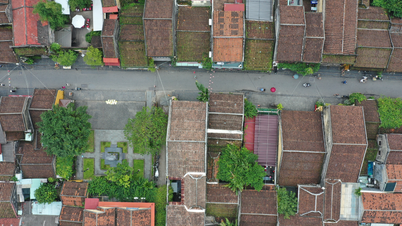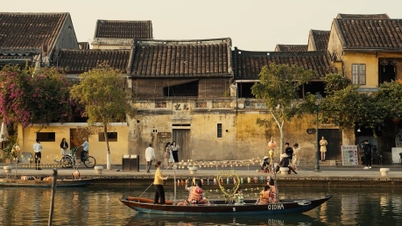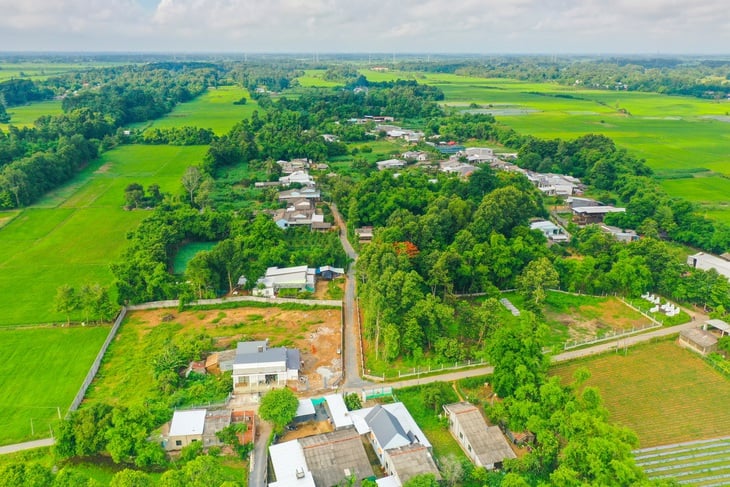
Peaceful countryside - Illustration photo: QUANG DINH
Meanwhile, adults who are shouldering the burdens of their families are glued to screens, relentlessly chasing after artificial intelligence and being exhausted by the responsibilities of modern life.
For the past few weeks, we've been heartbroken by the plight of elderly people: living in loneliness, lacking affection, and becoming easy targets for scams like "holiday traps."
What left me speechless wasn't the amount of money the elderly people lost, but the way the scammers gained their trust: they patiently listened, patted their hands, massaged their shoulders, and addressed them sweetly as "mother" and "daughter," things that busy children rarely do.
Three generations have been consumed by the same loneliness.
I recall the African proverb: "It takes a whole village to raise a child." Recently, anthropologist Sarah Blaffer Hrdy, in her book *Mothers and Others* (2009), demonstrated that humans are cooperative parenting primates: throughout history, a child has always been cared for by many people along with the mother. Humans have never evolved to raise a child alone until adulthood.
And in fact, perhaps the "village" is not only needed for future generations, but for both the present and previous generations so that they are not consumed by loneliness.
I also recall studying the town of Roseto in Pennsylvania, USA. In the 1950s and 1960s, the people of Roseto were mostly of Italian descent, ate a lot of fatty foods, smoked, and did heavy labor like the neighboring towns, yet the death rate from heart attacks was less than half that of their neighbors.



Researchers tested various hypotheses about genes, diet, and doctors; the only difference they found was a close-knit culture: three generations living together, shared meals as a large family, and neighbors helping each other in times of need.
A generation later, as children and grandchildren integrate into modern lifestyles, the old community disappears, and those health differences vanish. Clearly, connection is not something to be taken for granted; it is an essential condition for a healthy life.
In Vietnam, we once had a very close-knit neighborhood and family culture, with extended families living together. These days, however, are gradually giving way to the model of a husband, wife, and child living in a small apartment. Now, we've "sold distant relatives" but we're not "buying close neighbors" either.
Modern society operates increasingly through transactions: whatever you need, you get it for money. From babysitters and caregivers for the elderly to even companions, everything can be hired.
As for the non-transactional aspect, the giving and receiving without expecting anything in return, it gradually diminishes and disappears. Ironically, the sense of community and neighborly affection lies entirely in that aspect.
At forty, what I remember most about my childhood is that when my parents were away working, I had a neighbor boy, with whom I've been friends since third grade, for over 30 years now; his mother gradually became like a foster mother to me. Whatever he studied, I learned too.
Your mother found teachers for you two to learn drawing and computer assembly, and later I earned my first money by installing computers. The neighborhood played a significant role in raising me. After 20 years in education , I've realized that every child needs more than just a home.
You might think: nowadays everyone is busy, everyone minds their own business, it's hard to trust strangers, how can things ever go back to how they used to be? I understand, and I myself am living in an isolated apartment, also caught up in that same cycle of transactions.
But restoring a "village" doesn't cost as much as we might think. It starts not with money, but with an idea and a few small habits.



A few families living nearby, or a group of close friends, would have a shared meal every two weeks, taking turns looking after the children, chatting with the elderly parents, and each family would prepare a signature dish from their home...
No one has to bear the burden alone. And strangely enough, when the children cling to each other, when the adults have someone to lean on, when the elderly have someone to talk to, all three generations are happier without having to go through a "transaction."
Perhaps, without a "village," everyone, from children to adults and the elderly, feels lost and uncertain. The question to ponder is: Where will each of us begin to rebuild our "village" for ourselves and our loved ones?
Source: https://tuoitre.vn/chung-ta-da-danh-mat-ngoi-lang-10026061709182128.htm