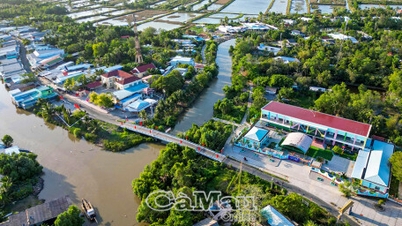
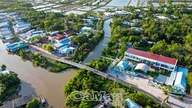
In early June 2026, in the Khe Cai rice fields (Dui Chieng village), the low-lying, frequently flooded rice paddies that previously yielded poor rice production were covered in the vibrant green of commercial lotus plants. The lotus plants thrived, developing uniformly, bringing joy and hope for a stable income for the farmers.
In 2026, the agricultural extension project "Converting low-yield rice paddy areas to commercial lotus cultivation linked to product consumption along the value chain" will be implemented in Dùi Chiêng village with the participation of 24 households on an area of 4.7 hectares. The households will receive support in terms of seeds, materials, technical training, and product consumption linkages.
As one of the pioneering households participating in the model, Mr. Tran Bon converted 3,500 square meters of frequently flooded rice land to lotus cultivation. Seeing that the lotus plants thrived, he continued to lease additional land from neighboring households, expanding the area to approximately 2 hectares.
Mr. Bon shared that previously, this area was mainly used for rice cultivation, but the economic efficiency was not high. Since switching to lotus cultivation, the plants have grown quite well, the investment costs are lower, and the care required is less. The lotus plants provide a stable harvest, improving the family's life.

Many households participating in the model also assessed that lotus plants are suitable for the local natural conditions. Despite unpredictable weather, lotus plants still grow well, are less susceptible to pests and diseases, and are easy to care for.
To ensure the model's effectiveness, the Center for Supplying Public Service regularly sends technical staff to monitor and guide people from land preparation and planting to care and pest control.

According to Ms. Nguyen Thi Huyen, a technical officer at the Que Phuoc Commune Public Service Supply Center, the lotus plants achieved a survival and growth rate of approximately 90% after practical evaluation of the project. The average yield reached 24 quintals/hectare, with a total production of over 11 tons across the entire model. With an average selling price of 45,000 VND/kg, total revenue exceeded 500 million VND, resulting in a profit of nearly 255 million VND.
"The economic efficiency of this model is about 3.8 times higher than rice production on the same area. People have also changed their production mindset, adopting farming methods that are linked to market demand and product consumption," Ms. Huyen said.
According to Mr. Nguyen Van Lanh, Vice Chairman of the People's Committee of Que Phuoc commune, the lotus cultivation model in Dui Chieng village has initially shown positive results. The lotus plants grow well, are suitable for the soil, are less susceptible to pests and diseases, contributing to improved land use efficiency and reduced production costs. Besides the economic value from lotus seeds, flowers, and roots, the model also has the potential to develop tourism and experiential activities.
“In the coming time, the locality will continue to promote propaganda and mobilize people to change the crop structure to suit the actual conditions; support the transfer of science and technology, and build product consumption linkage chains. At the same time, develop processed products from lotus to increase value, increase income and improve the lives of people,” Mr. Lanh said.
Source: https://baodanang.vn/chuyen-doi-dat-lua-kem-hieu-qua-sang-trong-sen-3341381.html
![[Image] Ho Chi Minh City: Ma Lang area, Chicken-Rice Market about to change its appearance](https://vphoto.vietnam.vn/thumb/1200x675/vietnam/resource/IMAGE/2026/06/25/1782377698627_ndo_br_m1-jpg.webp)


![[Image] Schools organize meetings and introduce teaching models to students admitted to grade 10.](https://vphoto.vietnam.vn/thumb/1200x675/vietnam/resource/IMAGE/2026/06/25/1782368077271_ndo_br_z7970052192242-1ec8daeb77a6eed1a4e9f58c564ddd3e-jpg.webp)
![[Photo] General Secretary and President To Lam receives Palestinian Ambassador Saadi Salama](https://vphoto.vietnam.vn/thumb/1200x675/vietnam/resource/IMAGE/2026/06/25/1782365384740_a1-bnd-9423-8322-jpg.webp)