

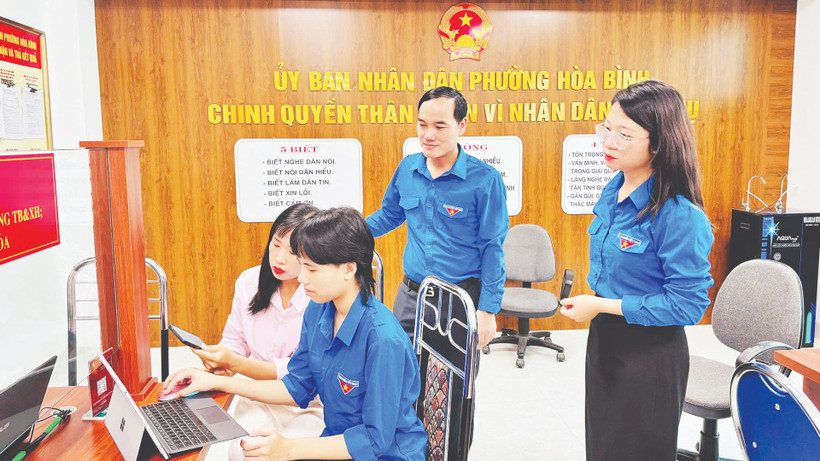
Youth union members in Hoa Binh ward, Phu Tho province, assist residents in searching for information on the online public service portal.
When citizens have timely access to information, participate in providing feedback, and enhance interaction through digital platforms, the gap between the government and the people will be narrowed, contributing to the rapid implementation of the Party's guidelines and the State's policies.
Enhancing the effectiveness of mass mobilization through digital technology.
Mass mobilization work has always been identified as a strategic task of the political system. The results of implementing Resolution No. 25-NQ/TW of the 11th Central Committee on "Strengthening and renewing the Party's leadership over mass mobilization work in the new situation" have contributed to renewing the content and methods of mass mobilization, promoting the people's right to self-governance, and at the same time raising the awareness and responsibility of Party committees and the political system at all levels.
The documents of the 14th National Congress emphasize the requirement for mass mobilization work in the new period to continue innovating the content and methods of propaganda and mobilization of the people; linking it with the effective implementation of socio-economic development policies, especially at the grassroots level.
In the context of the ongoing digital transformation, mass mobilization work is gradually adapting. The application of the internet, social media, and technological platforms in propaganda and mobilization is increasingly emphasized, contributing to expanding interaction channels and improving the effectiveness of serving the people.
Recognizing the role of digital transformation in mass mobilization work, many Party committees, governments, the Fatherland Front, and socio-political organizations have reformed the content and methods of mass mobilization to suit the characteristics of the digital age.
The Quang Ninh Provincial Women's Union is a shining example in implementing mass mobilization in the digital space. Currently, more than 94% of its members in the province participate as communicators and collaborators, actively sharing information within the community.
The digital mobilization movement has been widely implemented through various forms of activities, seminars, and online exchanges on the internet. Women's associations at all levels maintain 287 fanpages and 1,714 Zalo groups with over 75,000 members. These channels have become a rapid information bridge, spreading exemplary women and contributing to shaping positive public opinion.
More importantly, the association's activities have contributed to shaping a new way of life in the community, strengthening the connection between digital citizens and digital government, and creating a foundation for effective public relations in adapting to the digital environment.
When technology is effectively applied in public relations work, the gap between the government and the people will be increasingly narrowed, and the effectiveness of serving the people will therefore be enhanced. In many localities, public relations models linked to digital transformation have been implemented to create conditions for people to access technology and participate in community activities in the digital environment.
After more than a month of implementing the "digital community mobilization" model, Residential Group No. 8, Hoa Binh Ward, Phu Tho Province, has recorded many positive changes. The community cultural center of the residential group is equipped with a modern telecommunications infrastructure system such as: high-speed internet, camera system, smart TV and webcam for online meetings.
According to Ms. Dinh Thi Thu Hien, Chairwoman of the Fatherland Front Committee of Hoa Binh Ward, the goal of the model is to form new behaviors and lifestyles for citizens when participating in public services in a digital environment. Residential Group No. 8 has over 300 households with more than 1,000 residents. Previously, the use of online public services was limited because people were accustomed to traditional methods, the effectiveness of support from community digital technology groups was not high, and many people were not yet familiar with cashless payments.
After implementing the "digital public relations" model, technology was disseminated to every household through online groups and forums; the rate of people using online public services reached 100%. People formed the habit of exchanging information and asking questions on Zalo groups before carrying out administrative procedures. Online groups and forums also became a quick and timely channel for conveying the Party's guidelines and the State's policies and laws to the people.
To date, Hoa Binh ward has three residential groups implementing the "digital people mobilization" model. This result helps the locality maintain its position as one of the leading units in digital transformation in Phu Tho province.

Youth union members in Hoa Binh ward, Phu Tho province, assist residents in using online public services.
Proactive public relations in cyberspace.
In the digital age, every official working in mass mobilization must adapt to a new environment and target audience: the internet and "online citizens." According to Lieutenant General Le Van Hai, Deputy Political Commissar of the National Defense Academy, the advantage of Vietnamese digital citizens or online citizens is their skills, knowledge, and technological capabilities, allowing them easy access to and understanding of diverse and multifaceted information. However, hostile forces also exploit cyberspace to undermine the Party's ideological foundation, distorting and slandering the regime. This necessitates a long-term strategy for digital mass mobilization to maintain political and social stability.
In cyberspace, users can easily interact, share, and participate in forums, groups, and communities to connect and cooperate in all aspects of life, while also expressing individual or collective opinions on social issues. In reality, when Party committees and local authorities proactively grasp and predict the situation and developments in cyberspace, they can promptly implement appropriate mass mobilization solutions. Each cadre and Party member, through their personal computer and smartphone, can proactively disseminate official information to every citizen in the online community, contributing to the timely and accurate transmission of the Party's guidelines and the State's policies and laws.
Many Party committees, government agencies, and communities have also proactively established information channels and social media groups, investing in equipment to support digital public relations work. This allows them to provide official, complete, and timely information to guide public opinion. With information spreading rapidly, digital public relations serves as both a tool for propaganda and mobilization, and a provider of accurate and timely information, contributing to shaping public opinion.
The Political Affairs Department of the Ha Tinh Provincial Police recently launched a "Digital Public Relations" model, contributing to minimizing the risk of people being scammed online. The unit has developed an action plan, clearly assigned responsibilities, enhanced the capacity of administrators and collaborators, and invested in equipment and technology to support the management and production of digital content.
The unit has strengthened coordination between teams and departments, and connected with police units and localities to ensure that information is provided to the public quickly and accurately. In the past, the unit has proactively anticipated and guided public opinion, promptly combating false information. In addition, promoting positive images and exemplary actions within the provincial police force has also been emphasized.
To date, the implementation of the digital model for mass mobilization has become an important criterion in evaluating officials, using the effectiveness of interaction and consensus with the people as a measure of task completion.
Practical experience shows that the application of digital technology is opening up new and effective methods in mass mobilization work. When technology becomes a tool to serve the people and each official and Party member acts as a "bridge" in cyberspace, the bond between the government and the people will become even stronger. This will be an important foundation contributing to building solid social consensus in the digital age.
DONG HA, QUYNH CHI
Source: https://nhandan.vn/chuyen-doi-so-trong-cong-tac-dan-van-post949009.html



![[Photo] Prime Minister Pham Minh Chinh presides over meetings of the Government Standing Committee to discuss several important issues.](https://vphoto.vietnam.vn/thumb/1200x675/vietnam/resource/IMAGE/2026/03/16/1773674631996_ndo_br_img-5789-jpg.webp)
















![[Photo] Prime Minister Pham Minh Chinh holds a phone call with Angolan President João Manuel Gonçalves Lourenço](https://vphoto.vietnam.vn/thumb/1200x675/vietnam/resource/IMAGE/2026/03/16/1773674632171_ndo_br_dsc-4772-jpg.webp)
































































Comment (0)