

This was a statement by Minister of Information and Communications Nguyen Manh Hung at the Vietnam – Asia DX Summit 2024, held on the afternoon of May 28, 2024 in Hanoi, organized by the Vietnam Software and IT Services Association (VINASA) with the theme: “ Digital Transformation, Green Transformation, Digital Economy Development ”.
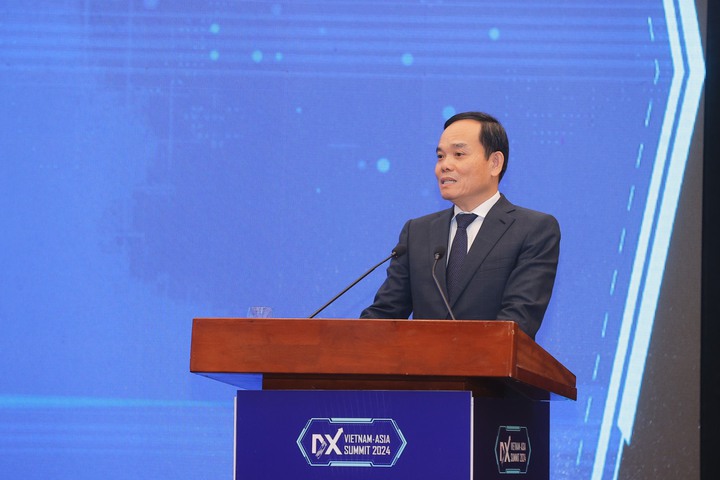
Deputy Prime Minister Tran Luu Quang: “The theme of the Forum is not only an inevitable trend of the world but also the shortest path to a bright future.”
Deputy Prime Minister Tran Luu Quang attended and spoke at the Forum. The event was attended by representatives from ministries, sectors, and localities; representatives from the Indonesian and Mexican Embassies; representatives from several international organizations; and leaders and experts from 17 economies in the region and 35 provinces and cities nationwide. Representing VINASA were Mr. Truong Gia Binh, Chairman of the VINASA Founding Council, and several other association leaders.
Digital transformation and green transformation are strategic choices.
Speaking at the Forum, Minister Nguyen Manh Hung emphasized the important role of digital transformation and green transformation in the first half of the 21st century. According to the Minister, digital transformation and green transformation are twin pillars that go hand in hand, supporting each other and contributing to ensuring a nation's rapid and sustainable development.
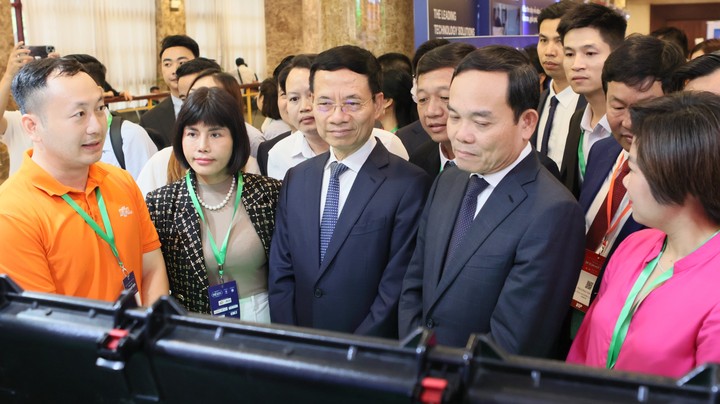
Deputy Prime Minister Tran Luu Quang and Minister Nguyen Manh Hung visited an exhibition showcasing digital transformation solutions.
The Minister pointed out that Vietnam has identified digital transformation and green transformation as strategic choices and key drivers of economic growth. In 2020, the green economy contributed approximately 2% of GDP with a growth rate of over 10%, while the digital economy contributed 12% of GDP. By 2023, according to calculations by the Ministry of Information and Communications, the digital economy will have grown strongly, contributing 16.5% of GDP with a growth rate of over 20% per year.
Digital transformation creates a new type of resource: data. This resource generates more and more with each use, unlike other resources which are depleted. Digital transformation also allows us to break free from the physical world. The physical world is virtualized in cyberspace, and innovation happens much faster in cyberspace. When success is achieved, it is reflected back in the physical world. The faster a nation undergoes digital transformation, the wealthier it will become.
Green transformation helps people reconnect with nature and protect the environment. For rapid development, digital transformation is necessary. For sustainability, green transformation is essential.
Both digital transformation and green transformation require digital technology. At its core, digital technology is semiconductor chips.
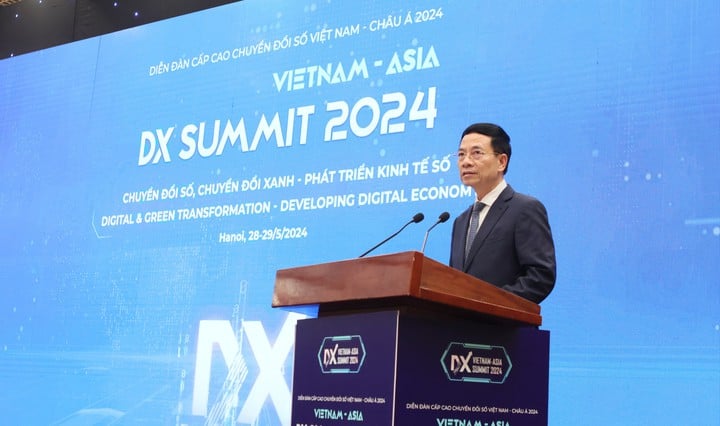
Minister of Information and Communications Nguyen Manh Hung: "Digital transformation is more of an institutional revolution than a technological revolution."
Businesses and associations interested in contributing their opinions to the Draft National Strategy on Semiconductor Chip Development are invited to do so.
Minister Nguyen Manh Hung stated that the Ministry of Information and Communications has completed the final draft of the National Strategy for Semiconductor Chip Development. This strategy focuses on three key areas: Semiconductor chip development is part of Vietnam's Electronics Industry Strategy; Vietnam will move from a global semiconductor workforce hub to a semiconductor industry; and Vietnam will be number one in the semiconductor supply chain from x to x + 1. The Minister expressed his hope that digital technology businesses and associations would contribute their opinions to the draft strategy.
According to the Minister, developing Vietnam's digital economy requires relying on digital innovation, investing in digital infrastructure, and especially AI computing infrastructure. It must integrate the digital economy into all sectors and fields. It must perfect the digital institutional framework, implement digital governance, and train digital skills and human resources, and especially attract digital talent.
Emphasizing the role of theory on digital transformation and the development of Vietnam's digital economy, Minister Nguyen Manh Hung stated that the Ministry of Information and Communications aims to develop this theory.
In just one month, Vietnam's digital transformation program will celebrate its 4th anniversary and enter its 5th year. In 2024, Vietnam will focus on developing the digital economy with four pillars: Information and communication technology industry; Digital economic development across sectors; Digital governance; and Digital data development.
Finally, the Minister emphasized that digital transformation is more of an institutional revolution than a technological revolution. Daring to apply, leading the way in application, and applying safely will create development and also lead to technological improvement. We should discuss more about institutional changes to pave the way for the widespread application of digital technologies.

MISA's exhibition booth
More businesses need to take the lead in developing fields such as AI and semiconductor chips.
Speaking at the event, Mr. Truong Gia Binh, Chairman of the VINASA Founding Council and representative of the Organizing Committee, shared: The whole world is entering a phase of smart development with two trends: digital transformation and green transformation. These are both driving forces and opportunities, but also significant challenges. To exploit the potential of digital and green transformation, creating dual development in both the digital and green economies, many Vietnamese businesses need to "venture" into pioneering the development of fields such as artificial intelligence, semiconductor chips, and smart electric vehicles in digital transformation and green technology. It is necessary to focus human resources and finances on these key technology areas.

Mr. Truong Gia Binh, Chairman of the Founding Council of VINASA
Digital transformation and green transformation are the shortest paths to a bright future.
At the Forum, Deputy Prime Minister Tran Luu Quang acknowledged and highly appreciated the digital transformation process implemented over the past four years. Accordingly, people's awareness of digital transformation has undergone positive changes. The government has accelerated digital transformation in sectors such as justice, agriculture, and banking, while simultaneously investing rapidly and strongly in digital infrastructure. As a result, fiber optic cables have reached all communes, wards, and towns, with 80% of households now having fiber optic access. Several Vietnamese businesses have made spectacular starts, gaining an increasingly stronger position in global competition.
The Deputy Prime Minister acknowledged the valuable suggestions and contributions of the delegates and experts attending the Forum. The Forum's theme not only reflects an inevitable global trend but also represents the shortest path to a bright future. Vietnam has a significant advantage in this area, especially in terms of human resources.
However, according to the Deputy Prime Minister, there are still some limitations and shortcomings that need to be addressed. Mechanisms, policies, and institutions have not truly created a runway for businesses to take off; digital infrastructure, the foundation for green growth, exists but does not yet meet the requirements; and resources have not been truly prioritized or considered a pioneering sector. In some criteria in the overall world ranking of the ability to leverage green transformation in socio-economic development, Vietnam still ranks 150th out of 190.
Regarding the course of action, according to the Deputy Prime Minister, priority should be given to implementing digital transformation, investing in digital infrastructure, especially in areas with demand and development influence such as economic zones and industrial parks, and prioritizing these areas; mobilizing resources outside the state budget; training human resources; and establishing mechanisms to encourage businesses to participate in digital transformation and green transformation, especially startups with a willingness to take risks and ventures.
At the Vietnam-Asia Digital Transformation Summit 2024, themed “Digital Transformation, Green Transformation, Digital Economy Development,” senior leaders and experts focused on discussing seven pressing issues across three thematic areas: Digital Transformation – Green Transformation, Digital Economy Development, and Transformation Technologies, with the following main contents:
– Digital transformation, green transformation, digital economic development . Focus on discussing, sharing, and consulting on practical issues such as: the National Strategy on Green Growth for the period 2021-2030, and digital-green solutions for sustainable development.
– Effective management and operation of businesses and organizations based on data. Digital and green transformation: Strategy, standards, and effective implementation. Proposing new strategies and technological solutions in management and operations to enable businesses to grow and develop sustainably, and guiding businesses in implementing green transformation according to international standards.
– Digital transformation and green transformation in industrial production . Focusing on specific, practical issues of digital and green transformation for the manufacturing sector, such as smart factory and green factory solutions to optimize energy and production efficiency…
– Green finance for sustainable development. The potential, current situation, and solutions for unlocking and developing green finance and credit in Vietnam will be discussed by experts at the workshop.
– Digital Trust and the Development of Cross-Border E-commerce. Discussing policies to promote cross-border e-commerce and foster the effective and sustainable development of the digital economy. Simultaneously, providing guidance on building trust online through Digital Trust – a platform for the development of the digital economy and cross-border trade.
– Cooperation in the development of the semiconductor industry. Vietnam has recently been seen as a place with "favorable timing, location, and human resources," offering numerous opportunities and potential for the development of the semiconductor industry, given its important geopolitical and economic position. The workshop focused on discussing policies for developing Vietnam's semiconductor industry and forming a Vietnamese semiconductor ecosystem.
– Technology drives digital transformation, green transformation, and the development of the digital economy. Sharing insights on technologies such as 5G, AI, and chatbots, and promoting the application of artificial intelligence in business digital transformation.
The seven pressing issues are also the themes of the seven workshops at the Vietnam DX Summit 2024. Over 70 speakers, including senior leaders and experts from relevant ministries and agencies such as the Ministry of Information and Communications, the Ministry of Planning and Investment, and the Ministry of Industry and Trade; provinces and cities with high growth rates in the digital and green economy such as Ho Chi Minh City, Da Nang, Hai Phong, and Bac Ninh; and major domestic and international brands such as Amkor, Temasek, VinFast, FPT, VNPT, Viettel, MISA, Ericson, and Momo, will be present.
In addition to the seven conference sessions, the Vietnam-Asia Digital Transformation Summit 2024 also features an exhibition showcasing digital transformation solutions from technology companies and business matching activities between domestic and international businesses.
![[Photo] General Secretary and President To Lam meets with National Assembly delegates from ethnic minorities.](https://vphoto.vietnam.vn/thumb/1200x675/vietnam/resource/IMAGE/2026/04/20/1776696701056_a1-bnd-8331-3342-jpg.webp)




![[Image] National Assembly discusses the implementation of the socio-economic development plan.](https://vphoto.vietnam.vn/thumb/1200x675/vietnam/resource/IMAGE/2026/04/20/1776696707422_ndo_br_img-20260420-185419-jpg.webp)
















































































Comment (0)