By now, the rice fields of Hai Lang have become the rice granary of the province. Farmers in this region are renowned for their high-level intensive farming skills and mastery of all scientific and technological advancements throughout the entire rice production chain. Currently, the total grain production of Hai Lang district has reached over 90,000 tons, and the production value per unit area has reached 126 million VND/ha, ranking among the top localities in Quang Tri province.
For Hai Lang district, the journey from a low-lying, monoculture, and extensive farming area with countless difficulties and shortages to the development efforts to become a key rice-producing region of Quang Tri province is a long story, imbued with enduring human values in the way of organizing life, organizing production, and the philosophy of " agriculture as the foundation" of many generations of Hai Lang people, a place likened to the Dong Thap Muoi region of Quang Tri province.
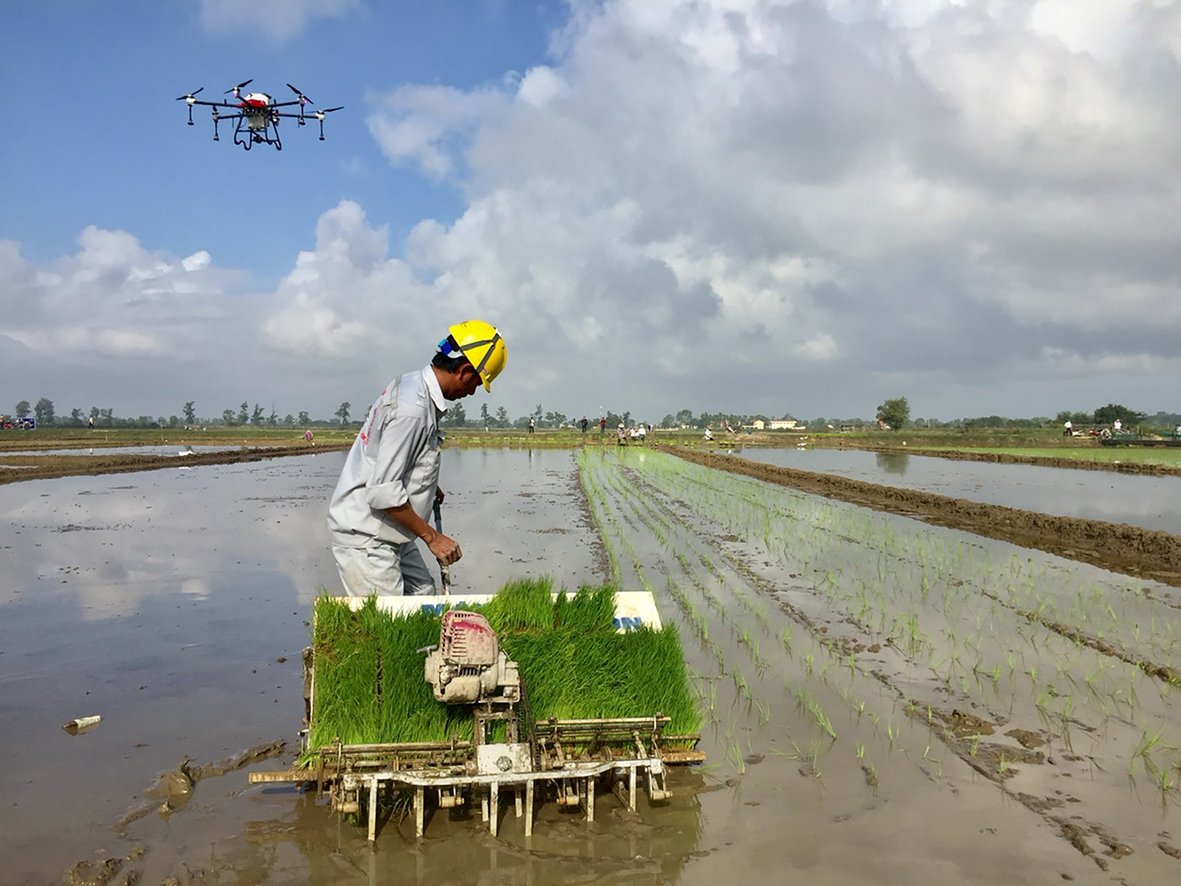
Using a rice transplanter in the fields of Hai Que commune, Hai Lang district - Photo: D.T.
The early days were difficult.
Let me begin the story of rice cultivation in Hai Lang with an important event for the land and people of this southernmost region of the province. At exactly 8:30 AM on May 18, 1990, a solemn rally was held at Hai Lang High School to celebrate the re-establishment of Hai Lang district.
This moment is made even more solemn and evokes special emotions in everyone, as the day Hai Lang celebrates the return of its original name coincides with the 100th anniversary of the birth of beloved President Ho Chi Minh on May 19th (1890-1990).
In his speech at the ceremony, District Party Secretary Hoang Xuan Hoa emphasized the field of agricultural development: Over the past nearly 15 years (from 1975 – the day Hai Lang district was liberated – to 1990), the face of the locality has gradually changed. Alongside successful examples of intensive farming in Long Hung, Dai An Khe, Vinh Thang, etc., several examples of intensive farming have emerged in low-lying areas such as Tho Bac, Hung Nhon, etc.
It must be acknowledged that the most pressing concern for the local government and people, both during the dry summer and rainy seasons, is that the heavily waterlogged lowlands, which occupy more than half of the district's area, have not yet been addressed with proactive irrigation; the lack of electricity for production, the incomplete irrigation system, and the underdeveloped state of commodity production...
Along with the re-establishment of the district, the immediate task for the locality is to focus on completing agricultural production plans, quickly harvesting the winter-spring crop, successfully implementing the summer-autumn crop, and launching the N2A irrigation project to proactively irrigate the fields.
At the ceremony, Chairman of the Quang Tri Provincial People's Committee Nguyen Buong also shared: The province knows that the district is facing many difficulties: flooding, monoculture, extensive farming, and almost no technical infrastructure; however, with the potential for agricultural development, the leadership and attention of the Party committees and authorities at all levels, and the tradition of diligence, hard work, and creativity of the people, Hai Lang will certainly make remarkable progress in the future...
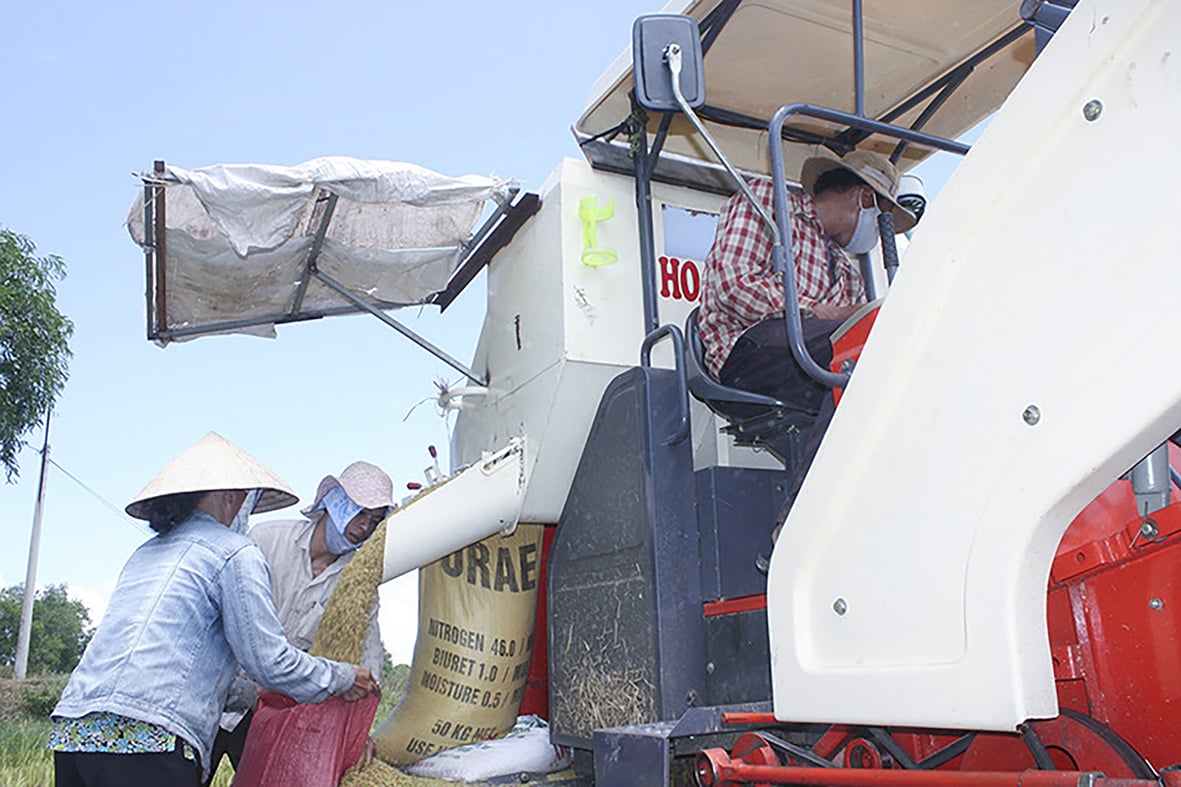
Farmers in Hai Lang harvest rice - Photo: D.T.
In his essay "Cactus Blooms in Thirst, on the Flooded Land of Hai Lang" published in the Quang Tri newspaper on May 17, 1990, author Nguyen Hoan reported that, at the time of the re-establishment of Hai Lang district, the entire district had approximately 5,500 hectares of rice fields, but only 1,500 hectares received irrigation water from the Nam Thach Han irrigation project during the winter-spring season and 1,000 hectares during the summer-autumn season.

According to the design, the N2A canal will irrigate 180 hectares of rice fields in Hai Phu, Hai Thuong, and Hai Lam communes, while irrigation water has not yet reached Hai Tho, Hai Truong, Hai Tan, Hai Hoa, and Hai Son communes, leaving their fields without water. The N6 canal only irrigates 800 hectares out of the 1,400 hectares designed for Hai Ba, Hai Que, and Kim Giao Cooperative (Hai Duong commune), and does not irrigate Hai Duong commune at all during the summer-autumn crop season.
Faced with the situation of 4,000 hectares lacking adequate irrigation for two cropping seasons, Hai Lang district has mobilized all resources to save the rice crop by utilizing local water sources and exploiting the advantages of rivers, ponds, and lakes to supply water to the rice plants; combining water pumping using diesel-powered and electric pumps with water wheels; and utilizing the Phuoc Mon and Phu Long reservoirs and the Khe Muong dam to quench the "thirst" of the vast rice paddies in Hai Son, Hai Truong, Hai Tho, Hai Thien, etc.
Nguyen Khac Chu, Director of the Department of Agriculture (in 1990), once stated that due to the unique topography of Hai Lang, which slopes from west to east, with hilly and coastal areas fragmented by rivers and streams, and some low-lying plains, organizing agricultural production faced many difficulties.
However, farmers in Hai Lang have strived to overcome this disadvantage by adopting new rice varieties and establishing a rational planting schedule to avoid early-season droughts, mitigate late-season floods, prevent lodging, improve disease resistance, and produce high-quality rice.
During the 1989-1990 winter-spring crop season, the Vinh Loi, Tho Bac, Van Nam, and Thuong Xa cooperatives, when switching to higher-grain-grade rice varieties (technical varieties), achieved 15-20% higher yields.
By 1990, the average yield of winter-spring rice in the entire district had begun to rise above 30 quintals/hectare. The main varieties introduced were CR203, IR36, MTL61, CN2..., which opened a new chapter in the rice fields of Hai Lang.
A flourishing harvest in the fields.
Since 2022, every harvest season, Mr. Ho Xuan Hieu, Chairman of the Board of Directors of Quang Tri Trading Corporation (Sepon Group), often invites me to Hai Que commune to watch rice farming. Collaborating with Kim Long Cooperative on organic rice farming, Sepon Group applies new techniques and technologies by providing technical guidance and field supervision throughout the production process. This includes machine transplanting, which is 10-15 times faster and reduces costs by 60-70% compared to manual transplanting; using high-quality organic fertilizers and fertilizer application machines to reduce labor for farmers; and producing indigenous microorganisms and biological preparations to protect and care for the rice plants.
In addition, the company uses drones to spray biological pesticides on rice crops, reducing costs for farmers and protecting the rice plants from damage caused by trampling. The circular economy in organic rice farming is also vividly demonstrated through the application of straw baling machines with molasses composting right in the fields to maximize post-harvest utilization, protect arable land, and reduce environmental pollution. The molasses-composted straw is fed to cattle, the rice husks are used as biological bedding for chickens, and the chicken manure is then collected as organic fertilizer for the rice...
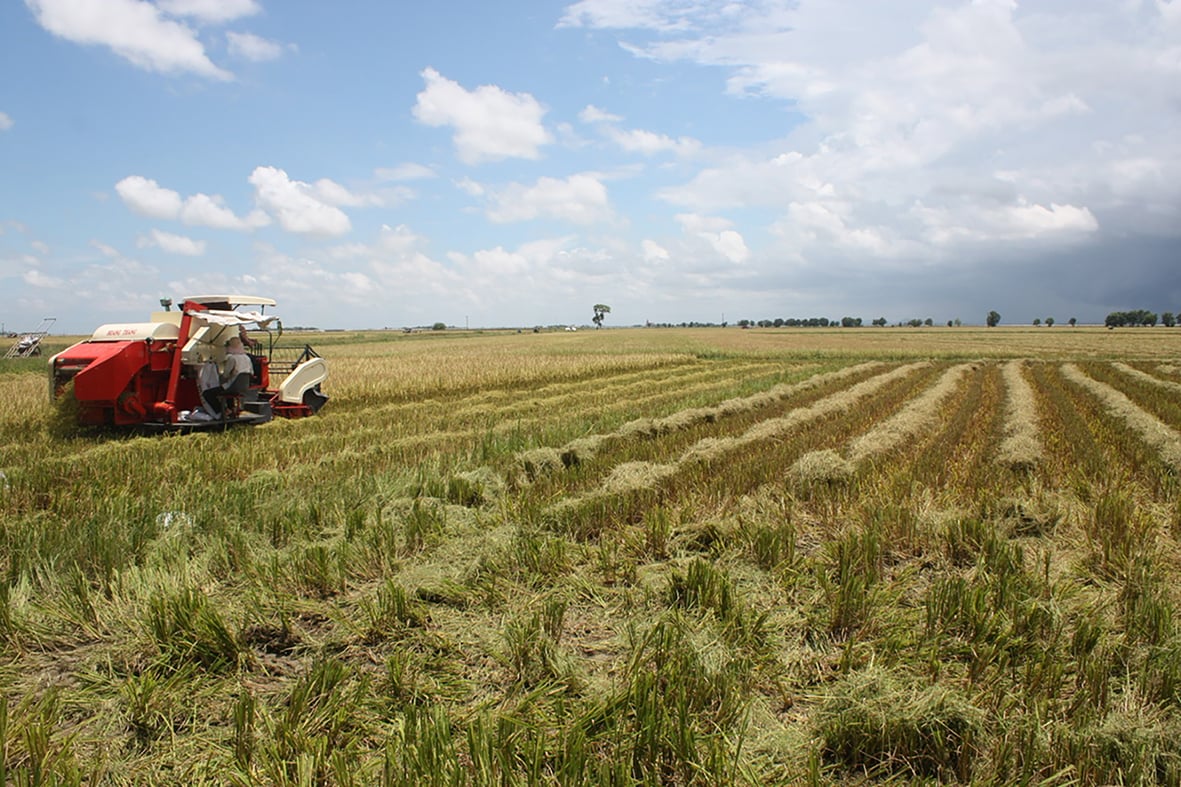
Large fields in the low-lying area of Hai Lang district - Photo: D.T.
For its part, to turn challenges into advantages, the district has focused on promoting agricultural production in all three regions: plains, hills, and sandy areas. The total rice cultivation area in 2024 reached 13,637.4 hectares (including 6,888.5 hectares in the winter-spring crop and 6,850 hectares in the summer-autumn crop). The main rice varieties were Khang Dan (30.2%), DBR 57 (23.9%), and the remainder were varieties such as An Sinh 1399, HN6, and HG 244. The average yield for the entire district reached its highest level ever, at 64.67 quintals/hectare (including 67.28 quintals/hectare in the winter-spring crop and 62 quintals/hectare in the summer-autumn crop). Rice production reached 88,188.4 tons. This year's bumper crop and favorable prices have created additional motivation for farmers to produce.
A highlight in rice production in Hai Lang district today is the focus on expanding the area of high-quality rice cultivation to 9,527.6 hectares; the area of large-scale rice farming to 1,695.1 hectares; and the production of local rice seeds to 524.7 hectares. The district continues to promote organic farming (approximately 410 hectares), VietGAP certification, and linking rice production and consumption with businesses; 467.1 hectares have already been linked for consumption.
To effectively protect rice crops, the district regularly conducts pest and disease forecasting and provides timely and effective guidance on control measures. It promotes the application of effective pesticide solutions in production, such as the Integrated Crop Health Management (IPHM) program, which has contributed to crop protection, soil degradation control, and the health of humans, animals, and the ecological environment in production. It encourages the application and widespread use of unmanned aerial vehicles (drones) for pesticide spraying; and the use of indigenous microorganisms, biological preparations, and herbal remedies in pest and disease control. It directs the timely handling of newly emerging rice pests and diseases in some areas, contributing to improved control effectiveness and the protection of rice yield and production in both seasons. Over 87.5 hectares of rice in the district utilize drones for pest and disease control.

The application of unmanned aerial vehicles (drones) has reduced production costs, decreased labor, and protected human health and the environment. The increased mechanization in land preparation and rice harvesting has contributed to accelerating production and harvesting, ensuring successful harvests.
On the eve of the Lunar New Year 2025 (Year of the Snake), Hai Lang district has set the goal of achieving a production value of over 126 million VND/hectare; and a total grain production of over 84,000 tons. The district aims to stabilize rice cultivation at 13,450 hectares, using high-quality rice varieties. The main rice varieties will include: Khang Dan, An Sinh 1399, HN6, DD2, Ha Phat 3...; and expand the cultivation of promising varieties such as: Bac Thom 7, DV 108, VNR 20, JO2, TBR 97, TBR279, ST 25, QR1, DQ11, HG 12, ADI28... The area for rice seed production will be 500 hectares, and the area for high-quality rice production will be 9,500 hectares. Arrange rice planting by region so that the rice plants flower in concentrated batches, allowing for better pest and disease management and facilitating land preparation and irrigation. Continue to promote land consolidation and the development of large-scale farming areas...
It's worth remembering that in early 2022, an unusual flood occurred from March 31st to April 2nd in the province. As the saying goes, "The heavens bring a flood in March; those who have rice seeds should mill them and eat them gradually...", this was an extreme and unusual flood, unprecedented in recent years, and occurred during the time when winter-spring crops were forming their yields, causing severe damage to agricultural production. Many key production areas in the province were completely destroyed, affecting the lives and livelihoods of the people. The entire area of organic rice cultivation that Sepon Group implemented at Kim Long Cooperative is located entirely within the "flood epicenter" of the low-lying Hai Lang region.
However, thanks to the efforts of local authorities, the management boards of agricultural cooperatives, and farmers, manpower and resources were mobilized to save the rice crop. Many measures such as building embankments and concentrating pumps to combat waterlogging and flooding were urgently implemented. Businesses also actively participated, working alongside farmers to protect the rice fields, so when the floodwaters receded, the rice plants still had enough strength to grow well, resulting in a bountiful harvest.
This is the solution to the "problem" of growing rice sustainably in the severely flooded areas, a problem that the leaders and people of Hai Lang district had been grappling with and worrying about for nearly 35 years...
Dan Tam
Source: https://baoquangtri.vn/chuyen-ve-cay-lua-o-hai-lang-190937.htm