

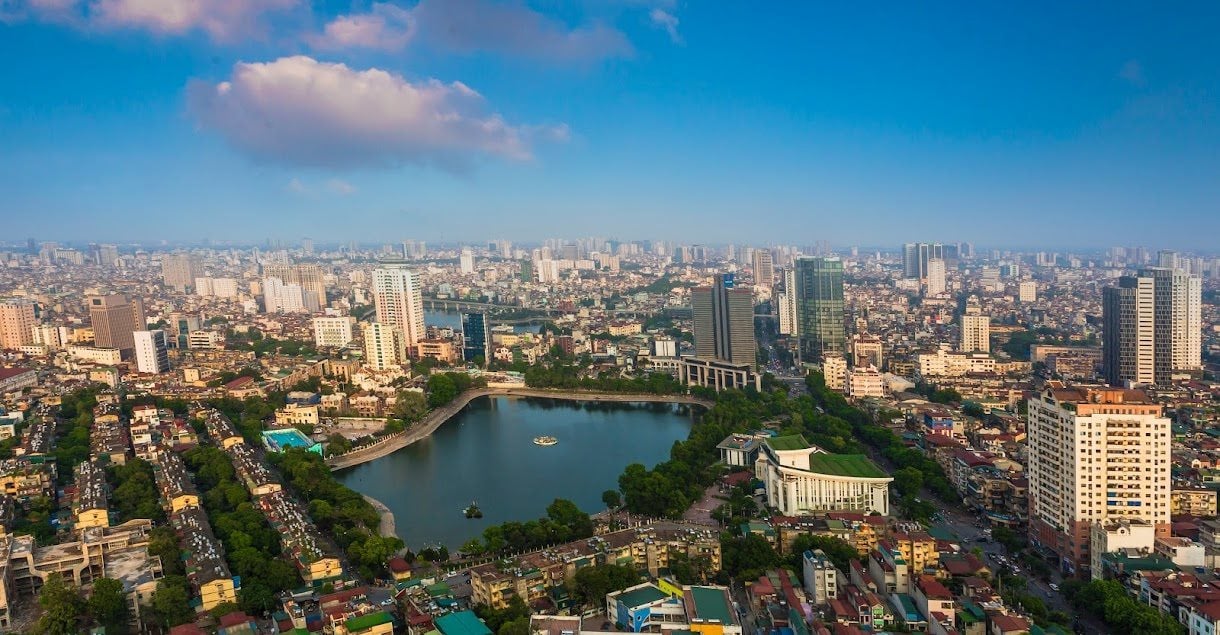
Development vision
Hanoi is not only the center of political , economic, cultural, and educational activities, but also a symbol of the country's development, unity, and prosperity. It is considered the heart of the nation, where all important aspects of life converge and spread throughout the country. Resolution No. 11-NQ/TW of the Politburo of the 11th Party Congress on the direction and tasks for the development of Hanoi Capital City in the period 2011-2020 has achieved many outstanding accomplishments, making significant contributions to the cause of national construction and defense. The economy has maintained relatively strong growth, averaging 6.83% per year; GRDP per capita in 2020 reached US$5,325, 2.3 times higher than in 2010.
However, alongside the achievements and successes, Resolution No. 15-NQ/TW on the direction and tasks for the development of Hanoi Capital City until 2030, with a vision to 2045, issued by the Politburo, clearly stated that Hanoi has not yet clearly demonstrated its role as the center and driving force for growth and development of the Red River Delta region, the key economic region of Northern Vietnam, and the whole country. Its competitiveness remains low, especially compared to the region and the world. Economic and social infrastructure development has not met the requirements; planning, planning management, land management, construction, urban development, traffic order and safety, and environmental protection are still limited; economic and social development, and urban development are not comprehensive and lack synchronization. The development of culture, society, and the building of Hanoi's people have not truly lived up to the role, position, potential, and historical and cultural foundation of the capital city's thousand-year history.
Therefore, in Resolution 15, the Politburo set the goal that by 2030, Hanoi will be a "Cultural - Civilized - Modern" city, becoming the center and driving force for the development of the Red River Delta region, the Northern key economic region, and the whole country. It will achieve deep international integration, high competitiveness with the region and the world, and strive to develop to the level of capitals of developed countries in the region. The average GRDP growth rate for the period 2021-2025 will be higher than the national average; GRDP for the period 2026-2030 will increase by 8.0-8.5% per year; and GRDP per capita will reach 12,000-13,000 USD.
Regarding the vision for 2045, Hanoi aims to be a globally connected city with a high standard of living and quality of life, achieving a GRDP per capita of over US$36,000; with comprehensive, distinctive, and harmonious economic, cultural, and social development; a model for the whole country; and a level of development comparable to that of capitals in developed countries in the region and around the world.
Therefore, to achieve the above goals, truly special mechanisms are needed to enable the capital city to reach its full potential. This is being addressed in the draft Law on the Capital City, which is currently being considered and passed by the National Assembly at its 7th Session, 15th National Assembly, on June 27th. In addition, alongside the draft Law on the Capital City, the Hanoi Capital City Planning for the period 2021-2030, with a vision to 2050, and the Adjusted General Planning of Hanoi Capital City to 2045, with a vision to 2065, are also being submitted to the National Assembly for consideration at the 7th Session.
"Unleash" the system and the people.
However, what mechanisms can truly "unleash" the capital, remove obstacles, and enable Hanoi to achieve breakthroughs is a matter of great concern. Perhaps the first issue that needs to be addressed is the administrative apparatus and the people – the decisive factors in determining success or failure.
National Assembly Deputy Tran Chi Cuong (Da Nang delegation) believes that granting cities the autonomy to decide and take responsibility for ensuring the conditions for establishing, reorganizing, and dissolving specialized agencies and administrative organizations under the city and district governments is essential to create a flexible, efficient organizational structure that suits the management requirements of each stage.
According to National Assembly Deputy Khuong Thi Mai (Nam Dinh delegation), the draft revised Law on the Capital City contains many provisions that strongly strengthen decentralization and delegation of power to the Hanoi City government in several areas, promptly institutionalizing the directives and conclusions of the Central Committee and the Politburo. This decentralization and delegation of power provides a legal basis for the Hanoi City government to be more proactive and decisive in reforming, restructuring, and organizing the government apparatus towards a streamlined, rational, modern, and effective operation to fulfill the assigned tasks and powers as required by the Politburo.
Meanwhile, Mr. Ta Dinh Thi, Vice Chairman of the National Assembly's Committee on Science, Technology and Environment, argued that the regulations on science and technology development and innovation policies in the draft law are truly outstanding and groundbreaking policy contents. According to Mr. Thi, this outstandingness lies in allowing higher education institutions, vocational education institutions, and other public science and technology organizations in Hanoi to establish businesses and permitting their employees to participate in the management and operation of these businesses, provided they obtain the consent of the heads of those organizations.
Based on current practices, higher education institutions, as well as science and technology institutions, institutes, and schools, have enormous potential to form circular ecosystems between research, technology transfer, and commercialization of products. Simultaneously, they can reinvest in research and development, especially maximizing the vast scientific and technological potential of the capital city.
“Currently, the capital city is home to 80% of public higher education institutions and science and technology organizations, and 70% of the country's total number of scientists with doctoral degrees or higher. We have seen very rapid development of the startup and innovation university model. With the rapid development of science and technology, product lifecycles and production cycles are very fast. These regulations ensure we keep pace with that trend,” Mr. Thi said.
Also related to the human factor, National Assembly Deputy Tran Thi Van (Bac Ninh delegation) argued that the regulation allowing public preschool and primary education institutions in Hanoi to conduct educational partnerships with foreign educational institutions would help students integrate within their own country, give teachers the opportunity to access advanced teaching methods, and reduce costs for parents compared to sending their children abroad for studies.
Controlled testing, prioritizing the right to cut off electricity and water.
Controlled testing is also a new feature considered a breakthrough for Hanoi this time. National Assembly Deputy Pham Trong Nghia (Lang Son delegation) highly appreciated the controlled testing mechanism. This is the first regulation at the law level to address this extremely important issue, responding to the requirements of scientific and technological development.
One prominent issue that has received attention and agreement is the regulation allowing, in cases where it is absolutely necessary to ensure security, order, and social safety in Hanoi, the Chairman of the People's Committee at all levels to apply measures to request the suspension of electricity and water services for construction projects and business establishments.
According to National Assembly Deputy Le Hoang Hai (Dong Nai delegation), Hanoi has recently experienced several tragic incidents involving fires in residential buildings and production and business establishments, causing significant loss of life and property. Therefore, if violations are not addressed and resolved decisively, it will be difficult to control the resulting damage. Suspending electricity and water services may not be the most drastic and thorough measure, but given the high demands for social order and safety in the capital, this is a necessary and prioritized measure. This is considered an initial preventative step, demonstrating the commitment and responsibility of all parties involved in ensuring safety and order in the city.
Regarding the cutting off of electricity and water to illegally constructed buildings, Mr. Tran Sy Thanh, Chairman of the Hanoi People's Committee, stated that this is an extremely pressing issue. For example, with buildings exceeding the permitted number of floors or lacking fire safety measures, the best way to stop the violations is to cut off electricity and water, and halt construction until residents move in. The solution is to address the issue before residents move in. Because if residents have already moved in, it will be difficult to relocate them. Therefore, for these violations, electricity and water must be cut off to prevent residents from moving in. "This power is not to be arbitrarily delegated but is reserved for the Chairman of the commune or district to decide. This power aims to protect the lives of the people," Mr. Thanh said.
Article 6 of Regulation No. 131-QD/TW clearly states: The responsibility of leaders, heads of agencies, organizations, inspection, auditing, and related individuals when failing to perform the acts stipulated in Article 4. Article 7 of the Regulation outlines the responsibilities of other organizations and individuals. It emphasizes the following: Strictly prohibiting the following acts: Unlawfully interfering with inspection, supervision, disciplinary enforcement, inspection, and auditing activities; abusing one's influence to affect those performing inspection, supervision, disciplinary enforcement, inspection, and auditing duties; establishing relationships to bribe or corrupt individuals with responsibility, positions, authority, or related parties for the purpose of covering up crimes or evading responsibility for violators. Abusing one's position, authority, or using one's own and family's prestige and influence to suggest, influence, or pressure competent authorities to make decisions or provide advice, recommendations, comments, assessments, or votes on conclusions and decisions regarding inspection, supervision, disciplinary enforcement, party inspection, and auditing that do not reflect the true nature of the matter. Providing inaccurate, dishonest, incomplete, untimely, or biased reports related to inspection, supervision, disciplinary enforcement, party inspection, and auditing. Other acts of corruption and misconduct related to inspection, supervision, disciplinary enforcement, party inspection, and auditing.
Source: https://daidoanket.vn/co-che-dac-thu-de-ha-noi-but-pha-10283934.html
![[Photo] The courage of new recruits of Brigade 144 on the training ground.](https://vphoto.vietnam.vn/thumb/1200x675/vietnam/resource/IMAGE/2026/05/27/1779881651341_anh-man-hinh-2026-05-27-luc-18-32-52.png)

![[Photo] The heat at the fireworks display site on the opening night of the Da Nang International Fireworks Festival 2026](https://vphoto.vietnam.vn/thumb/1200x675/vietnam/resource/IMAGE/2026/05/27/1779889741485_ndo_br_z7872039145157-fecaba5112f39e8352544099d7ef4738-5140-jpg.webp)






















































![[Photo] The courage of new recruits of Brigade 144 on the training ground.](https://vphoto.vietnam.vn/thumb/402x226/vietnam/resource/IMAGE/2026/05/27/1779881651341_anh-man-hinh-2026-05-27-luc-18-32-52.png)



























Comment (0)