

SGGP
The Standing Committee of the Government has just issued a conclusion stating that online gaming services will not be subject to special consumption tax. This announcement not only alleviates concerns for Vietnamese online gaming businesses but also creates opportunities for the gaming industry to develop, aiming to support its growth and make a positive contribution to social development.
Vietnamese businesses face fierce competition.
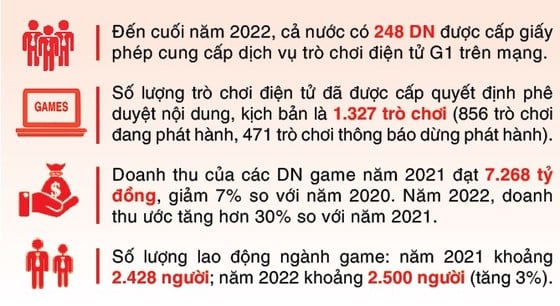
According to data from the Department of Broadcasting, Television and Electronic Information (Ministry of Information and Communications), only 15% of the 200 registered game companies are still operating in Vietnam. Meanwhile, unlicensed cross-border games generate 5 trillion VND in revenue annually, accounting for 30% of the game publishing market in Vietnam.
“Vietnam has great potential for developing the gaming industry, but it faces many prejudices and is not truly encouraged to develop. Therefore, domestic businesses encounter many difficulties and their development speed is limited. For many years, domestic game businesses have had to endure extremely fierce competition from global game and technology corporations, gradually losing their competitiveness in their own market,” said Mr. Nguyen Trong Nghia, representative of the Vietnam Game Producers and Publishers Alliance.
 |
| A conference connecting businesses in the gaming industry was organized by the Department of Broadcasting, Television and Electronic Information (Ministry of Information and Communications). |
Globally, the gaming industry is a cornerstone of the digital content and digital economy . According to estimates from Newzoo, total global gaming revenue reached $184 billion in 2022 and is projected to reach $194 billion in 2023. Vietnam and other Southeast Asian countries are considered emerging markets, with a large and rapidly growing internet user base. The average annual growth rate of gaming revenue in Southeast Asia from 2020-2025 is 8.2%, while in Vietnam it is nearly 9%, making it highly attractive to foreign gaming companies. Many developed countries view the gaming industry as a key pillar in the development of the digital economy. The gaming industry's activities also impact the revenue of other supporting products such as IT personnel, content creation, design, advertising, hardware (PCs, mobile phones, processors), and telecommunications networks.
The leader of a game production company stated that producing or releasing games for Vietnamese businesses in the domestic market is not very difficult, but the problem lies in fulfilling all obligations to the State and competing with foreign companies, which do not have to fulfill any obligations. This is also one of the reasons why only about 15% of registered Vietnamese game companies are still operating, while 85% have ceased operations or moved abroad to benefit from policies regarding procedures, infrastructure, tax rates, etc.
The Ministry of Information and Communications aims for the Vietnamese gaming industry to achieve a revenue of $1 billion USD within the next five years, with the number of publishers reaching 100-150 companies, and attracting approximately 400 new startups in this field.
Restrict cross-border gaming.
To promote the development of the domestic gaming industry, on July 24th, the Government Office announced the conclusions of the Standing Committee of the Government regarding draft laws and proposed legislation. According to this announcement, online gaming businesses will not be subject to excise tax for the time being. According to Mr. Thai Thanh Liem, CEO of Topebox game studio, this is something that domestic gaming businesses have been waiting for. “If excise tax is applied to games, domestic businesses will tend to relocate to overseas companies like Singapore, then provide cross-border online gaming services into Vietnam to avoid high taxes. On the other hand, applying excise tax will not encourage domestic gaming businesses to increase investment and development, while this is one of the few industries with great potential,” Mr. Thai Thanh Liem shared.
Meanwhile, according to experts, for the domestic gaming industry to develop, the prevention of illegal cross-border games must be more decisive. At a recent conference on implementing solutions for managing payment channels for games, chaired by the Ministry of Information and Communications, delegates argued that illegal cross-border games dominate the domestic market because payment for games is now easy through many methods, and payment intermediaries do not proactively check, or even fail to check, leading to the deposit of money into illegal games and gambling. According to Deputy Minister of Information and Communications Nguyen Thanh Lam, the Ministry of Information and Communications will coordinate with the Ministry of Public Security and the State Bank of Vietnam to take measures to prevent illegal games. Specifically, the Ministry of Information and Communications will require organizations and businesses providing intermediary payment services to implement solutions to prevent, and not connect with or process payments for illegal games through their payment systems or when requested by state management agencies.
 |
* Mr. TRAN PHUONG HUY, Director of VTC Intecom: Good management is better than applying special consumption tax policies.
The goal of imposing excise tax is to regulate consumer behavior and increase state revenue, but applying this tax to the gaming industry is completely different. According to data from the Vietnam Gaming Alliance, out of every 100 online gamers, fewer than 10 pay (exactly 5.8), with 90% of players not paying. This means that regulating the behavior of tax collectors is only regulating the behavior of 5.8 people, a very small number, and cannot achieve the goal. Even before the excise tax was imposed, consumers were already using foreign services; therefore, imposing a tax on the online gaming industry is inadvertently increasing unfair competition, leading to reverse protectionism for foreign game companies.
Globally, China and South Korea have implemented behavioral regulation measures by creating a connection between the government and relevant businesses regarding user information through citizen identification cards and registered phone numbers. Since 2010, China has clearly stipulated how long players are allowed to play, specific time slots, and payment amounts, depending on age. This has effectively controlled gaming, resulting in 70% of minors playing games for less than 3 hours per week, and a 32% reduction in the number of young gamers (from 122 million to 82 million in 2020). Vietnam could apply the successful lessons from China and South Korea. If we add regulations for issuing chip-embedded citizen identification cards to those under 14 years old, requiring minors to submit verification requests to the management agency when creating online gaming accounts, it will help the State and businesses manage online gaming accounts more effectively, thereby managing and controlling consumer behavior instead of applying excise tax policies.
* Mr. La Xuan Thang, Director of Online Game Publishing at VNG: A positive and trend-following perspective.
In countries like the United States, Japan, and South Korea, online gaming is not only recognized as an important economic sector but is also identified as a key area for cultural export. Recently, several countries such as Singapore and the United Arab Emirates have implemented policies to attract gaming corporations and companies to establish headquarters and operate there.
Gaming is an intellectual industry with high creative potential, a place where new technologies such as blockchain, VR, virtual learning, and esports—a sport recognized by the Olympic Committee as an official competition at major sporting events—should be viewed positively and in line with current trends. In Vietnam, online gaming is a conditional business, requiring content review by specialized state management agencies to ensure compliance with content requirements before market release and always including age classifications and user warnings. Meanwhile, most unhealthy and deviant content comes from games illegally distributed in Vietnam, not regulated by specialized agencies, and not paying any taxes to Vietnam. In recent times, state management agencies have made many efforts to prevent this situation, but no feasible solution has yet been found.
BINH LAM - KIM THANH wrote
Source











































































































Comment (0)