

About fifteen years ago, when he was 80 years old, Mr. Tran Kien invited a few of us to visit the old war zone where he had fought in the Ba To guerrilla army. You have to see him standing in the forest where he used to train, see him wielding a machete, swiftly cutting down trees to clear a path, to truly feel the guerrilla spirit within him.
There are countless anecdotes about Mr. Tran Kien, but as someone who served in the Truong Son Mountains during the resistance war, I vividly remember the story soldiers told each other about a special order he gave. It was a requirement that anyone passing through military outposts who dug up cassava (tapioca) to eat had to cut down the cassava plants and replant them afterward, so that those who came after would have food when they were hungry.
I think that if someone didn't have the spirit and calculating mind of a guerrilla fighter who was all too familiar with hardship, they would never have come up with such an order.
Throughout his life, Mr. Tran Kien held only one guiding principle: How to ensure that ordinary soldiers could live and fight to the best of their ability under the given conditions, and how to ensure that every ordinary citizen had their basic material and spiritual needs met so that they could live like normal human beings.
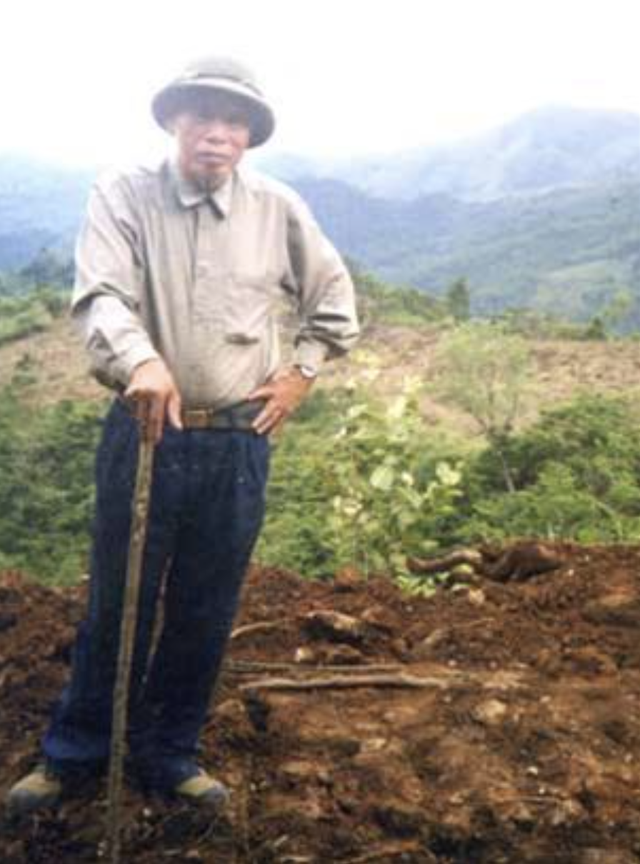
Throughout his revolutionary career, what Tran Kien was most proud of was the "Ba To Guerrilla Movement".
PHOTO: TL
Once, during a lighthearted conversation, Mr. Kien told me that when he was the Party Secretary of Dak Lak province, he mobilized many truck convoys to Ho Chi Minh City to transport... waste, which he then brought back to Dak Lak to fertilize coffee plants in the coffee plantations. And from there, he built the famous Dak Lak coffee-growing region that we know today.
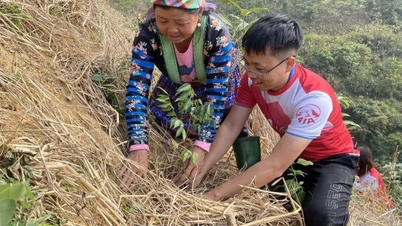
From his "three-tiered ecological" experiments to his dreams of scientifically and effectively transmitting farming and livestock techniques to ethnic minority communities—people who had made countless sacrifices to support the revolution during difficult times—Mr. Kien infused every task, however small, with a great love: love for the people, love for the poor and suffering.
Shortly before his death, Mr. Kien had traveled to Ba To (a mountainous district in the southwest of Quang Ngai province) many times, to the Central Highlands, and to remote villages in western Quang Ngai to meet with people of various ethnic groups.
One must see Mr. Tran Kien sitting among the poor to understand why ordinary people consider him one of their own. Not every leader is so fortunate, to be trusted and loved by the people in this way.
Born into a peasant family, a farmer turned revolutionary, Mr. Tran Kien dedicated his life to self-education. He learned from revolutionary practice and from books, but always compared those books to reality, using practice as a benchmark for what he learned. Mr. Tran Kien became an exemplary figure for those who pursued self-education.
Without hiding his ignorance, but also without any self-doubt, Mr. Kien, as a leader, made bold decisions that not every educated person could think of, and he also dared to persevere with his decisions.
Perhaps it's rare to find a leader who has held the highest official position like Mr. Kien, a high-ranking official who, upon retirement, lives peacefully in such a small house. A simple, one-story house. Looking at the photo of Mr. Tran Kien on a field trip to the highlands, I realize that it is the true portrait of a Ba To guerrilla fighter.
That's the kind of person Mr. Tran Kien was. He wasn't someone who lived honestly just to "gain a reputation" for himself. He lived honestly for his people. He was pure for his people, because he wanted to be worthy of them. He placed that purity and honesty on a constant: the people.
But I respect and admire him for another reason: he is an example for me, and certainly not just for me, of how a person who loves their people and has vowed to live for their people should live.
A historical legacy and an enduring spirit.
Eighty years ago, on March 11, 1945, the Provisional Provincial Party Committee of Quang Ngai led the people in a successful Ba To uprising, seizing revolutionary power and establishing the Ba To Guerrilla Team. This was the first partial uprising in the country, laying the groundwork for the successful August 1945 General Uprising to seize power.
Ba To is a strategically located area with a tradition of patriotism. It was where the colonialists established a detention camp to imprison revolutionary fighters, but it inadvertently became the center of leadership for the revolutionary movement in Quang Ngai.
The Ba To Uprising took place precisely at the time of the Japanese coup against the French (March 9, 1945). Seizing the opportune moment, in just one day, or rather, in just a few hours, on the night of March 11, 1945, the Ba To Uprising broke out, achieving complete victory without bloodshed.
The uprising affirmed the spirit of sacrifice for the Fatherland, continues to spread historical values, and serves as a driving force for building a sustainably developed Quang Ngai in the new era.

![[Photo] Conference announcing the Politburo's Decision on organizational and personnel matters](https://vphoto.vietnam.vn/thumb/1200x675/vietnam/resource/IMAGE/2026/04/01/1775017881825_bnd-2410-1472-jpg.webp)
![[Photo] Conference on the transfer and reception of Party organizations and Party members between the Party Committee of the Government and the Party Committees of the Central Party Agencies](https://vphoto.vietnam.vn/thumb/1200x675/vietnam/resource/IMAGE/2026/04/01/1775036784472_ndo_br_bnd-2620-jpg.webp)






























![[Photo] Prime Minister Pham Minh Chinh receives the Ambassador of the Russian Federation to Vietnam](https://vphoto.vietnam.vn/thumb/402x226/vietnam/resource/IMAGE/2026/04/01/1775046774818_anh-man-hinh-2026-04-01-luc-19-32-33.png)















Comment (0)