Following debates over banning children's access to social media in many countries, the province of Manitoba (Canada) recently proposed a ban on children's access to AI chatbots. This move immediately sparked mixed reactions, especially since previous bans on children's social media use have not shown clear effectiveness. In the context of AI increasingly penetrating schools and daily life, the question is not just "Should we ban it?", but also: "Should children be protected from AI, or should they be taught how to use this technology effectively?"

Children are using AI to help with their homework. Photo: PC Mag
When AI becomes the new "classmate"
Currently, the use of AI by students has become common in many parts of the world. According to a Pew Research survey, about 64% of American teenagers have used AI chatbots, with nearly one-third using them daily.
Many students use AI to search for information, get explanations of lessons, practice foreign languages, or get help with homework. For many students, AI chatbots are like a "24/7 tutor," always ready to answer questions without getting annoyed or tired, and without making them feel embarrassed to ask.
On the positive side, AI clearly offers undeniable benefits.
In the context of increasingly personalized education , many experts believe that AI can help students access knowledge at their own pace and according to their individual needs. A slow learner could receive repeated explanations without feeling pressured. Students in areas lacking teachers or with limited learning resources would also have better access to support.
The problem is, the more useful AI becomes, the more worried adults become.
What makes adults feel insecure?
One of the biggest concerns is that AI could gradually diminish children's ability to think independently.
When chatbots can write paragraphs, create essay outlines, or summarize books in seconds, the "struggle" with knowledge—a crucial part of the learning process—risks being shortened or completely eliminated.
Many educators believe that it is during the process of brainstorming, revising a paragraph, or trying to solve a difficult math problem that children develop critical thinking and reasoning skills. If AI does most of that work for them, children may learn faster, but their thinking abilities will be limited.



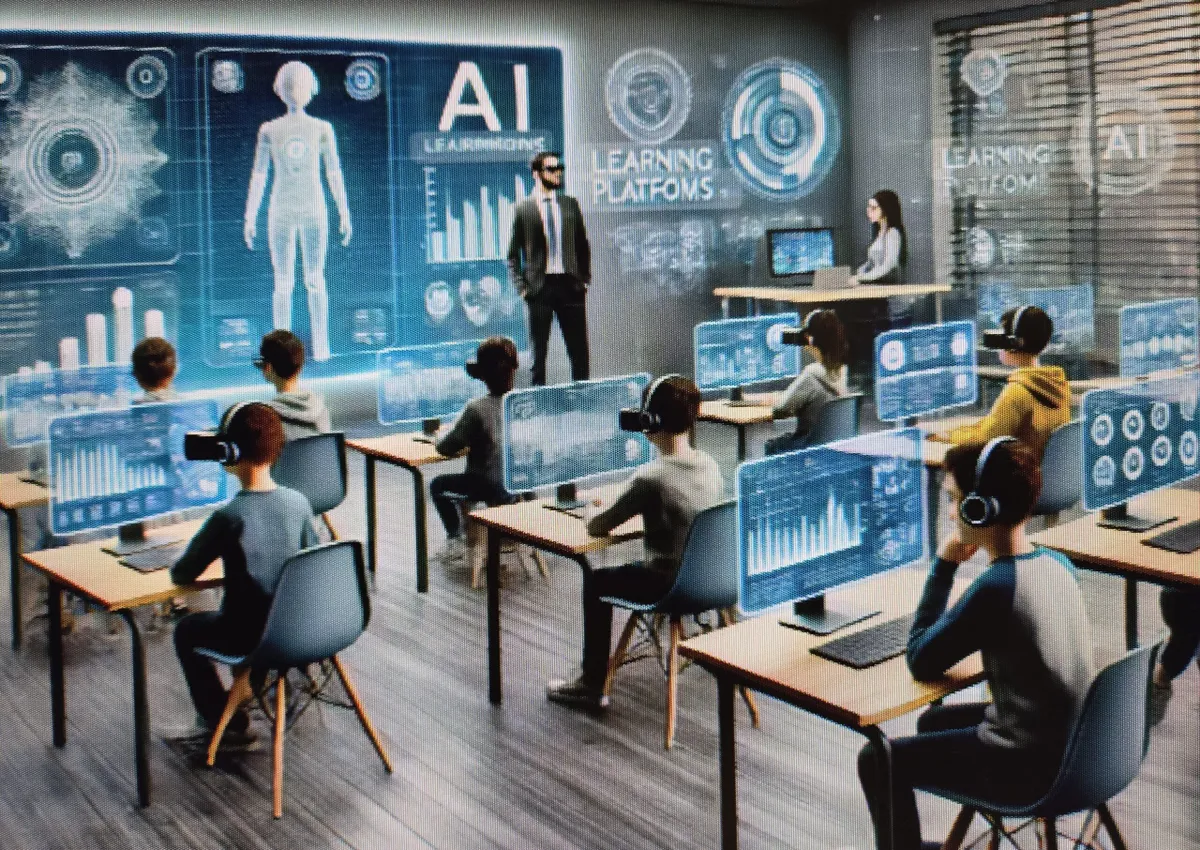
AI classroom. Photo: USDLA
Some psychologists are also concerned about the social impact of AI chatbots. Unlike real-life friends, chatbots typically don't disagree, argue, or rarely annoy users. They tend to agree and cater to the emotions of their interlocutors.
That might seem convenient, but it has led many researchers to worry that children will become accustomed to a "frictionless" style of communication.
Meanwhile, social maturity often comes from real-life experiences: arguing with friends, disagreeing with others, or learning to accept negative emotions.
Notably, several studies in the US have shown that many children admit to preferring to chat with chatbots rather than with real-life friends. Some children are also beginning to feel overly dependent on AI.
Therefore, many parents view AI with the same mindset as social media in the past.
Will prohibition be effective?
The reality is that previous technology bans haven't always been effective. As many countries tighten restrictions on social media use among teenagers, a significant number of young people still find ways to bypass age verification systems to continue using the platforms they want.
With AI, this can be even more difficult to control. Artificial intelligence technology is becoming increasingly prevalent, from search engines and learning software to browsers, smartphones, and even classrooms. Many schools have now integrated AI into their teaching, while tech corporations constantly promote AI as an essential skill of the future. This makes it nearly impossible to keep children away from AI applications.
Furthermore, some experts argue that an absolute ban could even be counterproductive. The more AI is perceived as "forbidden fruit," the more likely it is to pique the curiosity of young people.
Furthermore, not all impacts of AI are negative. If used correctly, AI can support more effective creativity, research, and learning. For many students, chatbots are simply a new tool – much like handheld calculators or the internet were before.
Perhaps that's why more and more experts are arguing that the issue isn't about "whether or not to ban AI," but rather how to teach children to use this technology in a healthy and responsible way.

The use of AI assistance for homework is becoming increasingly common among children. Photo: Getty Images



What children really need
In debates about AI, one idea is being mentioned more and more: "digital autonomy"—that is, the ability of humans to control how technology appears in their lives, rather than letting technology dictate their behavior.
For children, this can start with basic skills such as knowing when to use AI and when to do things themselves; knowing how to verify information provided by chatbots; understanding that AI is not always accurate; and most importantly, not letting technology completely replace real-life experiences.
Many education experts believe that children currently don't need more moral lectures about technology. What they need more is perhaps the support of adults, from parents and teachers to schools, in talking to them, setting limits, and guiding them on age-appropriate use of AI.
Source: https://vtv.vn/co-nen-cam-tre-em-su-dung-ai-100260624170742324.htm





![[Photo] "Hanoi Lotus Festival" honors the lotus flower that has been associated with Vietnam for thousands of years.](https://vphoto.vietnam.vn/thumb/1200x675/vietnam/resource/IMAGE/2026/06/27/1782516943048_sen-ha-noi-2026-minh-duy-1-jpg.webp)