The pressure of the new semester stems from the concerns of parents.
Many parents advocate for a push to resume learning from the beginning of July to prepare for the new school year. This group of parents believes that the past month of rest has been sufficient for children to recover their energy, and if they continue to relax for the next two months, students will forget all their previous knowledge, creating a significant gap when they enter the more advanced new curriculum. This is especially true for families with children preparing for school transitions or facing specialized exams; the pressure of competition is so intense that they cannot stand idly by and watch their children fall behind their peers.
Conversely, a significant number of parents have expressed opposition to cramming students with academic studies during this period. They share the reality that the pressure of studying throughout the nine months of the regular school year is already overwhelming, causing many children to experience prolonged physical and mental fatigue. Continuing to turn the summer into a third semester with a packed schedule of extra classes will rob children of their childhood, depriving them of opportunities to experience real life and develop essential survival skills.
A balanced approach to ensure summer doesn't become a burden.
Speaking to a reporter from the Health and Life Newspaper, Dr. Le Thi Huong, an education expert from Ho Chi Minh City University of Technology and Education, acknowledged that both viewpoints stem from parental love and concern for their responsibilities, but applying them in an extreme way can lead to undesirable consequences.



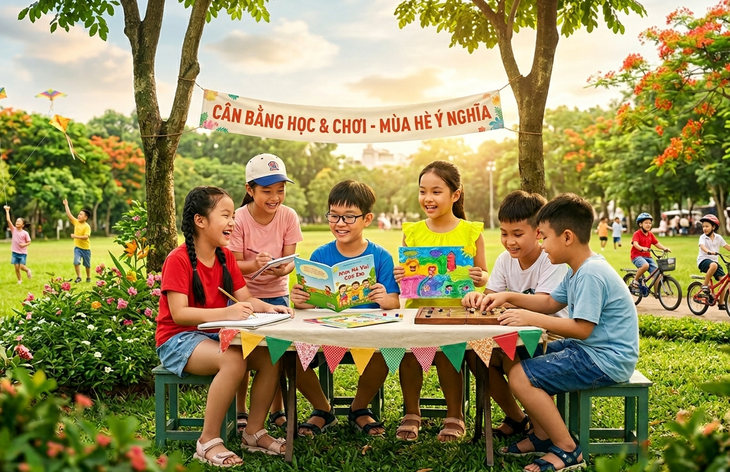
Before starting any plans, parents need to take the time to sit down and talk with their children, creating a summer schedule to ensure that children feel respected and responsible for their choices.
Analysts say that while supporting a break after nine months of intense studying isn't wrong, if children are completely undisciplined, allowed to stay up late, sleep in, and spend all their time in front of phone screens, the holiday will be distorted, completely disrupting healthy routines. Conversely, forcing children into a packed schedule of academic and foreign language classes at the beginning of July is actually a harmful mistake, confusing summer learning with extending the school year, depriving children of opportunities to develop practical skills beyond textbooks.
According to Dr. Le Thi Huong, the question of whether to choose a complete break from school or to send children to extra classes is not the core issue; the real problem is how to balance learning and playing to help children grow. The correct solution does not lie in choosing one of the two extreme options, but in a scientifically balanced approach based on each child's actual abilities and the specific circumstances of each family.
To solve this problem, experts suggest a practical four-step plan for parents during the remainder of the summer. First, parents need to take the time to sit down and talk, listening to their children's wishes to create a clear summer schedule that harmoniously blends gentle knowledge reinforcement, physical exercise, reading, and real-life experiences.
Next, the family must clearly assign someone to accompany and supervise the child to avoid haphazard implementation. Finally, principles regarding responsibility, rewards, and reminders should be agreed upon from the beginning so that the child learns to take responsibility for their choices.



Dr. Le Thi Huong stated that the greatest value after each holiday is not measured by the number of extra classes children attend, nor by the lax and undisciplined behavior they exhibit. A truly successful summer is when children enter the new school year with independence, good health, maturity, and full of positive energy.
Source: https://suckhoedoisong.vn/co-nen-cho-con-hoc-he-169260621214014374.htm



![[Photo] General Secretary and President To Lam receives Palestinian Ambassador Saadi Salama](https://vphoto.vietnam.vn/thumb/1200x675/vietnam/resource/IMAGE/2026/06/25/1782365384740_a1-bnd-9423-8322-jpg.webp)
![[Image] Ho Chi Minh City: Ma Lang area, Chicken-Rice Market about to change its appearance](https://vphoto.vietnam.vn/thumb/1200x675/vietnam/resource/IMAGE/2026/06/25/1782377698627_ndo_br_m1-jpg.webp)
![[Image] Schools organize meetings and introduce teaching models to students admitted to grade 10.](https://vphoto.vietnam.vn/thumb/1200x675/vietnam/resource/IMAGE/2026/06/25/1782368077271_ndo_br_z7970052192242-1ec8daeb77a6eed1a4e9f58c564ddd3e-jpg.webp)









![[GALLERY] Voidling Bound takes Steam by storm with 94% positive reviews.](https://vphoto.vietnam.vn/thumb/402x226/vietnam/resource/IMAGE/2026/06/25/1782396892878_tua-1-png.webp)