

My 10-month-old child has atopic dermatitis after birth, and applying various medications hasn't helped. Will bathing in seawater cure the condition? (Le Thu, Tay Ninh )
Reply:
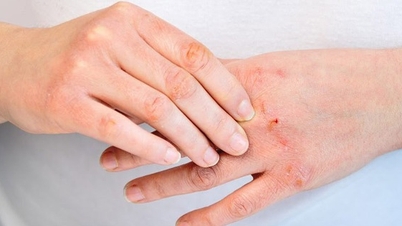
Atopic dermatitis (eczema) is a chronic inflammatory skin disease, commonly affecting children and adults. Children with the disease often present with red, dry, scaly, itchy, and burning skin, with many small blisters in the affected areas. They may also be fussy, irritable, and sometimes have poor appetite, sleep problems, and difficulty feeding.
The primary principle in treating atopic dermatitis is to identify and avoid triggering factors (gastrointestinal, respiratory, or contact allergies). Then, the doctor eliminates symptoms that cause discomfort to the child, such as reducing itching and inflammation, soothing the skin, preventing dryness, and treating infections with medication.
At this time, children's skin is often dry. Parents should apply moisturizing cream to soften the child's skin 2-3 times a day to prevent cracking and infection. If the baby's skin has many severe lesions, anti-inflammatory cream can be applied as prescribed by a doctor. When the swelling, redness, and itching subside, medication should be stopped, and moisturizing therapy should be intensified. Overuse of anti-inflammatory drugs can cause changes in skin color, thinning of the skin, increased hair growth, and a higher risk of infection. Children are treated with antibiotics when the skin becomes infected, oozing pus, fever occurs, lymph nodes swell, etc.
Several folk remedies are currently used to improve the symptoms of atopic dermatitis, for example, sea salt baths. However, the effectiveness of these treatments varies from patient to patient.

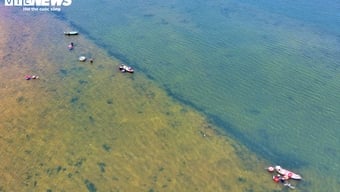
Proper sea bathing can help treat symptoms of atopic dermatitis. Photo: Freepik
Sea salt contains many minerals beneficial to the skin, such as magnesium, calcium, and potassium, which help reduce itching, inflammation, fight bacteria, and moisturize. Avoid swimming in the sea for more than 15 minutes, and do not swim in the early morning when it is too cold or between 10 am and 3 pm when it is too hot.
After bathing in seawater, parents should rinse their child with clean water, then dry them thoroughly and apply moisturizing cream to protect their skin. This method can be applied 2-3 times a week, but not more often. Salt has a mild exfoliating effect; frequent bathing can still erode the skin and counteract the treatment.
Regular sea bathing may be suitable for those living near the coast. For families not living near the coast, parents can mix a little sea salt into a basin of warm water, let the child bathe, and then rinse with clean water. If the child feels comfortable and the itching subsides, parents can let the child bathe 2-3 times a week. Refined salt, sea salt, or saline solution should be used.
This method only helps treat symptoms. Therefore, parents should take their children to a medical facility for examination to determine the severity of the condition. In fact, this method is not suitable for all cases of atopic dermatitis. For patients with dry skin, using high-concentration saline solution may worsen dryness, itching, and inflammation.
Dr. Dao Do Thi Thien Huong
Pediatrics Department, Tam Anh General Hospital
| Readers can post questions about children's illnesses here for doctors to answer. |
Source link
![[Photo] The General Secretary, President and his wife meet with Vietnamese-Chinese friendship leaders.](https://vphoto.vietnam.vn/thumb/1200x675/vietnam/resource/IMAGE/2026/04/15/1776264829725_vna-potal-tong-bi-thu-chu-tich-nuoc-to-lam-gap-mat-nhan-sy-huu-nghi-viet-nam-trung-quoc-8703641-3130-jpg.webp)
![[Photo] National Assembly Chairman Tran Thanh Man attends the opening session of IPU-152](https://vphoto.vietnam.vn/thumb/1200x675/vietnam/resource/IMAGE/2026/04/16/1776277863731_ctqh5-jpg.webp)
![[Photo] My Son at night: A thousand-year-old heritage site amidst the Milky Way](https://vphoto.vietnam.vn/thumb/1200x675/vietnam/resource/IMAGE/2026/04/15/1776261039184_ndo_br_chon6-jpg.webp)
![[Photo] Mrs. Ngo Phuong Ly meets and exchanges views with Mrs. Peng Li Yuan](https://vphoto.vietnam.vn/thumb/1200x675/vietnam/resource/IMAGE/2026/04/16/1776277858080_phu-nhan-1-jpg.webp)

















































































Comment (0)