

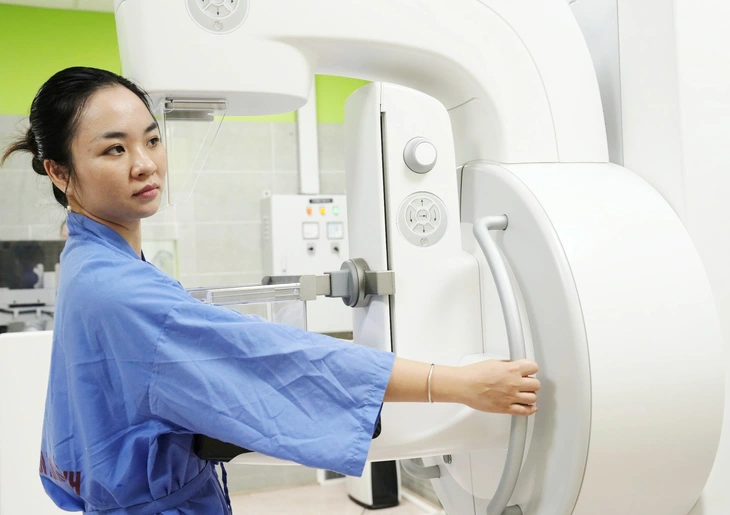
Mammography is a recommended method for early breast cancer screening - Photo: Provided by the hospital.
Can breast cancer be detected through X-rays?
According to doctors at Bach Mai Hospital, breast cancer in its early stages often progresses silently, with almost no obvious symptoms. Many people only discover it when the tumor has grown large or metastasized.
However, many cases of breast cancer are detected when the tumor is still very small, causing no pain or palpable abnormalities, thanks to routine mammograms. As a result, the mortality rate from breast cancer in women has decreased by 25-30%.
Experts say that mammography remains the most effective screening method for early detection of breast cancer, even when the lesion is only a few millimeters in size or not yet palpable clinically.
Accordingly, breast cancer is the result of a silent, long-term transformation process within breast gland cells.
Initially, the cells simply proliferate abnormally, overproducing. Over time, as gene mutations continue to accumulate, the damage can progress to carcinoma in situ, then invasive cancer, potentially spreading to other organs. This process is influenced by hormones, genetic factors, and the living environment.
Because of its insidious progression, early detection is especially important. With early diagnosis, patients have a better chance of effective treatment, reduced risk of total mastectomy, and significantly improved quality of life and long-term prognosis.
Mammography is a technique that uses low-dose X-rays to examine the structure of breast tissue. This method can detect very small lesions, especially microcalcifications, an early sign that may appear even before a clearly defined tumor forms.
In practice, patients are usually photographed in both breasts in standard positions so that the doctor can comprehensively assess the glandular tissue and compare the two breasts.
Many women worry about the potential harm of X-rays due to radiation. However, experts assert that the radiation dose used in mammograms is very low and within safe limits. The benefits of early cancer detection far outweigh the risks from radiation.
Do all people need to be screened?
Modern recommendations suggest that breast cancer screening should be based on risk stratification, rather than being applied universally to all women.
For those at moderate risk – meaning no personal history of breast cancer, no high-risk gene mutations, and no close relatives with early-onset cancer – many current guidelines recommend starting routine mammograms at age 40.
Meanwhile, high-risk groups such as those carrying BRCA1 or BRCA2 mutations, having multiple family members with breast cancer, or having undergone chest radiation therapy since childhood… need to be monitored earlier, even from the age of 25-30.
These cases often require a combination of mammography and magnetic resonance imaging to increase the likelihood of detecting lesions, especially in young women with dense breast tissue.
Doctors warn that many women only seek medical attention when they feel a lump or experience persistent breast pain. However, by the time symptoms become apparent, the disease is sometimes already in a later stage.
In addition to routine screenings, women should be aware of any abnormalities such as a hard lump in the breast or armpit; unusual nipple discharge; thickened, red, dimpled, or deformed breast skin; nipple retraction or changes in shape.
When these symptoms appear, patients should go to a specialized medical facility for timely examination and mammography.
Source: https://tuoitre.vn/co-the-phat-hien-ung-thu-vu-qua-chup-x-quang-20260514185708735.htm








































































































Comment (0)