

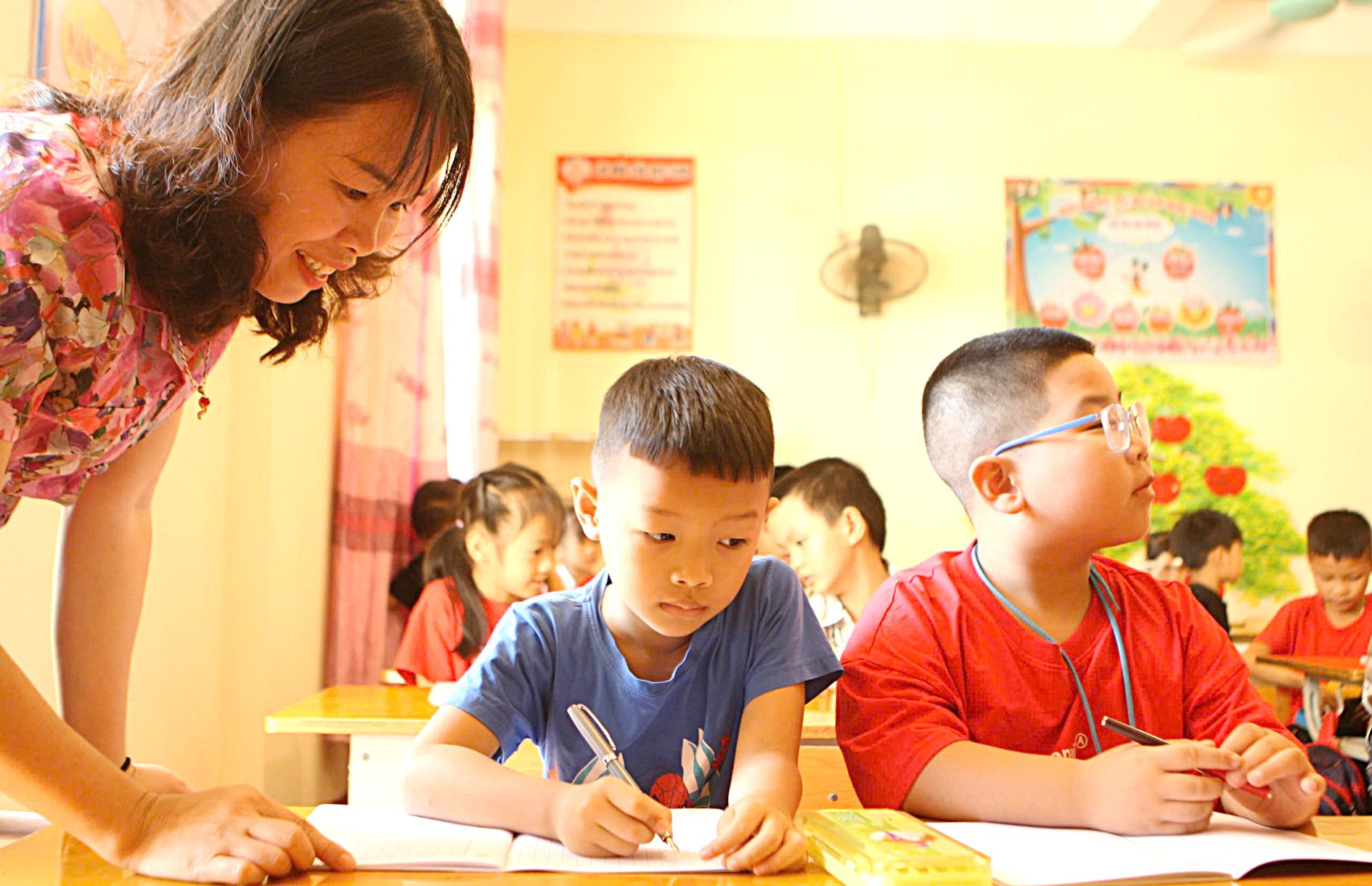
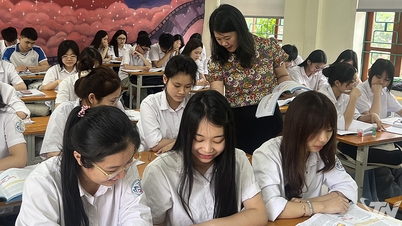
Teachers at Khanh Yen Primary School (Van Ban District, Lao Cai Province ) during a lesson at the beginning of the 2024-2025 school year - Photo: Vinh Ha
The Ho Chi Minh City Department of Education and Training has recently issued a document providing professional guidance for primary schools in the 2024-2025 school year. One of the requirements is that primary school principals innovate in school management in general and in classroom observation in particular.
In fact, over the past period, many primary and secondary schools in Ho Chi Minh City and other localities have made innovations in classroom observation.
Observing a class is not about "nitpicking."
"Course observation is not as rigorous in evaluating teachers' skills as it used to be. Therefore, I really enjoy observing my colleagues' lessons to learn and gain experience for myself. In addition, I also like being observed by colleagues so they can give feedback and help me develop," said Ms. Cao Thi Nguyet, a history and geography teacher at Mac Dinh Chi Secondary School (Tan Binh District, Ho Chi Minh City).
According to Ms. Nguyet, for some lessons, she will ask colleagues to observe, not only colleagues within her department but also from other departments. "Sometimes, I might not notice things while standing at the podium, but my colleagues sitting below will be more observant and spot my shortcomings. This is especially important during the current curriculum and textbook reform period," Ms. Nguyet said.
Similarly, Nguyen Binh Khiem Primary School (District 1, Ho Chi Minh City) has been innovating its lesson observation system for many years. "Young teachers and teachers who have recently transferred to a different grade level will have more opportunities to observe their lessons. The purpose of lesson observation is to advise, support, and promote innovation and development, not to nitpick. Evaluating teachers cannot be based on just one or two lessons; many other factors must be considered," said Ms. Do Ngoc Chi, the school principal.
A teacher from Nguyen Binh Khiem Primary School (who requested anonymity) admitted: "Previously, every time the Department of Education and Training came to observe my lessons, I felt a lot of pressure. Now that lesson observations are a regular activity, teachers are no longer stressed."
The school administration has facilitated our innovation in teaching methods. The school leadership pays attention to factors such as student engagement, teachers clearly defining lesson objectives, and the organization of activities. Therefore, we have confidently implemented the open classroom and green classroom model (inviting parents to observe lessons with their children) for many years now."
Class observation is no longer stressful, and teachers no longer have to "coach" students beforehand, forcing them to memorize lessons to "perform" during the observation session.
However, another teacher also commented: "Classroom observation is about counseling and support, so observers need to be knowledgeable about educational reforms. Some administrators observe classes and nitpick teachers about every little thing, focusing on rigid principles. Meanwhile, the Ministry of Education and Training has required teachers to be flexible and adapt their teaching to the students' needs. They were instructed to do so during training, but upon returning to their schools, the school administration doesn't allow for this flexibility."
Student-oriented
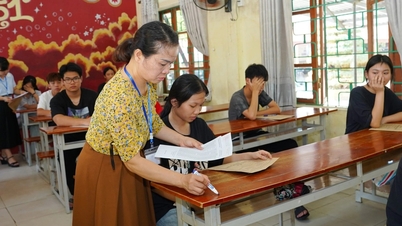
Ms. Pham Thi Thanh Thuy, vice principal of Yen Hoa High School ( Hanoi ), said that teachers have many daily tasks, so they cannot invest deeply in every lesson. However, when teachers are observed, they have to think, find methods, organize teaching, or apply technology. There is pressure, but it can also be seen as motivation for teachers to try harder.
"I believe this is a way to maintain quality and help teachers improve their professional skills and expertise during the teaching process," Ms. Thuy said.
Meanwhile, Ms. Nguyen Thi Nhiep, principal of Chu Van An High School (Hanoi), also believes that changing teachers' attitudes towards classroom observation requires a process where the school can create a culture of classroom observation.
"I believe the fundamental issue is changing the assessment goals and methods of evaluation and feedback. The assessment shouldn't focus on criticizing teachers, but rather on the students. Specifically, it should focus on how students have grasped the lesson, what difficulties they still face, and how teaching methods should be modified to help students overcome these difficulties or to better suit the students' needs."
"And the way feedback is given on each teacher's lesson must be constructive, meaningful, and involve sharing common experiences to make adjustments and improvements together. This innovative approach to lesson observation will gradually help teachers free themselves from the fear of 'lesson observation' they had before," Ms. Nhiep suggested.
Ms. Ngo Thi Nuong, a teacher at Khanh Yen Primary School (Van Ban district, Lao Cai province), shared: "We don't ask whether the teacher has done well, but rather whether the students have absorbed the lesson well. If not, we ask what changes our teachers need to make. And we leverage the collective intelligence of the group. This is very different from the previous method of simply observing lessons to rank and evaluate teachers."
More flexible deployment
Mr. Nguyen Xuan Thanh, head of the Secondary Education Department (Ministry of Education and Training), believes that professional group and team activities should be based on lesson study.
"Specifically, this involves developing illustrative lessons, organizing teaching, and observing classes to gain experience based on analyzing students' learning activities. Thus, instead of mandatory, formalized class observation regulations, class observation in general schools is implemented more flexibly and is included in the professional development plan of subject groups and teams in each school," Mr. Thanh emphasized.
Source: https://tuoitre.vn/coi-bo-ap-luc-du-gio-20240927104204715.htm


![[Photo] General Secretary and President To Lam presides over the meeting to approve the draft report on the results of the second inspection by the Politburo of the Standing Committee of the Hanoi City Party Committee.](https://vphoto.vietnam.vn/thumb/1200x675/vietnam/resource/IMAGE/2026/05/26/1779789811432_a2-bnd-4430-9620-jpg.webp)

























































Comment (0)