

They are not professional forest rangers, but rather "forest guardians" from the community. For them, protecting the forest is not only about preserving the habitat but also about safeguarding their own livelihoods and that of their villages.
When people can make a living from the forest
At Chu Yang Sin National Park, the policy of contracting forest protection is gradually proving effective. Using funds from forest environmental service payments and the state budget, the unit has contracted forest protection to 1,688 households in 26 villages and hamlets across 8 communes, covering an area of approximately 41,000 hectares.
On average, each hectare of forest is paid approximately 500,000 VND per year, with each contracted household earning around 12 million VND per year. For many families who rely on slash-and-burn agriculture, this is a significant income, contributing to a stable life. Y Doe Niê, from Ja hamlet, Hoa Son commune, is one of those who have been involved in forest protection contracts for over 10 years. Y Doe said: “Before, whenever I had free time, I would go into the forest to find bamboo shoots, collect firewood, and sometimes find other forest products to sell. Life was difficult, so I and many others in the hamlet still went into the forest to exploit forest products to make ends meet. Since participating in forest protection contracts, we no longer go into the forest to exploit resources as before, but have become direct patrollers, protecting each forest.”
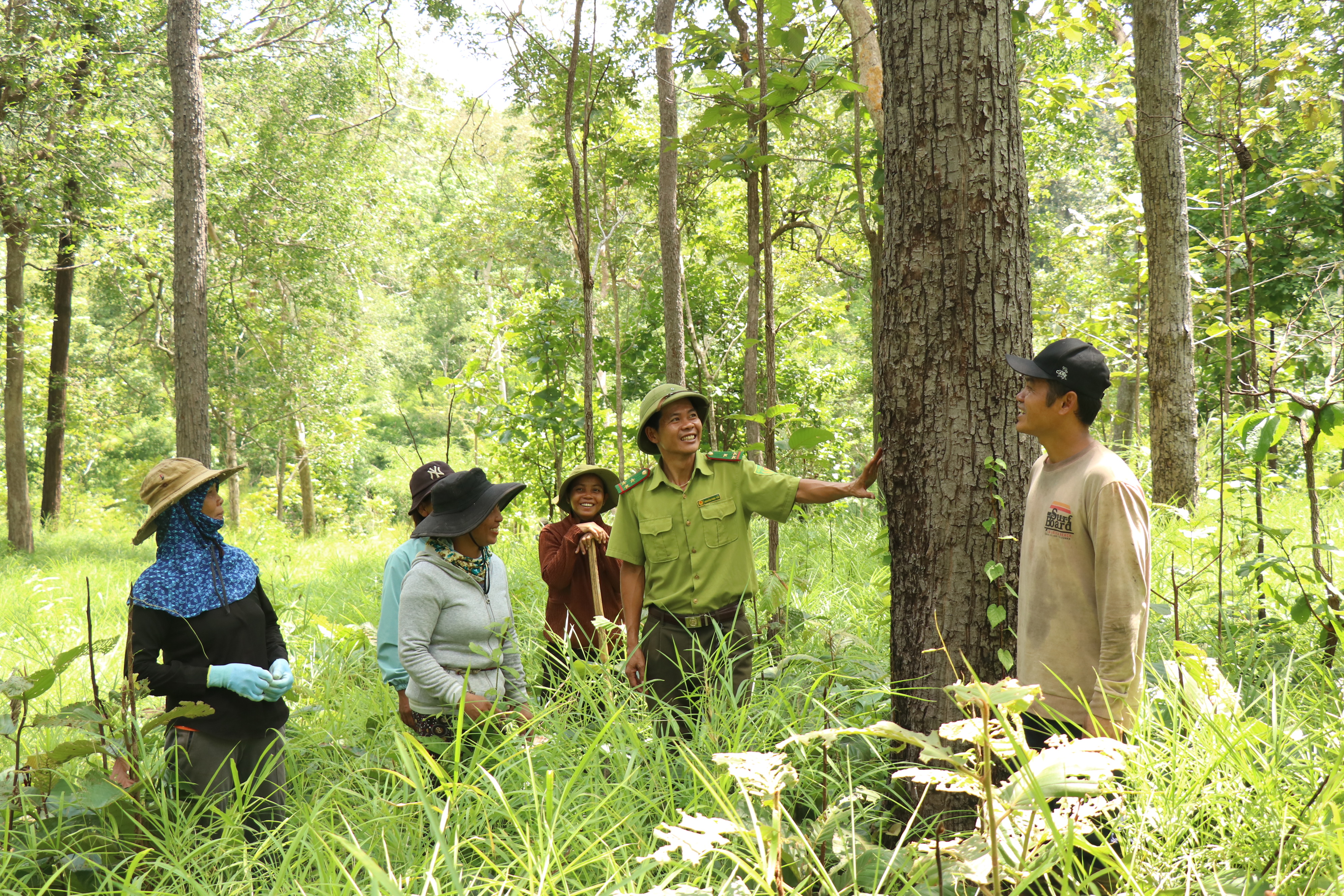 |
| Forest rangers of Yok Don National Park and local people are contracted to patrol and protect the forest. |
The job of those contracted to protect the forest is to go into the forest, remind and stop strangers from entering the forest illegally, and remove animal traps.
Each year, the more than 12 million VND in contracted income provides his family with a stable source of revenue. It's not just about money; it's also about a change in mindset, shifting from exploitation to conservation, from immediate survival to long-term planning.
This story of "transformation" is not unique to Chu Yang Sin. In Yok Don National Park, more than 2,500 households from 17 villages and hamlets across 4 communes have participated in contracted forest protection projects covering over 17,500 hectares. From 2017 to the present, the unit has paid more than 55 billion VND to the people.
Elder Y Mosk Hra, from Drang Phok hamlet, Buon Don commune, has been involved with the program since its inception. He persistently encouraged villagers to participate, gradually changing the community's awareness.
"In the past, people were hesitant, but now they understand. Protecting the forest is protecting assets for future generations. When anything happens, they report it to the forest rangers immediately, to prevent violations from occurring," he said.
The "extended arm" of the forest rangers.
Besides providing additional income for local people, the contracted workforce also becomes an "extension" of the forest rangers in forest protection efforts.
The terrain of Chu Yang Sin National Park is extremely complex, with rugged and heavily fragmented mountains. Meanwhile, each forest ranger is currently responsible for managing an average of about 600 hectares of forest. With such a small force, patrolling and controlling the entire area is a significant challenge.
In this context, the participation of the contracted local people is particularly important. Mr. Nguyen Viet Hang, in charge of Forest Ranger Station No. 1, Chu Yang Sin National Park, said that the contracted households are knowledgeable about the area, familiar with every trail and stream, so they provide very effective support to the forest rangers.
 |
| Forest rangers of Chu Yang Sin National Park and local people contracted to clear firebreaks are working to prevent forest fires during the dry season. |
"When patrolling together, they help detect early signs of wrongdoing. Many incidents are prevented from the outset, avoiding complications," said Mr. Hang.
Evaluating the effectiveness of the model, Mr. Loc Xuan Nghia, Director of Chu Yang Sin National Park, affirmed that forest protection contracting is a fundamental and long-term solution. “With a vast area and complex terrain, relying solely on forest rangers would be very difficult to cover everything. Having additional contracted personnel from local people significantly strengthens the ‘eyes and ears’ of forest protection at the grassroots level,” Mr. Nghia emphasized.
According to Mr. Nghia, this policy not only provides manpower support but also helps people earn additional income, thereby gradually reducing the pressure of illegal forest resource exploitation. Sharing this view, Mr. Pham Tuan Linh, Director of Yok Don National Park, believes that forest protection contracts have created a clear change in community awareness.
"People are no longer on the sidelines but have become active participants in forest protection. When they earn income from the forest, they will be more responsible towards it. This is an important factor in reducing pressure on resources and moving towards sustainable forest management," Mr. Linh said.
From the vast forests, the story of "living off the forest" is becoming a reality. When rights are linked to responsibilities, people not only live off the forest but also join hands in preserving it. And it is they, the children of the mountains and forests, who are contributing to preserving the greenery for today and tomorrow.
Van Tiep
Source: https://baodaklak.vn/moi-truong/202604/com-ao-tu-rung-6bf4682/
![[Photo] “Red Journey” 2026: Vietnamese Youth Continue Building the Bridge of Friendship Between Vietnam and China](https://vphoto.vietnam.vn/thumb/1200x675/vietnam/resource/IMAGE/2026/04/20/1776629730866_4055880775670638308-9618-4200-jpg.webp)








































































Comment (0)