

(QBĐT) - When talking about fishing, the use of bait is always involved. People must understand the " culinary needs" of each fish species to choose the appropriate bait. Fishermen in the past always used shrimp and worms as their main bait. In this article, I will discuss a fish species that, from ancient times to the present, has only been caught by one type of bait: the anchovy and artificial lure.
First, let's briefly touch upon the anchovy family. These are small fish that live in warm, saltwater environments, averaging about 6-7 cm in length. They have a round, oval body covered in shimmering white scales, sometimes creamy yellow or black, forming long streaks running from head to tail. Therefore, depending on their habitat, fishermen classify anchovies into several types: black anchovies, yellow anchovies, silver anchovies, etc.
In Vietnam, anchovies mainly live along the coast from Thanh Hoa southward. Anchovies are a special ingredient used to make the famous fish sauce, with anchovy paste (specifically, the "ruoi" variety) holding the top position. Anchovy paste fish sauce has an amber color and high protein content. In the old days, in my hometown, fishermen who caught lobsters always carried a bottle of anchovy paste fish sauce. In the biting cold of December, before diving into the reefs to catch lobsters, they would drink a sip of the fish sauce to increase their body temperature and resistance.
In the waters off Quang Binh province, starting in the second lunar month, anchovies emerge from offshore, forming large schools and encroaching on the coast. To catch these anchovies, fishermen must use trawling or scooping methods. Some net hauls yield over a ton of anchovies.
Especially after the Lunar New Year, when the sea is covered in thick fog, that's the peak time for anchovies to swarm in. Some years, anchovies flood into the Nhật Lệ estuary, and the fishing nets can catch up to 100 kilograms of fish. That time is called the "anchovy fog season" in my hometown.
 |
Among the anchovy family, only the silver anchovy thrives. When mature, the silver anchovy can reach a maximum length of about 12cm, with a body as thick as an adult's index finger, large eyes, and silvery-white scales. It is known as the "tròng" anchovy (fishermen simply call it "tròng"). This is the largest species in the anchovy family.
The diet of anchovies (in general) and anchovies in particular consists of plankton, the eggs of small fish, and the larvae of krill. Therefore, it's impossible to use real bait to catch them. Since ancient times, experienced fishermen have created a simple but very effective bait for catching anchovies: artificial bait. In the past, fishermen in estuary areas often used the downy feathers of egrets or white chickens as bait.
Nowadays, "modernized" anglers use fine fiber materials like parachute fabric or metallic thread in various colors. Instead of buying fishing hooks from tackle shops, they craft them themselves from very thin stainless steel wire (called hook holders) to suit their artificial baiting techniques.
Currently, in Bao Ninh commune (Dong Hoi city), there are several elderly fishermen who specialize in producing fishing hooks, and not just one hook, but an entire fishing rig. Making a rig requires skillful craftsmanship, meticulousness, and perseverance. The fishing line used to attach feathers (formerly) or nylon threads, or metallic thread (nowadays) to the hook (called "hook attachment") must be no larger than a strand of hair. The rig uses thin fishing line, about 1.2 meters long, and has 10-12 hooks. A lead weight, about half the size of an index finger, is tied to the end of the rig. The end of the rig is tied to the fishing line within the fishing rod system.
Even the fishing rod used for catching scad must meet certain "standards." Fishermen in estuary areas often use dried bamboo (a type of bamboo). Today's anglers use modern, lightweight rods about 2 meters long. The rod body tapers towards the front and must be flexible and highly elastic. When fishing, the person sitting in the boat swings the rod forward.
The lead weight acts as the guide, pulling the fishing line 10-15 meters away. After the lead weight hits the bottom, the rod is gently lifted, simultaneously reeling in about 1 meter of line. Then, the rod is gently lowered, lifted again, and another section of line is reeled in. This action is repeated. This process (called the "fishing reel") causes the hooks to move, and the nylon threads and colorful tinsel covering the hooks reflect light, creating an attractive lure that tricks the fish into biting the bait...
During the scad fishing season (February to June), on days with high tides, when seawater rushes in, schools of scad also move towards the riverbanks. Fishermen often anchor their boats near the river mouth or the Nhật Lệ bridge to cast their lines. When they feel a slight vibration in their hand holding the fishing rod, that's the signal that a fish has bitten the hook.
If the fish density is high, each cast of the line might catch ten fish, so a fisherman can catch 5-6 kg of scad in a single fishing trip. Besides scad, which is the main target, several other fish species are also attracted by the artificial bait, such as anchovies, scad, and barracuda, and they also bite the hook.
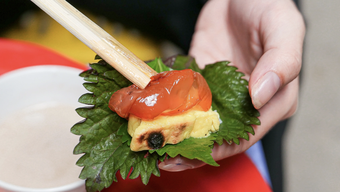
During peak season, anchovies are as big as a thumb. Freshly caught, they're immediately brought to Dong Hoi market. Buyers and sellers don't use scales; they count them by the piece. Anchovies stewed with green chili peppers are a delicious dish in the meals of the fishermen in my coastal village. When the weather is sunny, they dry them to make dried food for the rainy season. That's how anchovies are a product of the fishing industry – no need to buy bait for the fishermen in my coastal village!
Trung Bao Nhat
Source



![[Photo] Prime Minister Pham Minh Chinh receives the Director of RMIT University Melbourne (Australia)](https://vphoto.vietnam.vn/thumb/1200x675/vietnam/resource/IMAGE/2026/04/02/1775142120087_thiet-ke-chua-co-ten-2026-04-02t214220784-png.webp)


















































































Comment (0)