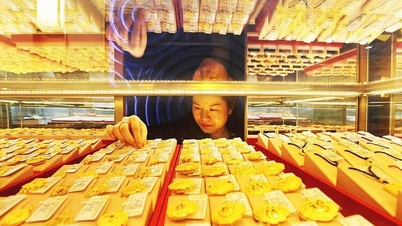
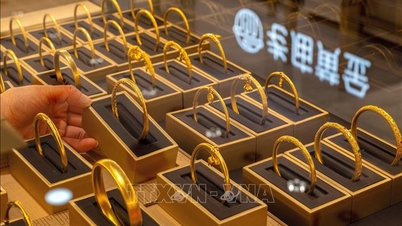
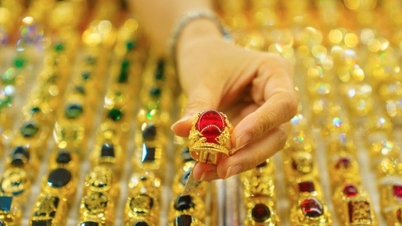
A gold shop in Shenzhen. Photo: GETTYIMAGES
A multi-billion dollar industrial chain.
According to data from the Qichacha business data platform, cited by the South China Morning Post on May 17th, the number of businesses registered to operate in the gold recycling sector in China is projected to increase by 78.74% in 2025 compared to the previous year, reaching 740 businesses – the highest increase in the past 10 years. Notably, in just the first five months of 2026, an additional 488 new businesses have entered the market. This figure indicates that the gold recycling industry is entering an unprecedented period of explosive growth, coinciding with the rapid rise in global gold prices.
Unlike previous gold rushes, which were primarily focused on hoarding, the current wave is more pragmatic. As gold prices continue to rise, many Chinese citizens are starting to sell their old gold jewelry, long-term gold holdings, or exchange them for gold bars and other investment products with higher liquidity. This trend has created favorable conditions for the gold recycling industry to develop at a very rapid pace.
According to the China Gold Association (CGA), investment demand for gold continued to surge in the first quarter of 2026. Consumption of gold bars and gold coins alone increased by 46.4%, exceeding 202 tons. Conversely, demand for gold jewelry decreased by more than 37% due to excessively high gold prices. This indicates that gold in China is gradually shifting from a consumer asset to a financial asset.
The rapid development of China's gold recycling industry is transforming the traditional structure of the domestic gold market. While previously the collection of old gold was primarily carried out by small, independent gold shops, this sector has now rapidly developed into a large-scale industrial chain, utilizing modern technology and closely integrated with the digital financial system.
The industry's operating model is relatively clear: Businesses purchase gold bars, old gold jewelry, or products containing precious metals, then refine, recycle, and resell them on the market as raw materials or new products. However, what sets it apart today is the rapid technological and financialization of this sector. In Shenzhen, especially in the Shuibei district, China's largest jewelry production and trading center, gold recycling is booming. Many businesses have implemented real-time gold pricing systems, directly linked to international gold prices. People can verify gold quality, determine its value, and receive electronic payments via apps like Alipay or WeChat Pay in just a few minutes.


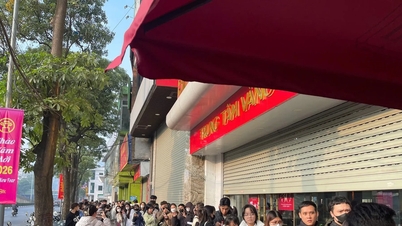
Chinese media have recently been reporting on the phenomenon of people lining up to sell gold at major shopping malls in Shanghai and Shenzhen. Some places have even seen the emergence of automated "gold ATMs" capable of identifying gold purity, weighing it, and disbursing payment instantly. This image shows that gold recycling is gradually becoming a popular financial activity in urban Chinese life. Chinese economic experts believe that the rapid development of the gold recycling industry stems from three main factors. First, the price of gold has risen too sharply in a short period, making gold hoarded by the population an attractive source of profit. Second, consumer demand has weakened amidst an economic slowdown, forcing many households to utilize gold as a reserve asset. Third, the development of digital technology has made gold transactions more transparent and convenient.
According to Bloomberg, Shenzhen is considered the "gold recycling capital" thanks to its complete industrial ecosystem. Shanghai continues to play a central role in bullion trading thanks to the Shanghai Gold Exchange. Analysts believe that the combination of these two centers is helping China form an increasingly competitive gold value chain at the global level.
According to observers, if China's gold reserves continue to grow, coupled with the development of its domestic trading and recycling ecosystem, Beijing could gradually increase its role in shaping the Asia-Pacific gold market. However, alongside the opportunities, the Chinese gold recycling industry also faces considerable risks. Some experts warn that the influx of new businesses could lead to uncontrolled competition, quality fraud, or distorted financial speculation. Furthermore, if gold prices reverse sharply, many fledgling businesses could face liquidity and cash flow difficulties.
Financial security tools
The boom in China's gold recycling industry is inseparable from major global economic and political shifts. Over the years, gold has increasingly taken on strategic significance beyond its conventional commercial value. For many countries, especially major economies seeking to reduce their dependence on the US dollar, gold has become a tool for financial security in an uncertain international environment.
Following the outbreak of the Russia-Ukraine conflict (February 2022) and the imposition of numerous financial sanctions against Moscow by the West, many countries began to pay more attention to diversifying their foreign exchange reserves. This trend is particularly evident in emerging economies. Central banks around the world have been continuously increasing their gold purchases over the past three years at a rate rarely seen since the 2008 global financial crisis. In this trend, China is one of the countries attracting the most attention. The People's Bank of China (PBC) has been continuously adding to its gold reserves for months, although the pace of purchases has been adjusted at times. Analysts believe Beijing is gradually reducing its dependence on USD-denominated assets while strengthening its resilience to international financial shocks.
From a strategic perspective, this is particularly significant. In the context of increasingly fierce US-China competition, increasing gold reserves is not merely a financial decision, but also carries geopolitical implications. Some Chinese scholars argue that gold is becoming a "security buffer" for economies seeking to mitigate risks from the Western-dominated financial system. This sentiment has strongly permeated Chinese society. As the government increases gold purchases, people tend to view gold as a safer asset. With gold prices continuously reaching new highs, gold trading and recycling activities have become even more vibrant. In other words, the current boom in the gold recycling industry is a combination of both market factors and strategic psychology.
However, the outlook for the global gold market in the near future remains subject to many variables. Some experts from the World Gold Council (WGC) believe that the upward trend in gold prices may slow down if the US economy remains stable and the Federal Reserve (FED) continues to keep interest rates high for longer than expected. The gold market is highly sensitive to interest rate fluctuations and the strength of the US dollar. Nevertheless, unlike previous cycles, the current gold price surge is supported by very strong physical demand from Asia. This provides a more stable foundation for the gold market.



For China, the development of the gold recycling industry also signifies a circular economy and the utilization of domestic resources. In the context of increasingly fierce competition for strategic resources, the recovery and recycling of precious metals helps reduce dependence on imported raw materials and enhance industrial self-reliance. More importantly, the boom in the gold recycling industry reflects a profound shift in Chinese social psychology. After years of rapid growth driven by real estate and credit, the Chinese economy is entering a long-term adjustment phase. In this environment, people tend to prioritize asset preservation over risky speculation.
Therefore, behind the bustling antique gold shops in Shenzhen or Shanghai is not just a story about profit. It is also a manifestation of a more uncertain global economic era, where gold, the oldest metal in human civilization, is once again becoming a symbol of financial security and power.
According to Nhandan.vn
Source: https://baoangiang.com.vn/-con-sot-vang-o-dat-nuoc-ty-dan-a490374.html



![[Image] Schools organize meetings and introduce teaching models to students admitted to grade 10.](https://vphoto.vietnam.vn/thumb/1200x675/vietnam/resource/IMAGE/2026/06/25/1782368077271_ndo_br_z7970052192242-1ec8daeb77a6eed1a4e9f58c564ddd3e-jpg.webp)
![[Image] Ho Chi Minh City: Ma Lang area, Chicken-Rice Market about to change its appearance](https://vphoto.vietnam.vn/thumb/1200x675/vietnam/resource/IMAGE/2026/06/25/1782377698627_ndo_br_m1-jpg.webp)
![[Photo] General Secretary and President To Lam receives Palestinian Ambassador Saadi Salama](https://vphoto.vietnam.vn/thumb/1200x675/vietnam/resource/IMAGE/2026/06/25/1782365384740_a1-bnd-9423-8322-jpg.webp)