Vietnamese people consume music in two ways: music as an event to experience, share, and express, and music as art to feel and listen to.
Give it your all at the concert!
In just a few years, the live concert market in Vietnam has entered a completely different phase: ticket prices are no longer measured in "hundreds of thousands," but start in the millions – even reaching tens of millions of dong. These figures not only reflect the appeal of the artists, but also show a new economic structure forming behind music.
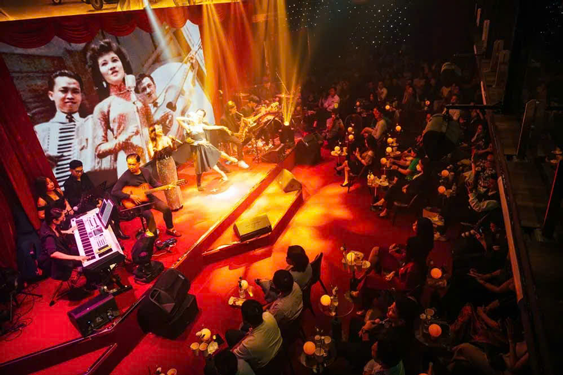
A music night at Ben Thanh tea room (Ho Chi Minh City). Photo: HA THANH PHUC
My Tam's "See The Light" live concert is a prime example. Ticket prices ranged from approximately 1.5 million to 12 million VND for the highest category – a price once considered "unimaginable" for the domestic market. Notably, all tickets sold out quickly, with even the premium categories selling out before the show even began.
Meanwhile, Ha Anh Tuan's "Sketch A Rose" concert in Vietnam typically has ticket prices ranging from 1.5 million to 6 million VND. However, when the show is taken internationally, the highest ticket price reaches 450 USD (approximately 11.7 million VND). Clearly, the current price level for Vietnamese concerts is approaching – or even reaching – the level of international shows.


The "Brother" concerts, a hot show in 2024-2025: VIP tickets are always sold out before showtime. The concept of "hunting for tickets to see your idol" began with the first shows of the "Brother Says Hi" and "Brother Overcomes a Thousand Obstacles" live concert series. To date, each show has held its 9th night, but the "ticket hunting" phenomenon remains intense. According to ticket market data, SVIP (premium) tickets for these concerts range from 10 million to 12 million VND per pair and "sell out in just a few minutes." This clearly reflects a reality: premium tickets are always the first to sell out, and buyers are not the majority but rather a group with high purchasing power.
Previously, concerts in Vietnam were often considered "cheaper than in the region." However, this gap is now rapidly narrowing. Tickets for domestic concerts range from 1.5 million to 12 million VND; tickets for Vietnamese artists' concerts abroad range from 3 million to 11.7 million VND, and tickets for fancon events of young singers also range from 1.5 million to 4 million VND per ticket. Some international concerts in Vietnam, such as K-pop, cost around 8 million to 9.8 million VND per VIP ticket. This shows that the Vietnamese market is no longer a "price gap" but is approaching regional standards in the high-end segment.
Relax and unwind in a tea room.
While the mainstream concert market continues to break ticket price records, a quiet but significant shift is taking place: audiences are beginning to seek out smaller spaces – from tea rooms to acoustic stages – where music is almost entirely performed live. This shift not only reflects changing tastes but also reveals a deeper cultural perspective on how Vietnamese people are consuming music in this new context – especially as authorities increasingly crack down on lip-syncing.
At large tea houses in Ho Chi Minh City, such as Khong Ten or Ben Thanh, ticket prices typically range from 300,000 to 800,000 VND for a regular music night, and 1 million to 2 million VND for well-known artists or special nights. Compared to concerts costing several million to over 10 million VND, this price range is more "accessible." However, what keeps tea houses attracting audiences isn't the low price, but the unique experience. Small spaces (100-300 seats), live bands, minimal or no playback, and close interaction between singers and audience – here, music isn't just a "show," but a true listening experience.
While concerts are a "rare event," tea rooms operate on a completely different logic: shows take place weekly, even every night; artists can perform continuously for many nights a month; audiences return repeatedly, not just "going once out of curiosity"... The demand for "authentic listening" among a segment of the audience has also increased, with tea rooms prioritizing vocal quality over visuals.
According to insiders, the Vietnamese music market is shaping a new trend in how music is approached and experienced: cozy tea rooms and grand concerts. In a context where "authentic listening" is becoming a new standard, perhaps the crucial question isn't "Where do we listen?" but rather "Why are we listening?".
The cost is considerable.



A modern concert is a true "production project" with a large-scale stage (stadium show with 40,000 spectators like My Tam's), a symphony orchestra, a live band, a choir (in Ha Anh Tuan's show); lighting technology, LED screens, visual effects, and operating costs, insurance, logistics... (in shows like "Brother"). These elements push costs up to tens of billions of VND, forcing producers to set higher ticket prices to balance the cost. Concert tickets are no longer just entertainment products but have become a form of "socially valuable experience".
Source: https://nld.com.vn/concert-bung-no-phong-tra-thang-hoa-196260506195103112.htm























![[Photo] Strengthening character and expertise: Intense training for artillery soldiers.](https://vphoto.vietnam.vn/thumb/1200x675/vietnam/resource/IMAGE/2026/06/30/1782815602541_lu-368-1875-4571-jpg.webp)