

Humanity has once again taken a giant leap forward in its exploration of the universe. Scientists have just released the largest interactive map of the universe ever created, based on data from the James Webb Space Telescope (JWST) – the most advanced observational instrument ever built by humankind. This achievement is part of a large-scale survey project called COSMOS-Web, led by the California Institute of Technology (Caltech), aimed at shedding light on the formation and evolution of galaxies in the very early stages of the universe.
This extraordinary map covers an area of approximately 0.54 square degrees of the sky – nearly three times the surface area of the Moon as seen from Earth. It stores over 1.5 terabytes of data and captures images of thousands of astronomical objects, from stars to ancient galaxies dating back up to 13.5 billion years. Using the near-infrared camera (NIRCam) on the James Webb telescope, researchers can see regions of space so far away that light from them takes billions of years to reach Earth – meaning we are witnessing the first traces of the universe after the Big Bang.
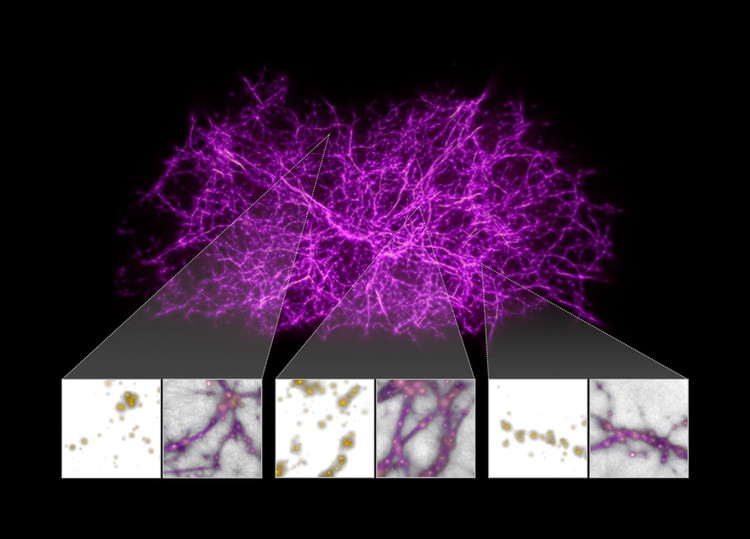
The COSMOS-Web map captures images of thousands of astronomical objects, from stars to ancient galaxies dating back up to 13.5 billion years. Photo: NASA Science.
Another highlight of this map is its completely free interactive feature, allowing the public to freely access, explore , and zoom in and out of areas of space using a web browser. Although users cannot yet look up the specific names of galaxies, the map still provides a visually engaging and captivating experience thanks to its ability to flexibly switch between display modes such as RGB images or images captured with NIRCam – allowing viewers to feel the grandeur and vibrancy of the universe like never before.
The public release of the map not only serves the scientific community but also demonstrates a strong commitment to disseminating astronomical knowledge to the public. In the age of open data and digital technology , this project is clear evidence of the effective combination of pioneering scientific research and internet technology to bridge the gap between knowledge and the community.
Since its launch in late 2021, the James Webb telescope has consistently delivered sharp images and invaluable data about the universe. With this new interactive map, NASA's flagship telescope continues to affirm its central position in the mission to explore the origins and structure of the universe – a mission that holds both profound scientific significance and sparks the imagination and passion for discovery in millions worldwide.
Source: https://khoahocdoisong.vn/cong-bo-ban-do-vu-tru-lon-nhat-lich-su-tu-james-webb-post1547681.html

![[Photo] Prime Minister Pham Minh Chinh presides over a meeting on private sector economic development.](/_next/image?url=https%3A%2F%2Fvphoto.vietnam.vn%2Fthumb%2F1200x675%2Fvietnam%2Fresource%2FIMAGE%2F2025%2F12%2F20%2F1766237501876_thiet-ke-chua-co-ten-40-png.webp&w=3840&q=75)






























































































Comment (0)