

|
bbbbbbb |

Barcelona left the Champions League with a feeling that's hard to describe. They won the second leg, played energetic and dominant football. But after two legs, they were still eliminated with an aggregate score of 2-3. And as former legend Thierry Henry pointed out, that wasn't due to luck.
It stems from how Barcelona made things difficult for themselves.
The price of taking risks
Barcelona did many things right against Atletico. They controlled the game, pushed high up the pitch, and maintained pressure for most of the match. Their 2-1 victory in the second leg of the Champions League quarter-finals on the morning of April 15th accurately reflected what happened at the Metropolitano Stadium.
But the Champions League isn't just about one match.
In the two matches, Barcelona conceded three goals. These weren't random goals. They were the result of a familiar approach: the defense pushed high, leaving gaps behind, and the opponent only needed one opportunity to exploit them.
Thierry Henry, who played for both Arsenal and Barcelona, didn't shy away from calling it "a recipe for disaster."
At the highest level, every detail is punished. When the defense lacks the speed to adapt, the organization to provide cover, pushing forward becomes risky. And Barcelona have taken that risk, time and time again.
|
Atletico Madrid's Lookman punished Barcelona's high defensive line. |
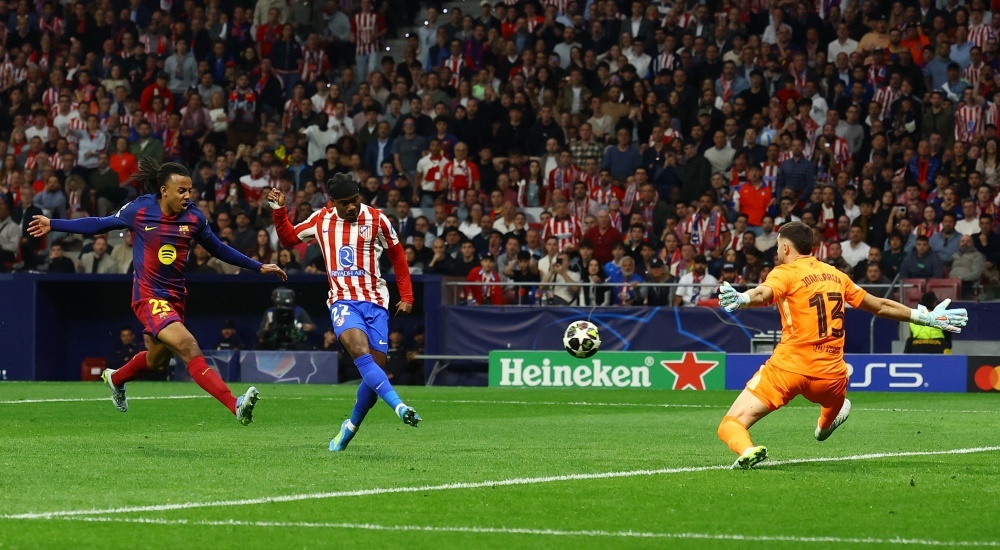
The problem isn't the philosophy. Barcelona has always been associated with an active, control-oriented, and attacking style of play. But a philosophy only works when the right people are involved.
Otherwise, it becomes a weakness.
Against Atletico, that was clearly evident. Barcelona dominated, but couldn't control the decisive moments. Just one through pass, one break from pressing, and the defense was immediately stretched.
Spaces appear. And in the Champions League, those spaces always come at a price.
The problem remains unsolved.
Henry wasn't talking about a single match. He was talking about a long-standing issue.
Barcelona currently lacks stability in defense. It's not just individual mistakes, but the ability to maintain structure throughout the match. World- class center-backs are not only good at tackling, but also at reading the game and controlling space.
Barcelona haven't consistently achieved that. The red cards for Pau Cubarsi and Eric Garcia in both legs exposed weaknesses in the Catalan team's defense.
|
Barcelona were eliminated in the Champions League quarter-finals. |

When facing teams like Atletico, this difference becomes even more apparent. Diego Simeone's team doesn't need many chances. They wait and capitalize. And whenever Barcelona leaves a gap, Atletico is ready to exploit it.
That's pragmatism. But it's also a sign of courage.
Barcelona is different. They play emotional, energetic football. But emotion alone isn't enough to win two-legged knockout matches.
The imbalance between attack and defense leaves them constantly vulnerable. One side creates opportunities, while the other exposes weaknesses.
And when those two factors don't meet, the outcome is already decided.
The 2-1 victory in the second leg therefore carries significant meaning. It shows Barcelona's potential and their ability to dominate. But at the same time, it also exposes their limitations.
Barcelona may win one game. But to progress further, they need more than that.
They need a top-class defense to protect their advantage. They need stability to maintain their lead over both legs. And most importantly, they need to adapt to the current reality.
Otherwise, as Henry warned, this scenario will repeat itself. Not just once. But possibly for many years.
The Champions League is not lacking in teams that play beautiful football. But only those teams that know how to manage their risks can go far. Barcelona played well. But Atletico Madrid is the team that progressed. And the gap between the two lies with Barcelona themselves.
Source: https://znews.vn/cong-thuc-tham-hoa-nhan-chim-barcelona-post1643642.html
![[Photo] Capturing each moment at the "People We Meet" photography exhibition.](https://vphoto.vietnam.vn/thumb/1200x675/vietnam/resource/IMAGE/2026/04/15/1776245695648_1-8944-jpg.webp)
![[Photo] National Assembly Chairman Tran Thanh Man concludes official visit to Italy, departs for IPU-152](https://vphoto.vietnam.vn/thumb/1200x675/vietnam/resource/IMAGE/2026/04/15/1776253436109_vna-potal-chu-tich-quoc-hoi-ket-thuc-tham-chinh-thuc-italy-len-duong-du-ipu-152-tai-tho-nhi-ky-8702876-7969-jpg.webp)
![[Photo] General Secretary and President To Lam and his wife, along with General Secretary and President Xi Jinping and his wife, attending a tea party.](https://vphoto.vietnam.vn/thumb/1200x675/vietnam/resource/IMAGE/2026/04/15/1776245678527_vna-potal-tong-bi-thu-chu-tich-nuoc-to-lam-va-phu-nhan-cung-tong-bi-thu-chu-tich-nuoc-tap-can-binh-va-phu-nhan-du-tiec-tra-8702812-9829-jpg.webp)
![[Image] Overview of the Tam Trinh-Giai Phong connecting road section after land clearance is completed.](https://vphoto.vietnam.vn/thumb/1200x675/vietnam/resource/IMAGE/2026/04/15/1776245679644_ndo_br_dji-0195-jpg.webp)
![[Photo] General Secretary and President To Lam and General Secretary and President Xi Jinping meet with youth from both countries.](https://vphoto.vietnam.vn/thumb/1200x675/vietnam/resource/IMAGE/2026/04/15/1776245687540_vna-potal-tong-bi-thu-chu-tich-nuoc-to-lam-va-tong-bi-thu-chu-tich-nuoc-tap-can-binh-gap-go-thanh-nien-hai-nuoc-8702371-jpg.webp)
![[Image] Current status of the land area of over 5.5 hectares that Ho Chi Minh City is considering reclaiming.](https://vphoto.vietnam.vn/thumb/1200x675/vietnam/resource/IMAGE/2026/04/15/1776245690095_1-3102-8409-jpg.webp)



























































Comment (0)