

Cu Chi: Land of Steel, Fortress of Bronze
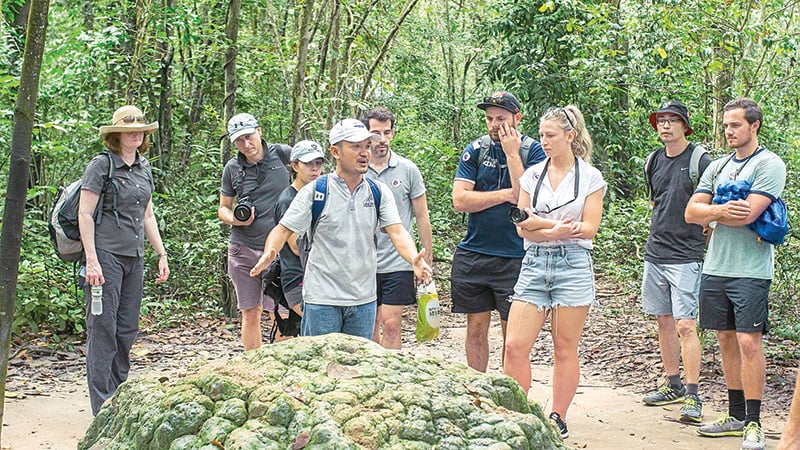
Tourists visiting the Cu Chi Tunnels. Photo: Cu Chi Tunnels Historical Site.
A German politician, upon visiting the Cu Chi Tunnels, exclaimed: “For many years I doubted the Vietnamese people’s struggle. How could a small and poor country defeat a large and wealthy country like the United States? But after coming here and crawling through 70 meters of tunnels, I have answered that question for myself.” Even more than that, there is admiration and respect for the strength, intelligence, spirit, and will of Vietnam, of which Cu Chi is a powerful testament.
According to historical documents, during the resistance war against French colonialism, in 1948, the army and people of Tan Phu Trung and Phuoc Vinh An communes in Cu Chi district began constructing short, simple tunnels to hide documents, weapons, and provide shelter for revolutionary cadres operating behind enemy lines. From 1961 to 1965, the tunnel system was further improved, with the "backbone" tunnel extending to six communes in the northern part of Cu Chi district, then spreading into a vast, interconnected network of tunnels.
Even during the intense bombing and shelling by the US-backed South Vietnamese forces, with the slogan "not an inch will be given up, not a millimeter will be surrendered," the soldiers, militia, and civilian Party organizations, along with the people of Cu Chi, worked day and night, simultaneously fighting and digging tunnels, trenches, and fortifications. They actively built "fighting villages and hamlets," "anti-American zones," forming a solid defensive position to encircle, attack, wear down, and destroy the enemy. Using only the most rudimentary tools—hoes and bamboo shovels—but with unwavering determination and a strong belief in victory, the army and people of Cu Chi created a massive 250km underground network, connecting villages and hamlets like a miraculous "underground village." And it wasn't just the soldiers; from the families in the "zone," every household dug tunnels and trenches connecting to the underground network, creating a continuous system for both production and fighting to defend their villages. Therefore, in this place, every citizen was a soldier, and every tunnel was a fortress against the enemy.
Located near the nerve center and capital of the puppet regime of the invading army, the Cu Chi tunnels quickly became a thorn in the side of the US-backed South Vietnamese government, a target they sought to destroy. For a long time, through bloody and inhumane sweeps, the enemy relentlessly attacked and destroyed the base area and the tunnel system. For example, in Operation Cedar Falls, dubbed "Peeling the Earth's Skin," starting on January 8, 1967, they mobilized 30,000 troops, supported by tanks, armored vehicles, artillery, and air power, launching a fierce attack on the "Iron Triangle" area. Their goal was to destroy the Saigon-Chợ Lớn-Gia Định Military Region Command, the leadership body of the Regional Party Committee, eliminate the main units of the Military Region, destroy the base area and tunnel system, forcibly relocate civilians, and turn the area into a "Free Zone of Destruction." In addition to state-of-the-art war equipment and machinery, the enemy employed a "rat army" of 600 specially selected, small-statured engineering soldiers tasked with destroying the tunnels. Before launching the sweep operation, the enemy used B-52 bombers and jet aircraft to bomb and bombard continuously for a month, aiming to "clear the ground" for helicopters to drop troops and tanks and infantry to attack the base area. They even used napalm bombs to burn hundreds of hectares of forest and gardens. Bulldozers cleared the forests, then piled the trees together, doused them with gasoline, and set them on fire.
Faced with the enemy's atrocities, the fighting forces and the people held their ground tenaciously, fighting back fiercely, protecting the Command Headquarters, the leaders of the Regional Party Committee, and most of the base area. Wherever the enemy went, they were relentlessly attacked with every means and every weapon. A miraculous feat occurred at the Ben Duoc intersection, where a guerrilla team of only 9 soldiers, including a female nurse, held firm in the tunnels, killed 107 enemy soldiers, and destroyed their tanks.
Operation Cedar Falls quickly resulted in heavy losses, with 3,500 enemy soldiers, 130 tanks and armored vehicles, and 28 aircraft put out of action. Meanwhile, on our side, only a few short sections of tunnels collapsed, a negligible loss compared to the 250km of interconnected, multi-level tunnels.
Claiming to be a professional, battle-hardened invading army, supported by state-of-the-art machinery, they suffered a humiliating defeat at the hands of the rifles and booby traps set by the people and soldiers of Cu Chi. Attempting to salvage their "honor," the US and its allies sent military experts from many belligerent capitalist countries to Cu Chi to investigate and study the tunnel system. From there, they resorted to every vile and despicable tactic, continuing their atrocities in the area, from flooding the tunnels with water, using trained dogs and bulldozers, planting anti-aircraft grass to disrupt the terrain... to using chemical weapons. However, no force could stop the will for independence and national reunification of our army and people.
Throughout their 21-year journey of tenacious and courageous fighting in the dark depths of the earth, the main army units, along with the army and people of Cu Chi, fought 4,269 battles of varying sizes. Through these battles, they captured 8,581 weapons of all types, eliminated more than 22,582 enemy soldiers, destroyed over 5,168 military vehicles; shot down or damaged 256 aircraft, and sank or burned 22 combat boats and ships...
To achieve those glorious victories, thousands of regular army soldiers and guerrilla fighters had to endure all kinds of harsh conditions beyond human endurance in the dark, cramped depths of the tunnels. Many fainted and had to be brought to the tunnel entrance for artificial respiration before regaining consciousness. Maintaining the secrecy of the tunnels, with hundreds of people going up and down daily, was also extremely difficult. A broken blade of grass, soiled in it, or an unusually torn leaf had to be repaired to avoid detection and attack by the enemy...
This shows the intelligence, spirit, and strength of Cu Chi. As the late General Secretary Do Muoi affirmed: "The Cu Chi Tunnels are a symbol of patriotism and the indomitable will and unwavering determination of our people for independence and freedom." And the late President of the Communist Party of Cuba, Fidel Castro, wrote: "This is a work of extraordinary creativity, demonstrating the talent, boldness, perseverance, and heroism that led to the historic victory of the Vietnamese people... It is truly a source of pride and glory for those who accomplished this project!"... From this tunnel system, our troops, in conjunction with the people, launched a simultaneous attack on the enemy's strongholds in Saigon in the spring of 1968, capturing most of the key targets of the US-backed South Vietnamese regime, such as the Independence Palace, the US Embassy, the Radio Station, the General Staff Headquarters, the South Vietnamese Navy Command, and Tan Son Nhat Airport...
By the spring of 1975, large forces of the 3rd Army Corps and many main and local units had gathered here before advancing to liberate Cu Chi town and the enemy's last stronghold in Saigon, bringing the resistance war against the US to a complete victory at 11:30 AM on April 30, 1975, in the historic Ho Chi Minh Campaign.
The title "Cu Chi, the land of steel and bronze" was written in this way, reflecting the unwavering spirit and will to defeat the enemy, the determination to "not give up an inch, not retreat a millimeter," a will that values independence and freedom above all else... All this spirit and will contributed to forging a heroic Vietnamese strength.
Today, the area once covered by the tunnels is now a lush, fertile farmland, and bustling, vibrant villages. The people of Cu Chi are continuing the tradition of this resilient land, enthusiastically building their homeland into an increasingly prosperous, beautiful, and civilized place, a strong fortress protecting the beautiful Ho Chi Minh City...
Dong Thanh
This article uses materials from: Cu Chi Tunnels Historical Site, "Cu Chi Tunnels in the heart of the nation and honored guests from all over the world" (Ho Chi Minh City Publishing House); "Vietnamese tunnels in the resistance war against French colonialism and American imperialism" (Hong Duc Publishing House)...
Source: https://baothanhhoa.vn/cu-chi-dat-thep-thanh-dong-246791.htm














![[E-Magazine]: Gentle Season](https://vphoto.vietnam.vn/thumb/402x226/vietnam/resource/IMAGE/2026/04/03/1775224637323_e-magazine-mua-w1200t0-di2613d199d5164634t11920l1-mdd-022.webp)



































































Comment (0)