

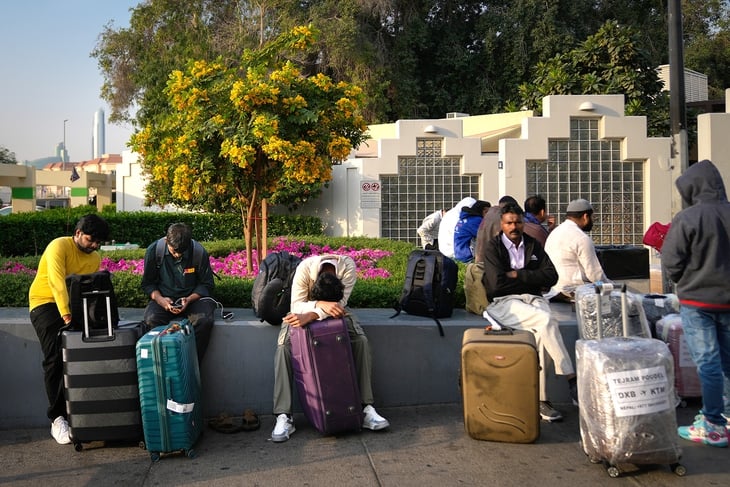
Passengers were stranded at Dubai International Airport after it closed on March 1st - Photo: AP
All of this is putting airlines in a difficult position: costs are soaring while demand risks declining.
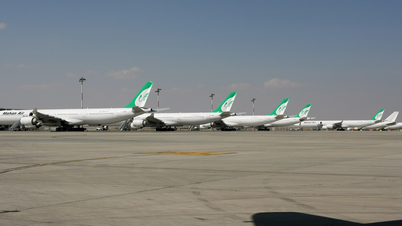
Dubai International Airport, one of the world's busiest transit hubs, has been closed for the fourth consecutive day.
The financial markets reacted almost immediately, with shares of numerous major airlines plummeting, raising concerns that industry-wide profits could be severely eroded if this situation continues.
Global air travel disrupted.
This disruption is not limited to the Middle East. Since 2022, when Russia closed its airspace to the West, many Europe-Asia routes have had to reroute through the Middle East.
Now, this alternative corridor is further narrowing, forcing aircraft to reroute through the Armenia-Azerbaijan corridor or detour further south through Saudi Arabia and Oman, increasing flight times and driving up fuel costs, according to AFP.
In morning trading on March 2nd in the US, shares of American Airlines, United Airlines, and Delta Air Lines all fell by more than 6%.
In Europe, IAG – the group that owns British Airways – at one point plunged more than 12% before narrowing its losses.
In Asia, trading on March 3 saw shares of Japan Airlines fall 3.5%, Korean Air Lines drop nearly 8%, and Cathay Pacific decline over 2%.
Shares of major Chinese airlines, including Air China, China Eastern Airlines, and China Southern Airlines, fell by 3% to 5% in both Hong Kong and Shanghai.
Chain effect
The impact of the conflict extends beyond canceled flights. CNN points out that in the aviation industry, aircraft and crews operate on complex, rotating schedules on a global scale.
When a link in the chain is broken due to airspace closures, aircraft may be stranded outside their intended operating locations, crews may be stuck at transit points, forcing airlines to activate backup fleets or cancel additional flights to re-establish the network.
This "resetting the chessboard" process is both costly and time-consuming. Airlines have to arrange accommodation for stranded employees, adjust work schedules, obtain permission to fly through alternative airspace, and recalculate fuel loads.
If the new route exceeds the aircraft's operating range, the airline may have to add a technical stop for refueling – leading to increased landing fees, ground handling fees, and operating costs. With thin profit margins, each additional flight hour puts direct pressure on profitability.
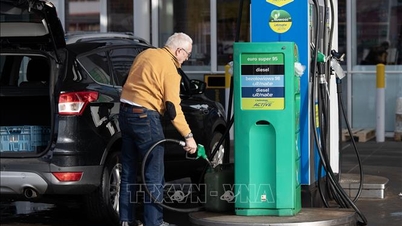
Alongside the operational shock is the energy crisis. With fuel accounting for about a quarter of total operating costs, any sustained price increase quickly erodes industry-wide profits.
Some European airlines have contracts to control fuel prices in advance to reduce risk, while many American airlines often do not employ this strategy and instead rely on fare adjustments.
In the short term, airfares may not rise sharply as airlines still want to maintain demand. However, analysts warn that if the conflict lasts for four weeks as Trump has stated, international airfares will inevitably trend upwards.
However, if oil prices remain high for many weeks, the final cost will still tend to pass on to passengers.
The airline will cover the travel insurance costs.
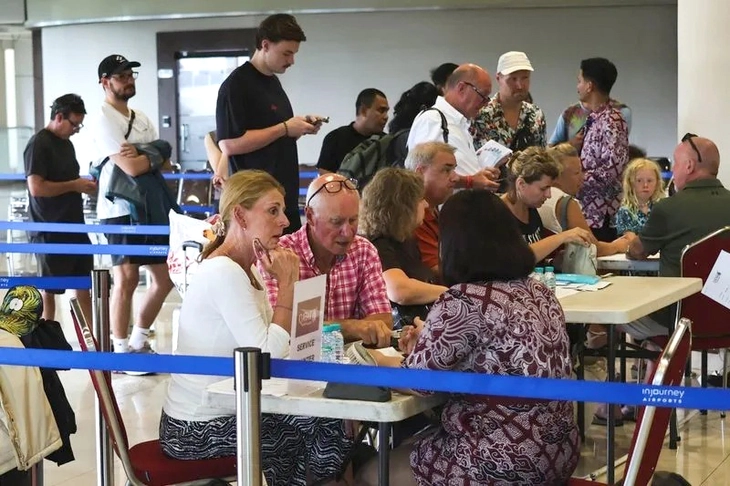
Passengers were stranded at Gusti Ngurah Rai International Airport (Indonesia) after flights to Dubai and Abu Dhabi (UAE) were canceled on March 1st - Photo: Reuters
When airspace is closed for military reasons, passengers often immediately think of travel insurance as a safety net.
The reality is quite different: most standard insurance policies include clauses excluding war and military action.
This means that any claims related to flights canceled, delayed, or rerouted due to armed conflict may be denied, even if passengers purchased insurance before the conflict broke out.
According to The West Australian , Natalie Ball, CEO of the travel insurance comparison website Compare Travel Insurance, stated that standard travel insurance typically does not cover changes, cancellations, or delays resulting from war, military action, or airspace closures by authorities. These exclusion clauses are common in most travel insurance policies today.
Notably, the timing of insurance purchase does not create an exception. Even if passengers purchased insurance before the conflict occurred, the war exclusion clause still applies in full.
Some insurance companies may offer limited coverage under specific extended terms, but this varies depending on the company and the particular product package. Therefore, the terms of the contract are crucial and passengers need to read them carefully.
Given this situation, experts recommend that passengers work directly with the airline or ticket agent instead of relying on insurance.
When a flight is canceled or delayed, passengers have the right to a refund, a re-flight, medical care, and in some cases, compensation.
Many airlines quickly implemented flexible policies. According to CNN, Emirates allowed affected passengers to change flights before March 20 or request a refund.
Etihad Airways is offering free ticket changes for tickets issued before February 28th with flights scheduled until March 7th, allowing for free rescheduling until mid-March.
Outside of the Middle East, British Airways allows passengers with flights to Dubai, Doha, Abu Dhabi, Tel Aviv, or Amman to change their dates or receive refunds depending on the departure date.
Virgin Australia has confirmed that some flights operated by its partner Qatar Airways between Australia and Doha have been cancelled or turned back after Qatari airspace closed, and has pledged to assist passengers with refunds, rebooking, or travel credits.
According to the Irish Independent , passengers who choose to change their flight earlier will enjoy benefits including meals, hotel accommodation, and airport transfers.
In cases where the airline is unable to fulfill requests immediately due to a large volume of inquiries, passengers should retain their receipts to be reimbursed for any reasonable expenses later.
On the part of the governments, the UAE stated that it would cover the accommodation costs for tens of thousands of stranded passengers and requested hotels to extend the stay for guests due to force majeure. Several countries are also preparing repatriation flights for their citizens.
Source: https://tuoitre.vn/cu-soc-moi-voi-hang-khong-toan-cau-20260304081439964.htm

![[Photo] General Secretary and President To Lam meets with National Assembly delegates from ethnic minorities.](https://vphoto.vietnam.vn/thumb/1200x675/vietnam/resource/IMAGE/2026/04/20/1776696701056_a1-bnd-8331-3342-jpg.webp)

![[Image] National Assembly discusses the implementation of the socio-economic development plan.](https://vphoto.vietnam.vn/thumb/1200x675/vietnam/resource/IMAGE/2026/04/20/1776696707422_ndo_br_img-20260420-185419-jpg.webp)



















































































Comment (0)