

The economic pillar of ethnic groups
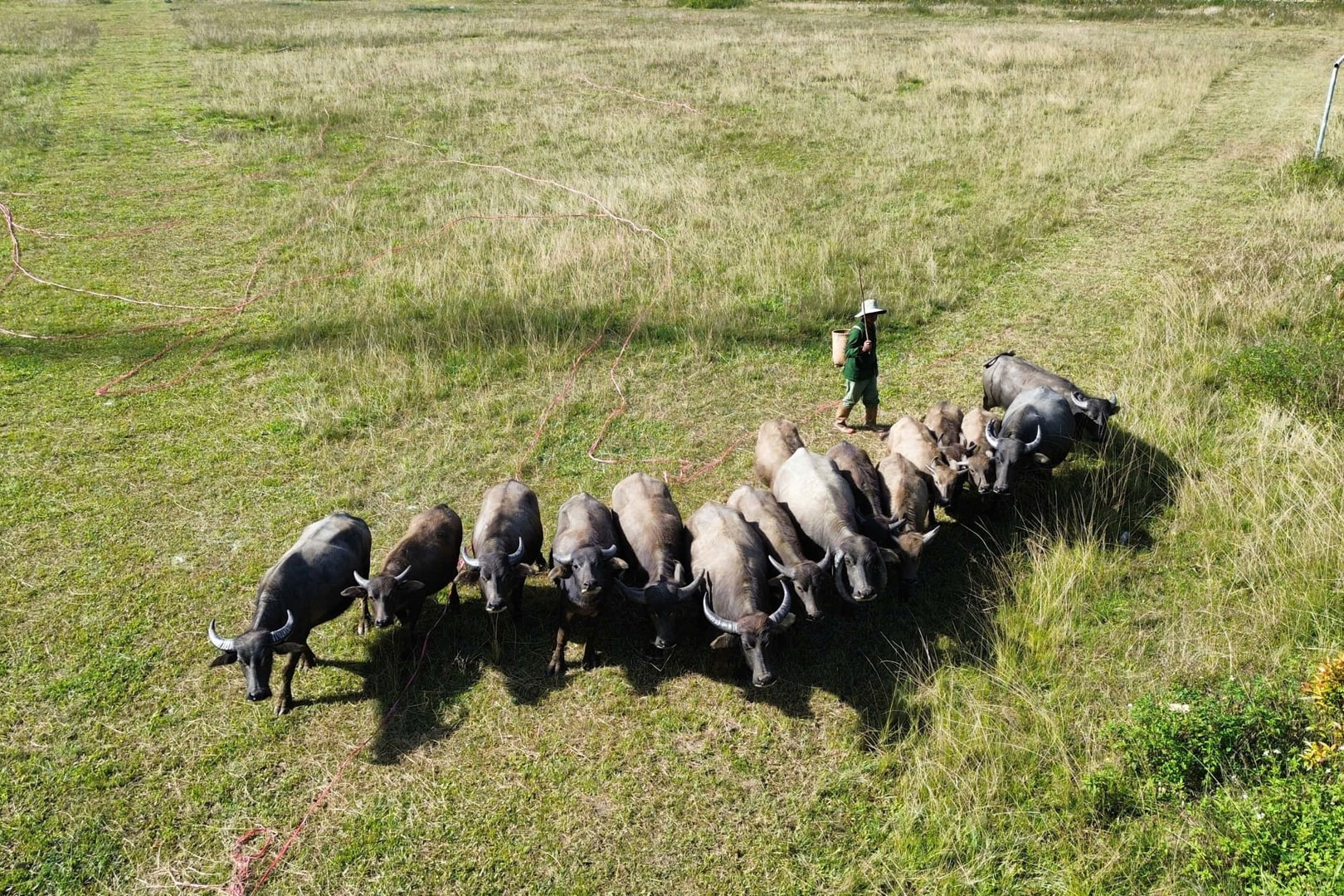
The morning in Ta Nang begins with the tinkling sound of bells echoing from the mist-covered hillsides. While trekking groups prepare to conquer "Vietnam's most beautiful route," in the villages of the Churu, Nung, and K'ho people, a different rhythm of life begins: buffaloes and cows are herded out to graze.
In his simple house in Tuo Neh village, 63-year-old Ya Thuong, a Churu ethnic minority man, leisurely puts water and lunch into his basket, preparing to go herd his buffaloes. His life is intertwined with rice fields, coffee plantations, and… his herd of buffaloes. In 1995, when his family's finances were still difficult, he started raising buffaloes. From just a few at the beginning, his herd now numbers between 15 and 20.
Mr. Ya Thuong shared that raising buffaloes isn't about selling them annually, but rather about saving them. When he needs money for his children's education, building a house, or for a major family event, he sells a few.
Mr. Ya Thuong's buffalo herd produces 2-3 calves each year. Not only does it provide a direct source of income, but the herd also helps his family save significantly on production costs. Previously, he used buffaloes for plowing the fields; now, he utilizes the manure as fertilizer for his crops and even sells some of it to neighboring households.
His family's income also comes from 1 hectare of coffee plantation and a few acres of rice paddies. Because the land isn't large, he manages to grow 1 acre of grass as supplementary feed for his livestock, and utilizes the straw after the rice harvest. Most of the work is done by family members. The family's farming and livestock raising forms a mutually supportive cycle, helping to reduce costs and maximize the use of agricultural by-products.
For Mr. Ya Thuong, the buffalo herd is not only his greatest asset but also something he "gives back" to his children when they get married, a very unique way of accumulating wealth among the local people.
Not far from Tuo Neh village, Mr. Ya Phin in Ma Bo village (Ta Nang commune) is considered one of the exemplary livestock farmers in the region. He started raising buffalo and cattle in 2009, and at one point his family's herd reached over 50 animals. "There were times when I raised a lot, but I had to plan carefully and keep the herd within my means of care," Mr. Ya Phin said. Currently, his family maintains 10 cows and 13 buffaloes. Six of his buffaloes and cows are about to give birth. Last year, he sold five, earning nearly 100 million VND.
Besides livestock farming, Mr. Ya Phin has 1.5 hectares of coffee, yielding about 3.4 tons per harvest. The manure from his buffaloes and cows is used to fertilize the coffee plants, reducing the cost of chemical fertilizers. His family also cultivates 4 sao (approximately 0.4 hectares) of rice paddies, providing both rice for consumption and straw for livestock feed. For many years, Mr. Ya Phin has found buffaloes and cows to be his most stable and least risky source of income compared to crops, especially in increasingly harsh weather conditions.
The method of accumulating wealth through herds of buffalo and cattle, as practiced by Mr. Ya Thuong and Mr. Ya Phin, is also a common practice among many ethnic minority households in Ta Nang to cope with seasonal risks and market fluctuations. With natural grazing, buffalo and cattle here reproduce once every 15-20 months.
According to breeders and market assessments, buffalo and cattle raised on natural pastures and given plenty of exercise have firm muscles, well-defined marbling, a deep red color, and less fat. The meat has a naturally sweet, rich flavor and a distinctive aroma, different from meat from livestock raised on industrial feed.
Meat from naturally raised buffalo and cattle is increasingly attracting consumer attention due to its superior quality and nutritional value. Recognizing this, the Ta Nang - Phan Dung food processing business boldly invested in machinery and equipment to produce Ta Nang - Phan Dung coffee-flavored dried beef. However, despite the Ta Nang - Phan Dung coffee-flavored dried beef product receiving OCOP 3-star certification and high market appreciation for its quality and flavor, its current market demand is not yet stable. This highlights the need for additional solutions to support consumption connections, product promotion, and market expansion so that this local specialty product can fully leverage its advantages and value.
The largest grazing area in the region.
According to statistics, Ta Nang commune currently has a herd of nearly 9,000 buffalo and cattle. This includes 2,577 buffalo and 6,270 cattle. With this scale, Ta Nang is considered a large buffalo and cattle farming area compared to many neighboring regions. In recent years, the commune government has supported and collaborated with the people in preventing and controlling seasonal diseases in buffalo and cattle. As a result, the people can confidently engage in livestock farming.
Mr. Nguyen Tien Dien, Secretary of the Ta Nang Commune Party Committee, assessed that large-scale livestock farming has been identified by the locality as one of the economic pillars and included in its leadership and guidance resolutions. Based on the advantage of grasslands under the forest canopy and a relatively large remaining land area for livestock farming of approximately 1,500 hectares, the commune is planning concentrated livestock farming areas and simultaneously calling on businesses to invest on a scale of 20-50 hectares or more, aiming to form a linkage chain between the people and businesses.
Ta Nang has attracted interest from several large livestock businesses, raising hopes for the formation of large-scale livestock farming models linked with local people. However, currently, household-based livestock farming remains dominant, suited to the production practices and conditions of ethnic minority communities.
A unique aspect of livestock farming in Ta Nang is the close integration between crop cultivation and animal husbandry. Livestock not only provide value from meat and breeding stock but also supply fertilizer, contributing to a closed production cycle that helps people stabilize their lives.
For many visitors, Ta Nang is a land of rolling grassy hills and fluffy sea of clouds at dawn. With 78% of its population being ethnic minorities, it is also a land of buffalo and cattle, and of families quietly building their livelihoods over the years.
Ta Nang is gradually becoming a specialized livestock farming area, where traditional livelihoods are elevated into a driving force for development, supporting ecotourism and contributing to shaping a harmonious development model between people, forests, and markets.
Farmers in Ta Nang primarily earn their income from agricultural production, cultivating approximately 6,088 hectares of land. This includes over 2,500 hectares of coffee, 1,050 hectares of rice, and about 400 hectares of short-term crops.
Source: https://baolamdong.vn/cua-de-danh-o-ta-nang-414773.html
![[Photo] Solemn bathing ceremony and Buddha procession in Hue](https://vphoto.vietnam.vn/thumb/1200x675/vietnam/resource/IMAGE/2026/05/31/1780228263543_1-jpg.webp)

![[Photo] The General Secretary, President and his wife begin their state visit to the Philippines.](https://vphoto.vietnam.vn/thumb/1200x675/vietnam/resource/IMAGE/2026/05/31/1780230559452_anh-man-hinh-2026-05-31-luc-19-28-11.png)
![[Photo] Admire the coral "masterpiece" amidst the million-year-old heritage of Dak Lak province.](https://vphoto.vietnam.vn/thumb/1200x675/vietnam/resource/IMAGE/2026/05/31/1780221235105_anh-man-hinh-2026-05-31-luc-16-53-27.png)












![[Video] Sunset at Lap An Lagoon – Where the sun sets over the fishing nets](https://vphoto.vietnam.vn/thumb/340x192/vietnam/resource/IMAGE/2026/05/31/1780192137701_beach-landscape-sea-water-nature-grass-745871-pxhere-com.jpeg)






































![[Photo] Admire the coral "masterpiece" amidst the million-year-old heritage of Dak Lak province.](https://vphoto.vietnam.vn/thumb/402x226/vietnam/resource/IMAGE/2026/05/31/1780221235105_anh-man-hinh-2026-05-31-luc-16-53-27.png)


































Comment (0)