

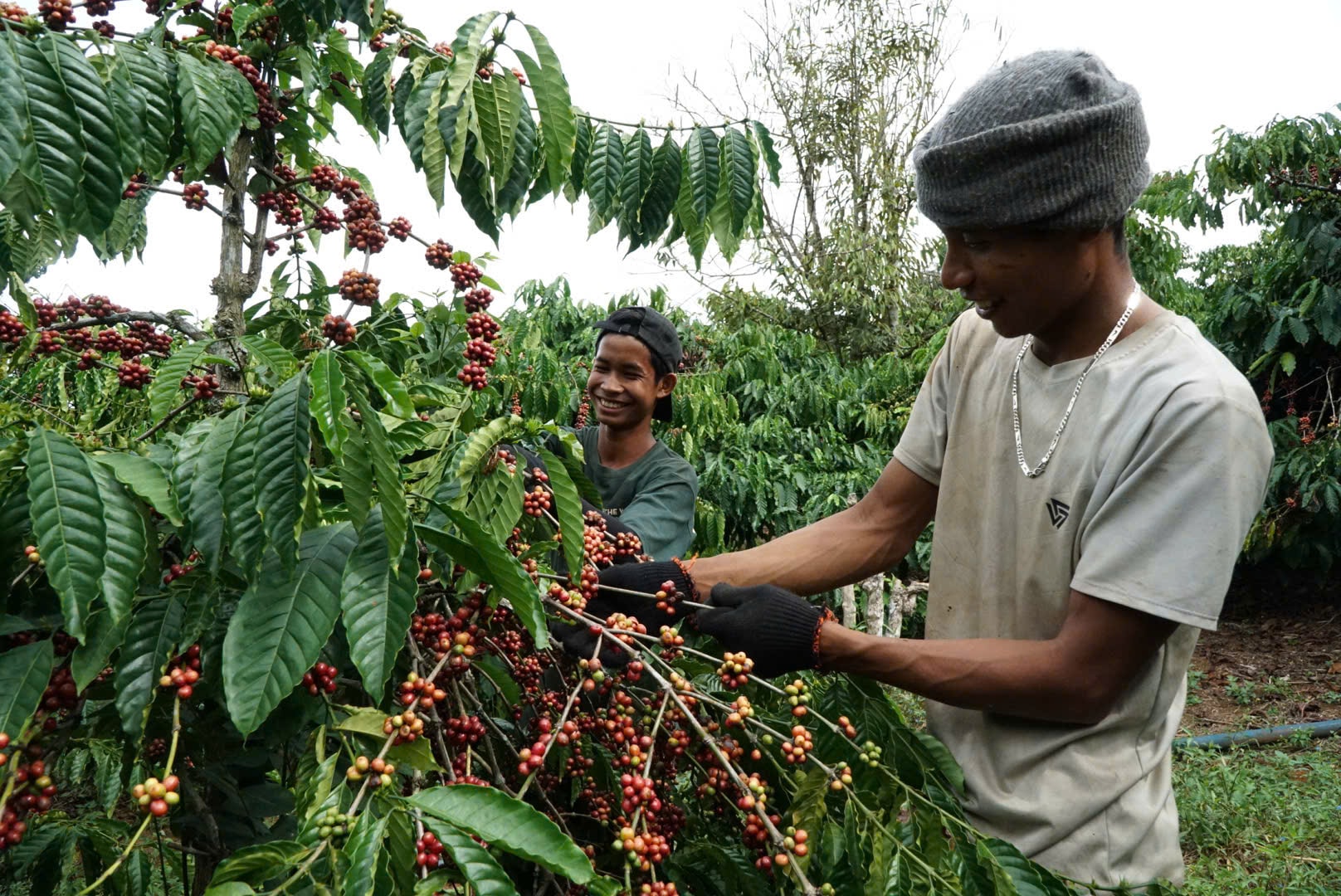
From economies of scale to the pressure of new standards
The EUDR requires imported coffee products to demonstrate that they did not cause deforestation after December 31, 2020, ensuring land legality and traceability to each individual plot. Exporting coffee requires not only delicious and clean produce but also a clear "record" from the plantation to the port. Meanwhile, the entire province only has 435 hectares of coffee plantations with registered planting area codes, a very small number compared to the more than 328,000 hectares currently under production.
Beyond simply assigning planting area codes, the greater challenge lies in building and unifying a forest database as of December 31, 2020 – the most important legal basis for proving that no deforestation has occurred. Currently, the province must review and standardize forest maps according to the new administrative boundaries, and also needs high-quality remote sensing imagery for comparison. This is a complex and costly task, requiring the coordinated efforts of many sectors and support from the central government and international organizations. Meanwhile, coffee production in Lam Dong mainly relies on approximately 220,000 farming households, mostly small-scale farmers. Collecting GPS and polygon data for each plot, guiding farmers in declaring information, and updating it on the traceability system... is a huge undertaking that cannot be completed solely through administrative efforts.
From a business perspective, Ms. Trinh Thi Thanh, Director of a coffee purchasing and export company in Nam Gia Nghia ward, said that immediately after the EU's anti-deforestation regulations were disseminated, the company proactively reviewed its entire raw material area and implemented various solutions to meet the new requirements from the European market. However, production reality presents many challenges, as most coffee plantations are small-scale and intercropped with many other plants, making the cost and effort of registering planting area codes and building a traceability system time-consuming and expensive. Businesses urgently need stronger support from state management agencies, especially in providing unified guidance on procedures, forest data, and mechanisms for verifying compliance with EUDR, in order to reduce risks and costs for businesses and farmers.
The test isn't just for farmers.
Lam Dong province has established a solid foundation for sustainable coffee production. Currently, nearly 119,000 hectares of coffee plantations in the province have received VietGAP, 4C, UTZ, Rainforest, and organic certifications; forming 65 supply chains involving over 29,000 farming households and dozens of businesses and cooperatives. Coffee intercropping models with fruit trees and industrial crops, covering approximately 60,000 hectares, not only increase income but also align with ecological principles, reducing pressure on land and forest resources.
However, sustainability certification and supply chain linkages are only necessary conditions. The EUDR requires a higher level of transparency, greater detail, and stricter legal compliance. If businesses fail to establish a synchronized traceability system, if local authorities do not have a firm grasp of the current state of land and forests, and if farmers are not given specific guidance, the risk of being excluded from the EU market is very real. According to the roadmap, large businesses must comply with the EUDR from December 31, 2025, and small and micro-enterprises no later than June 30, 2026.
Conversely, the EUDR could become a powerful impetus for the in-depth restructuring of Lam Dong's coffee industry. Well-organized raw material areas with complete data and adherence to environmental standards will have a clear advantage in price and market negotiations. State management agencies create the legal framework and basic data, businesses proactively invest in traceability systems and work alongside farmers, while coffee growers need to change their production habits, record and disclose information transparently.
Source: https://baolamdong.vn/eudr-thu-thach-nganh-ca-phe-lam-dong-426243.html
![[Photo] Admire the coral "masterpiece" amidst the million-year-old heritage of Dak Lak province.](https://vphoto.vietnam.vn/thumb/1200x675/vietnam/resource/IMAGE/2026/05/31/1780221235105_anh-man-hinh-2026-05-31-luc-16-53-27.png)

![[Photo] The General Secretary, President and his wife begin their state visit to the Philippines.](https://vphoto.vietnam.vn/thumb/1200x675/vietnam/resource/IMAGE/2026/05/31/1780230559452_anh-man-hinh-2026-05-31-luc-19-28-11.png)
![[Photo] Solemn bathing ceremony and Buddha procession in Hue](https://vphoto.vietnam.vn/thumb/1200x675/vietnam/resource/IMAGE/2026/05/31/1780228263543_1-jpg.webp)















![[Video] Sunset at Lap An Lagoon – Where the sun sets over the fishing nets](https://vphoto.vietnam.vn/thumb/340x192/vietnam/resource/IMAGE/2026/05/31/1780192137701_beach-landscape-sea-water-nature-grass-745871-pxhere-com.jpeg)



































![[Photo] Admire the coral "masterpiece" amidst the million-year-old heritage of Dak Lak province.](https://vphoto.vietnam.vn/thumb/402x226/vietnam/resource/IMAGE/2026/05/31/1780221235105_anh-man-hinh-2026-05-31-luc-16-53-27.png)
































Comment (0)