

From streamlining the organizational structure to making it "lean, efficient, and powerful"
A significant and outstanding achievement in Party building and rectification during the 13th National Congress term was the nationwide restructuring and streamlining of the apparatus. Occurring rapidly with unprecedented political determination, this historic "major overhaul" was not simply a mechanical reduction but was likened to a "reorganization of the nation" to make the apparatus more effective and efficient.
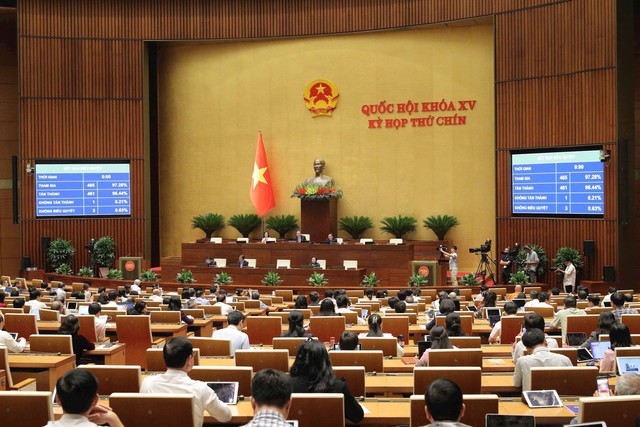
The National Assembly voted to approve the Resolution on the reorganization of provincial-level administrative units on June 12, 2025.
PHOTO: VGP
With the motto "lean, efficient, strong, effective, and efficient," after the restructuring, the Government now has 14 ministries, 3 ministerial-level agencies, and 5 government-affiliated agencies. Notably, all 13/13 general departments and equivalent organizations were abolished; 509 departments and equivalent organizations were streamlined (a reduction of 76.2%); and 231 divisions and equivalent organizations were reduced (60.2%). The number of public service units within the organizational structure of ministries and agencies decreased by 82/224 units, equivalent to 36.6%.
At the provincial level, 709 agencies were reduced, and at the district level, 8,289 agencies were reduced. After the two-tiered local government model officially came into operation, the country now has 34 provincial-level administrative units and 3,321 commune-level administrative units, creating a foundation for reforming local governance methods.
National Assembly representative Mai Van Hai (Thanh Hoa) assessed the transition to a two-tiered local government model as "a comprehensive and profound revolution, the best ever." He compared it to the previous one, saying, "Before, the more we expanded, the more bloated the system became; this time, we have done it very fundamentally, and now the system is operating smoothly." However, because this is "unprecedented," Mr. Hai believes that further institutional improvements are needed, especially clearly defining the authority between the central and local governments, and between provinces and communes, to avoid the situation where "old mechanisms" are applied to the "new model."
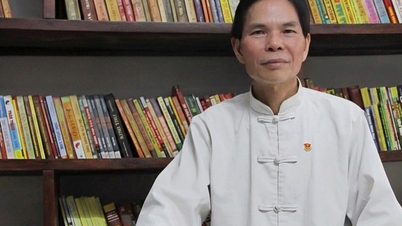
Affirming that restructuring the apparatus is the right direction to overcome overlapping and duplication of functions and tasks, former Director of the Institute of Party History Nguyen Manh Ha pointed out that this is also an important prerequisite for reducing recurrent expenditures and focusing resources on development investment and social welfare.
However, he acknowledged that every major overhaul comes with its share of "pain." The rapid mergers have left many officials, especially at the grassroots level, feeling overwhelmed and confused. Furthermore, while the downsizing policy is humane, it has also created the paradox of "reverse brain drain," where capable individuals proactively resign to receive benefits or seek better opportunities elsewhere. According to Mr. Ha, this is a practical problem that Party building efforts in the coming period need to pay special attention to.
In a general overview, Prime Minister Pham Minh Chinh remarked that the operation of the two-tiered local government system to date has been "very successful." This is a very fundamental transformation, shifting from management to creation and service to the people, based on digital transformation. This model helps reduce intermediaries, bringing the government closer to the people and more responsive to their needs.
"A system of habits that has been in place for 80 years cannot possibly achieve the goals we have set so quickly," the Prime Minister said, noting that the guiding principle of transformation is not to strive for perfection or rush, but to not miss opportunities for development.
Reaching a breakthrough at the "key of keys" stage.
Deeply aware that cadres are "the foundation of all work," during the 13th term, the Party implemented groundbreaking changes in its thinking regarding human resource management. The "term-based" mindset and the mentality of "being on the payroll means lifelong stability" were gradually dismantled.
Mr. Nguyen Manh Ha views the use of Key Performance Indicators (KPIs) and the identification of specific job positions as a very objective measure, representing a shift from qualitative to quantitative evaluation. "KPIs become evidence to eliminate incompetent employees, helping to overcome the previous mentality of deference and hesitation in giving feedback and criticism," Mr. Ha analyzed.
Another significant and groundbreaking achievement in personnel work during the past term was that, for the first time, the Party completed the process of appointing 100% of provincial and city Party secretaries and provincial and city People's Committee chairmen who are not from the local area, and is continuing to implement this for other positions. This policy aims to ensure objectivity and overcome factionalism, nepotism, or nepotism among leaders at all levels. Expressing strong support, delegate Nguyen Thi Yen (Ho Chi Minh City) suggested expanding this to include positions in the judicial sector such as courts, procuratorates, and inspectorates to ensure absolute independence. "I propose that this be clearly stated in this term, without further research. If research is conducted, it might be implemented, but it might not be," Ms. Yen said when commenting on the draft documents of the Party presented to the 14th National Congress.
Besides issuing "tools" to control officials, the Party has also institutionalized the protection of dynamic officials who dare to think and act for the common good by issuing Conclusion No. 14-KL/TW dated September 22, 2021, and Decree No. 73/2023/ND-CP. This is considered an important solution to "unleash" the mindset of officials in performing their duties and responsibilities. Mr. Nguyen Manh Ha believes that it is necessary to clearly distinguish between violations due to personal gain and violations due to inadequate mechanisms. If officials work enthusiastically, democratically, openly, and without self-interest, then even if mistakes are due to objective factors, their responsibility should be mitigated or waived.
And to protect officials who dare to think and act, according to Mr. Ha, the most fundamental solution is not to shout slogans, but to establish a safe legal framework for officials who are assigned and empowered so that they can work with peace of mind.
Regarding the restructuring of the administrative apparatus, delegate Nguyen Huy Thai (Ca Mau) suggested that this is the opportune time to re-establish the mechanism for evaluating and utilizing cadres and civil servants in general, and talented individuals in particular, especially young people, so that they can contribute and work in a favorable and suitable environment. Recalling a meeting between the Ca Mau National Assembly delegation and students from the province studying in Hanoi and surrounding areas in November 2025, Mr. Thai shared the desire of young people that graduates with competence, ambition, dreams, and dedication should not be discriminated against in recruitment and employment.
"If young people see that daring to think, daring to act, and daring to take responsibility always comes with risks and losses, then no one can be sure that young people will not fail and wait for opportunities, which means not living authentically, not being dynamic and creative," Mr. Thai worried and suggested that there needs to be a mechanism for valuing talent based on the principle of transparent competition coupled with accountability.
Of course, protecting officials doesn't just stop at refraining from criminal prosecution when risks occur (if the motive is pure), but more importantly, it's about granting them sufficient authority to proactively perform their duties. National Assembly representative Le Thu Ha (Lao Cai) proposed the principle: "It is necessary to clearly define the person, the task, and the responsibility; increasing authority must go hand in hand with increasing control; accordingly, a fixed list of delegated tasks should be issued along with a set of indicators to evaluate the effectiveness of implementation." Implementing a combination of solutions will help the team of officials fully utilize their capabilities, so that "every working day is a day of creation, each person is a soldier on the front lines of reform," as requested by General Secretary To Lam.
"Combating waste" is on par with "combating corruption".
For the first time, during the 13th Party Congress, the Party elevated the awareness of waste prevention and control to an urgent task, placing it on par with and alongside the fight against corruption, with the motto "no forbidden zones, no exceptions".
Wastefulness is recognized as having serious consequences, sometimes even greater than corruption, due to its insidious nature and long-term negative impact on development resources. Therefore, the current breakthrough solution focuses on drastically streamlining the administrative apparatus to optimize public spending; tightening management and ensuring efficient use of national resources, especially land. Simultaneously, it aims to remove institutional bottlenecks to unlock resources and prevent the waste of development opportunities for the country.
Source: https://thanhnien.vn/cuoc-dai-phau-lich-su-185260109231815851.htm








![[Video] Voters in a mountainous commune in Quang Tri province are ready for election day, March 15th.](https://vphoto.vietnam.vn/thumb/402x226/vietnam/resource/IMAGE/2026/03/12/1773300751141_1080-jpg.webp)











![[Photo] A vibrant celebration of generations of Nhan Dan Newspaper staff](https://vphoto.vietnam.vn/thumb/1200x675/vietnam/resource/IMAGE/2026/03/11/1773228432744_cb-75-nam-7-7034-jpg.webp)















































Comment (0)