

The startup company Destinus has designed a hydrogen supersonic aircraft that could travel from Frankfurt to Sydney in just over 4 hours or from Memphis to Dubai in 3.5 hours.
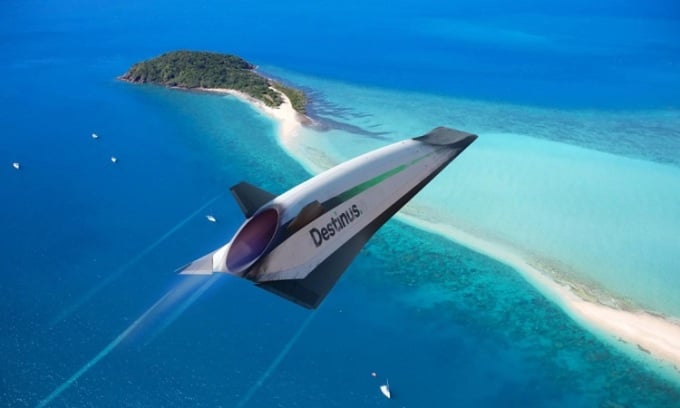
Design of a hydrogen-powered supersonic aircraft. Photo: Destinus
Destinus's design is a hydrogen aircraft that travels five times faster than the speed of sound, reducing flight times by a quarter compared to current commercial aircraft, CNN reported on May 4th. Based in Switzerland with a team of 120 employees in Spain, France, and Germany, Destinus was founded in 2021 but has quickly achieved several milestones. The company's first two prototypes have successfully completed test flights and are about to undergo hydrogen flight trials. A third prototype, Destinus 3, is expected to make its maiden flight later this year.
According to Martina Löfqvist, the company's business development director, while leading competitors like Boom Supersonic focus more on smaller models to understand the mechanics and find ways to make these manned aircraft work, Destinus is directly moving towards autonomous flight. The company's strategy is to develop small drones before upgrading them into passenger or piloted aircraft.
Destinus chose hydrogen as its fuel because it is a clean, renewable energy source with increasingly lower production costs, which can help the company realize its goal of high-speed, long-distance flights. Hydrogen aircraft are still in their infancy, and hydrogen jet engines are not yet commercially operational. "We are trying to fly from Europe to Australia at Mach 5 (6,174 km/h). Using kerosene would make the vehicle quite heavy, while hydrogen is very light. Hydrogen also has a higher energy density than traditional jet fuels," Löfqvist shared.
Destinus' long-term goal is to fly entirely on hydrogen and produce zero emissions. However, in the short term, the company plans to use conventional aviation fuel called Jet A for takeoff, then switch to hydrogen at Mach 3 (3,704 km/h) because hydrogen is not really useful or better than Jet A until supersonic speeds are reached.
The prototype of the Destinus is a streamlined, wing-and-body aircraft. This supersonic design first emerged in the 1950s but never went into production. Löfqvist shared that this basic shape had been studied for many years so that the aircraft could glide on top of the shock waves created by the aircraft itself. It's a fairly efficient shape because you can use less fuel to fly thanks to the lower air resistance.
With each new prototype, Destinus improves and refines the design. The next prototype, Destinus 3, will fly at supersonic speeds and may perform hydrogen-powered flights by 2024. According to Löfqvist, the vehicle is quite large, similar in size to the previous prototype at 10 meters in length, but 10 times heavier and 20 times more complex in terms of structure and propulsion. In the 2030s, the company will put into operation a small passenger aircraft with a capacity of 25 passengers, focusing on business class. In the 1940s, the full-size version will be divided into several classes, including economy class.
An Khang (According to CNN )
Source link
![[Photo] The General Secretary, President and his wife meet with Vietnamese-Chinese friendship leaders.](https://vphoto.vietnam.vn/thumb/1200x675/vietnam/resource/IMAGE/2026/04/15/1776264829725_vna-potal-tong-bi-thu-chu-tich-nuoc-to-lam-gap-mat-nhan-sy-huu-nghi-viet-nam-trung-quoc-8703641-3130-jpg.webp)
![[Photo] National Assembly Chairman Tran Thanh Man attends the opening session of IPU-152](https://vphoto.vietnam.vn/thumb/1200x675/vietnam/resource/IMAGE/2026/04/16/1776277863731_ctqh5-jpg.webp)
![[Photo] My Son at night: A thousand-year-old heritage site amidst the Milky Way](https://vphoto.vietnam.vn/thumb/1200x675/vietnam/resource/IMAGE/2026/04/15/1776261039184_ndo_br_chon6-jpg.webp)
![[Photo] Mrs. Ngo Phuong Ly meets and exchanges views with Mrs. Peng Li Yuan](https://vphoto.vietnam.vn/thumb/1200x675/vietnam/resource/IMAGE/2026/04/16/1776277858080_phu-nhan-1-jpg.webp)































































Comment (0)