

Speaking and acting simultaneously, the nimble young man helped Mrs. Hang open the package. Immediately, emotions overwhelmed her; in her hands was a notebook with a blue plastic cover, the very notebook that, more than 50 years ago, the tenth-grade girl had given to her boyfriend before he left to join the army.
***
It was the early days of 1972. Breaking news from the battlefield disrupted the peaceful atmosphere of the charming town by the Thuong River. It seemed we were preparing for a major offensive, building momentum for a counterattack in the South, and also gaining the upper hand at the Paris peace talks. For the high school seniors, this was a unique opportunity to contribute to the seemingly imminent victory of the nation. Many boys in class 10G couldn't sit still and volunteered to enlist, including their class leader, Dung.
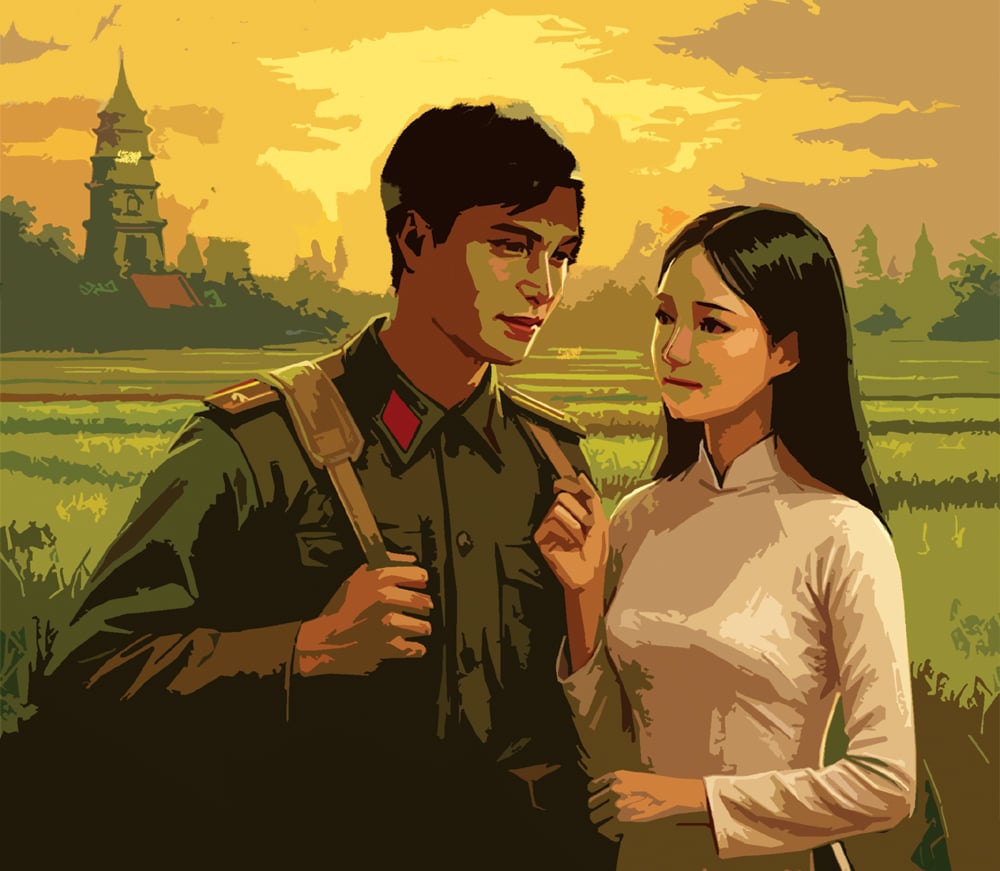 |
Illustration: Hien Nhan. |
Hang, Dung's close friend, was the first person in the class he shared this decision with. It was the day they rode home together after a day of cleaning up the school's bomb shelter. After several years of ceasing bombing in North Vietnam from the 18th parallel northward, the Thunderbolts and Phantoms of the US Air Force were once again roaring across the skies of North Vietnam. As they parted ways under the bamboo grove by the Thuong River, Dung said:
- I've volunteered to enlist. I'll probably be leaving soon…
- Oh, if you leave, who will be class president?
Dũng chuckled at his classmate's question. The question was a little funny, but it reflected the reality that, in Hằng's mind and that of most of his classmates, Dũng being class president was a given. From 8th grade until now, the entire class G had consistently elected Dũng as class president because he was academically gifted, friendly, and proactive in class and school affairs.
For some reason, the two were very close despite their vastly different family backgrounds. Hang's family was well-off; her father held an important position at the Ministry of Agriculture , and her mother was a teacher. Dung's parents, on the other hand, were railway workers. His father drove trains, and his mother sold tickets at the town's train station. Hang was the youngest of four siblings, so she was spoiled. Meanwhile, Dung was the eldest of four siblings, three boys and one girl. His parents were factory workers, and life was difficult during the subsidy era, so outside of school hours, Dung did all sorts of jobs to help his parents. Since junior high school, during summer breaks, Dung would bring hot herbal tea to the train station to catch trains going in and out. In the evenings, he would chop weeds and cook pig feed. In this way, Dung managed to earn enough money to buy books and school supplies for himself and his siblings. What made his classmates, including Hang, admire their class president was that despite his hard work, Dung was an excellent student, especially in Literature.
In the early days of Dung's military service, Hang still saw the image of her slender boyfriend, sitting attentively by the bookshelf in her living room. Initially, Dung was so captivated by that bookshelf that he overcame his shyness about the difference in their circumstances. That's what Dung later admitted in letters he sent from the distant battlefield of Quang Tri . Approachable, academically gifted, and a good singer, Dung was well-liked by many girls in his class. Everyone in the class and the school remembered Dung's Quan Ho folk singing at parties and performances. Now, all of that is just a memory…
Receiving back the memento from her dear friend years ago deeply moved Ms. Hang. For her, that memento brought back countless memories of her school days and the first stirrings of love. That day was the day before Dung enlisted. Wanting some private time, Hang chose the time when families were gathered for their evening meal, when there would be few visitors. Sure enough, Hang arrived while Dung was having his farewell meal with his parents and siblings. Hang only had time to slip Dung a notebook with a light blue plastic cover and a few stamps, gently hold his hand, and leave. The dedication expressed the wishes of loved ones as the young men set off into the world of arrows and bullets: "Dung, go safely. Remember to write to Hang. Address…".
At the age of 18, if it weren't for the war, Dung and his peers would have been on the threshold of a new life: university, a vibrant life on construction sites and in factories, and the blossoming of first love. But that was also the time when the war against the US for national liberation entered its most intense phase. From the very beginning of 1972, tens of thousands of young people from the North, including tenth-grade students who had just finished the first semester of their final year of high school, enlisted in the army. Due to the demands of the battlefield, localities had to "borrow" soldiers, meaning they mobilized entire generations of young people who should have had the opportunity to complete their high school education or at least celebrate the Lunar New Year of the Rat with their families and loved ones.
***
Dũng bid farewell to his 10G class and his high school in the town during those days. After his basic training, he joined a bridge and ferry engineering unit and went all the way to Vĩnh Linh (Quảng Trị). Due to the urgent situation, the new recruits were not allowed leave before going to the battlefield as usual. Hằng learned of Dũng's departure to the battlefield through a hastily written letter he dropped off on the road as the truck passed through the town one spring night; the envelope was still stained with mud. Subsequent letters were sent from Vĩnh Linh. In the letters, Dũng told Hằng about Cửa Tùng, where the Bến Hải River flows into the sea, where his unit assembled ferries weighing tens of tons to transport tanks and artillery across the river to liberate Quảng Trị.
With the romantic soul of a talented student, he described the smooth white sand beach with its gentle, caressing waves, without mentioning the difficulties and dangers he and his comrades were facing. One thing that bothered Hang, even making her feel resentful towards her friend, was that in his letters, he never officially expressed his feelings for her, even though she had taken the initiative on their farewell. She even wondered: Perhaps Dung didn't have feelings for her as she mistakenly thought?
Then the letters from the battlefield became less frequent. Hang was sent to study abroad in a country belonging to the Soviet Union. During her time living and studying in that foreign country, she was always troubled by a longing: if only there hadn't been a war, these spacious lecture halls would have been filled with Dung and all the other outstanding young men and women who were dedicating their youth to the cause of liberating the South, unifying the country, and bringing the nation together as one.
It wasn't until she graduated and returned home in 1978 that Hang learned of Dung's death. Life went on, and even now, half a century after peace was restored, Hang is a wife, a mother, and a grandmother… yet sometimes the old question still haunts her: Did Dung have feelings for her? Why was he silent?
***
Attached to the blue-covered notebook was a letter. The writer, now 70 years old, recounted that he was from Bac Ninh town and met Dung early on April 30, 1975, by the Cat Lai River, about 30 kilometers from Saigon, when his unit, in coordination with the bridge and ferry engineering brigade, was paving the way for the main army to advance and liberate Saigon. Around 7:30 a.m., the two men shared a cigarette after a brief reunion as fellow natives of Ha Bac. Dung quickly handed him the notebook so he could write down his home address, promising to meet again after the victory. At that moment, Dung received orders to command a PAP amphibious vehicle to receive a surrendering group of marines. In just a few moments, Dung fell to the ground from a burst of AR15 bullets from a group of remaining troops. After the overwhelming attack that annihilated the stubborn remnants, he and his unit advanced their attack towards the inner city of Saigon, with Dung's notebook still in his pocket…
Times change. The hardships and difficulties of the post-war era weighed heavily on the shoulders of the soldiers returning from the battlefield. He and his family had to find a way to make a living in the former battlefield. Life, with its worries about food and clothing, swept away memories, even those that seemed unforgettable, like the reunion on the morning of April 30th.
Only recently, while searching through his mementos, did he rediscover the old notebook. Thanks to Ms. Hang's dedication from years ago: "Dung, have a safe journey. Remember to write to Hang. Address…" and after considerable effort, he finally found Ms. Hang's current address. He returned the notebook to her, seeing it as a way of atoning for not keeping his promise to his comrade and fellow villager whom he had only briefly met years ago.
What moved her to tears was that, unlike the letters sent from the battlefield, in this notebook, Dung expressed deep affection for his secret girlfriend, and his wish that they would be together when the country was at peace. There would be a time when Dung would take Hang back to Tho Ha, his maternal hometown, to visit the ancient temple and listen to Quan Ho folk songs…
Although she considered the notebook a priceless memento, after sharing it with Dung's younger siblings, Ms. Hang still decided to donate the blue-covered notebook to the school's history room – the high school where the two friends studied together – after having read it over and over until she knew it by heart…
Bac Giang - Hanoi, April 2025.
Source: https://baobacgiang.vn/cuon-so-bia-xanh-postid416971.bbg


![[Photo] Standing Committee member of the Party Central Committee Tran Cam Tu presents the Decision appointing the Secretary of the Party Committee of the Ho Chi Minh National Academy of Politics.](/_next/image?url=https%3A%2F%2Fvphoto.vietnam.vn%2Fthumb%2F1200x675%2Fvietnam%2Fresource%2FIMAGE%2F2026%2F02%2F02%2F1770039902160_le-cong-bo-bt-hvctqg-11-7880-jpg.webp&w=3840&q=75)


![OCOP during Tet season: [Part 3] Ultra-thin rice paper takes off.](/_next/image?url=https%3A%2F%2Fvphoto.vietnam.vn%2Fthumb%2F402x226%2Fvietnam%2Fresource%2FIMAGE%2F2026%2F01%2F28%2F1769562783429_004-194121_651-081010.jpeg&w=3840&q=75)


Comment (0)