

In his memoir "That Day at 15," poet Hai Bang recounts: "After the success of the August Revolution, I carried a Laotian spear and joined the self-defense force at the flagpole square in front of Ngo Mon Gate with the people of the city to witness the abdication of Emperor Bao Dai. Because I belonged to the royal family, how could I avoid being moved when I heard Vinh Thuy say: 'I would rather be a citizen of an independent country than a king of a slave country.' At that time, the hearts of the people of Hue were burning like fire. I left school and eagerly followed my friends to enlist in the liberation army. On the grounds of Dong Khanh school, I anxiously waited for the recruitment committee to call my name…" That was the moment when 15-year-old Vinh Ton (Hai Bang) bid farewell to Hue to join the National Guard in August 1945. Since then, for 30 years and through two wars of resistance, the poet has never once returned to his homeland.
 |
In the summer of 1952, poet and painter Tran Quoc Tien prepared to leave the Ba Long war zone to join the 95th Regiment for the campaign. While waiting to march, the poet composed the poem "One Hundred Years of the Old Forest" (Tran Quoc Tien also composed a poem with the same title). Then, both of them put the poems in a jar and buried it by the riverbank before saying goodbye to the war zone with so many memories. In the poem "One Hundred Years of the Old Forest," poet Hai Bang wrote:
This afternoon I turn twentieth.
Far from home, I seek romance in the forest.
The gun passed from hand to hand, guarding during the months of May, waiting.
At the top of the pass, we walk in mid-air.
Throughout the resistance, time relentlessly passed. 10 years, 20 years, 30 years… as the day of Hue's liberation drew near, the moment of overwhelming hope to return to one's homeland brought tears to the eyes of those who wrote.
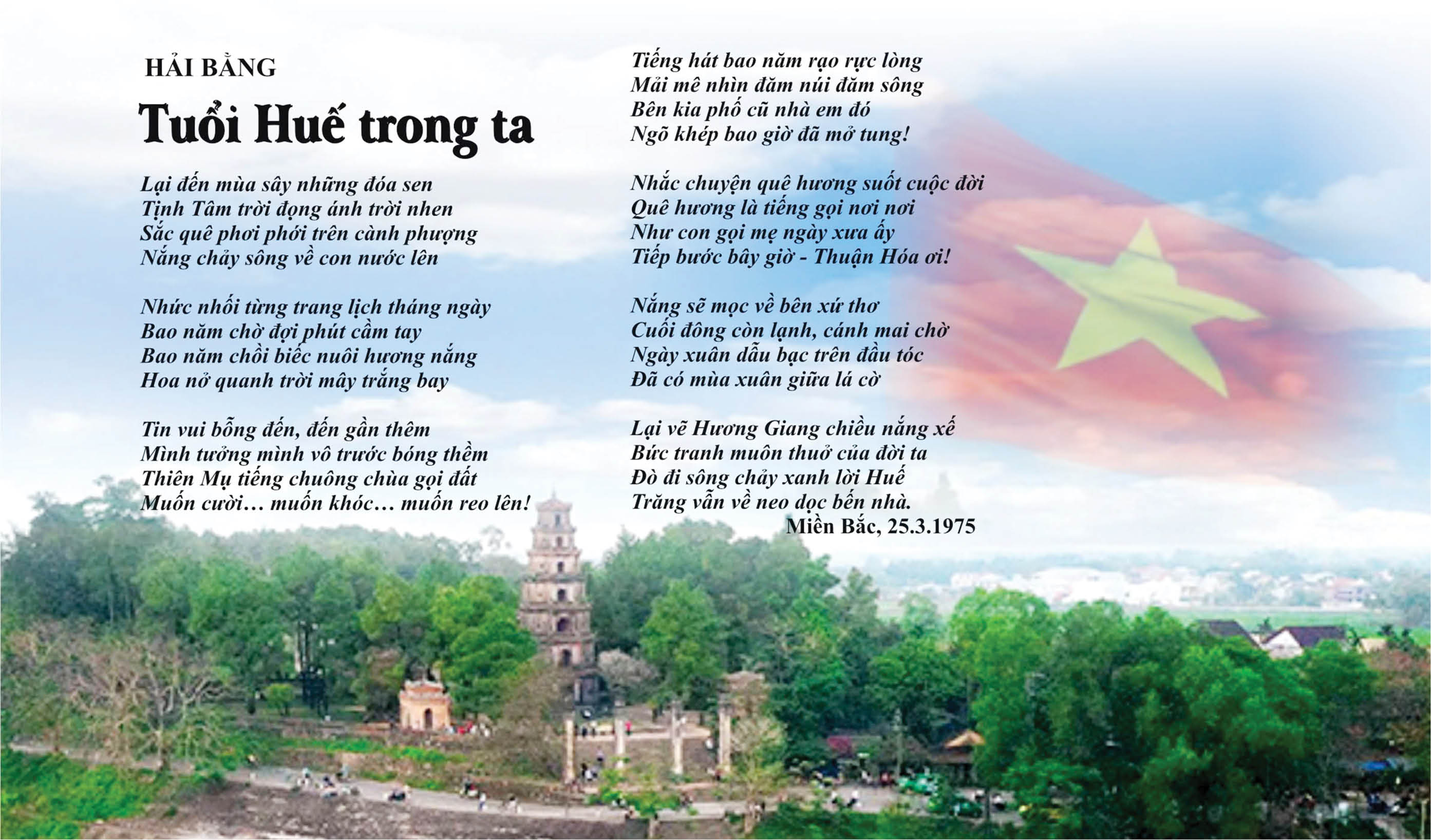
The poem "Hue Age in Us" begins with the symbolic yet concrete setting of the lotus season in Hue during summer, "the season when lotus blossoms bloom," and "the vibrant colors of the countryside on the phoenix tree branches," followed by images of eager anticipation:
Each page of the calendar is a painful reminder.
We've waited so many years for this moment to hold hands.
That longing, that anticipation, is soothed, stirred by the reality of the approaching liberation of Hue, stirred by the imagery in the heart: "Good news suddenly arrives, drawing closer / I imagine myself entering the threshold first / The sound of the temple bells calling to the land at Thien Mu Pagoda / I want to laugh… I want to cry… I want to shout!" That emotion bursts forth in the space and time of the reality of longing, the burning desire for the day of reunion.
Every street corner and alleyway blended with the people's hearts to celebrate the liberation of Hue. Their spirits soared, their excitement mingled with the joy of the people, especially since the author had been away from his homeland for 30 years and was now returning for a reunion. That moment was truly exhilarating, but at the time of writing the poem (in the North, March 25, 1975), this return was merely a vivid imagination, a stirring image conveyed through the words.
Generations set out to achieve national unity and reunification, a sacrifice fueled by burning faith and aspiration. Upon returning to their homeland, each had lived half their lives, yet that faith and hope continued to shine brightly.
The sun will rise again in the land of poetry.
The late winter is still cold, the apricot blossoms are waiting.
Even though springtime brings gray hair,
There was spring among the flags.
From the time he left in the spring of Independence (1945) and returned in the spring of Reunification (1975), although time can be counted, the length of the wait for reunification cannot be measured. Leaving when his hair was still black, returning when it was gray, the poet remains optimistic and hopeful because "there is spring under the flag," the spring of reunification…
Therefore, "The Age of Hue in Our Hearts" will no longer be a measurable physical time, but rather the timeless age of historical values that created the spring of liberation. Fifty years later, rereading the poem that marked the moment of Hue's liberation, my heart is filled with emotion, sharing the author's feelings as memories flood back with the passage of time…
Source: https://huengaynay.vn/van-hoa-nghe-thuat/da-co-mua-xuan-giua-la-co-153132.html

![[Photo] Diary of the photojournalism contest “Vietnam on the journey of innovation”](https://vphoto.vietnam.vn/thumb/1200x675/vietnam/resource/IMAGE/2026/03/09/1773041117692_anh-man-hinh-2026-03-09-luc-14-24-45.png)
![[Image] 20 islands in the Spratly Islands special administrative region hold early elections.](https://vphoto.vietnam.vn/thumb/1200x675/vietnam/resource/IMAGE/2026/03/08/1772949669607_img-20260308-112026-90-jpg.webp)
![[Image] Vietnam's diverse colors on its journey of innovation](https://vphoto.vietnam.vn/thumb/1200x675/vietnam/resource/IMAGE/2026/03/09/1773041390813_anh-man-hinh-2026-03-09-luc-14-28-17.png)





























![[Photo] Diary of the photojournalism contest “Vietnam on the journey of innovation”](https://vphoto.vietnam.vn/thumb/402x226/vietnam/resource/IMAGE/2026/03/09/1773041117692_anh-man-hinh-2026-03-09-luc-14-24-45.png)















Comment (0)