

 When talking about Lang Son cuisine , one cannot fail to mention the delicious cakes rich in cultural identity that cannot be found anywhere else. Among them is Xì ón cake - a traditional cake of the Tay and Nung ethnic groups in Lang Son. From simple, rustic ingredients such as glutinous rice, mung beans, white beans, etc., the people have created a fragrant, chewy cake that embodies the spirit of their homeland.
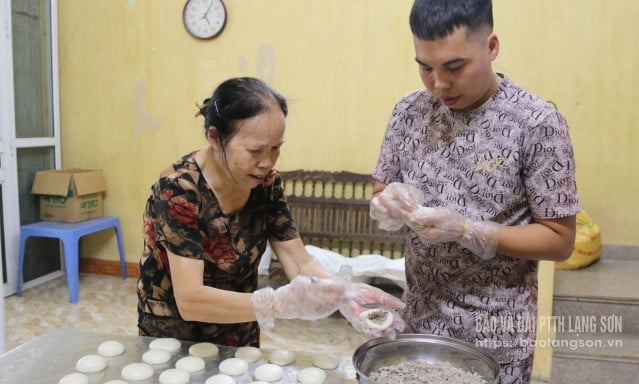
"Xì ón" is a term in the ethnic language, referring to a soft, round, and plump cake. The name itself reflects the small, round shape of the cake, embodying the spirit of togetherness and the desire for fulfillment in the lives of the Tay and Nung people. According to locals, the origin of the "xì ón" cake is unknown; it's a dish passed down through many generations. In the past, when life was difficult and challenging, people created this cake to treat guests on occasions like weddings, festivals, and holidays. Now, with improved living standards, many people make this cake to sell daily, catering to a wider range of customers.
Unlike other types of cakes such as sticky rice cakes or glutinous rice cakes, Xì ón cakes have their own unique characteristics, from ingredients to wrapping method. The main ingredients are glutinous rice, mung beans, white beans, or salted peanuts. Notably, the cakes are wrapped in banana leaves, which is also the secret to keeping them fragrant and maintaining their chewy texture for as long as possible.
To learn more about how to make Xì ón cake, we had the opportunity to visit Ms. Hoàng Thị Đồng in Tam Thanh ward, Lạng Sơn city. Ms. Đồng, who has over 20 years of experience making Xì ón cake, shared: "Since I was little, my mother and grandmother taught me how to make traditional cakes of the Tày and Nùng ethnic groups. Even now, I still preserve this tradition and make a living from it. Unlike other cakes, to make a delicious and flavorful Xì ón cake, the baker must be meticulous from selecting the glutinous rice to wrapping the cake. I usually choose the Tràng Định variety of glutinous rice, with round, large, and uniform grains, so that the finished cake is chewy and fragrant."
Ms. Dong added that the cake-making process requires patience and meticulousness. “First, the glutinous rice must be washed thoroughly, soaked for about 8 hours, then drained and steamed for about an hour. Once the rice is cooked, it's immediately pounded; if left to cool, it won't form into cakes. Previously, I used to pound the cakes manually by hand, each time taking about half an hour, which was very strenuous. About 5 years ago, I invested in a pounding machine, shortening the time to 15 minutes. The process of making the filling also requires great care. Mung beans and white beans must be soaked for 4 hours, rinsed to remove the husks, steamed until cooked, then pounded until smooth and mixed with scallion oil for a fragrant aroma. In addition, depending on customer demand, I also make peanut and sesame filling for dipping. The banana leaves must also be washed and dried one by one. Currently, on average, I sell about 100 to 120 cakes a day, priced from 4,000 to 5,000 VND per cake, bringing my family an income of about 400,000 VND per day.”
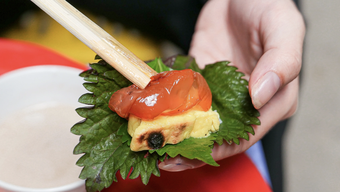
After completing all the steps, the baker uses the dough to shape it into a seashell, then places the filling in the middle and rolls it into a ball. The translucent white color of the rice, combined with the sweet, fragrant, and rich flavor of the filling, creates a harmonious blend of ingredients, resulting in a unique and distinctive pastry.
Ms. Hoang Thi Chi from Hoang Dong commune, Lang Son city, shared: "Having had the opportunity to try the 'xi on' cake made by Ms. Hoang Thi Dong in early January 2025, I found it to be a very delicious and familiar cake, not as cloying as other cakes. Both adults and children in my family praised its taste. After enjoying the 'xi on' cake, every time my family has a feast or ancestral commemoration, I order 30 to 50 cakes for my family and guests to enjoy."
According to our survey, there are currently about 10 households making Xì ón cakes in Lang Son city. Not only is it a traditional dish, but Xì ón cakes are now also popular with customers from outside the province. Ms. Nguyen Thi Quynh, a tourist from Hanoi, shared her feelings after tasting the cake: "In 2025, I had the opportunity to work in Lang Son. After enjoying many local specialties, I was particularly impressed with Xì ón cakes. With its unique name and chewy, fragrant taste, it wasn't greasy. More importantly, it gave me a heartwarming feeling, like I was sharing a part of the culture of the Tay and Nung ethnic groups. Since then, I occasionally ask my family in Lang Son to order dozens of cakes for me to eat and give as gifts."
In the flow of modernity, while many cultural traditions are gradually fading away, many people are still maintaining and preserving this unique traditional cake, deeply rooted in their ethnic identity. It's not only a staple at feasts but also present in culinary competitions and cultural events, serving as a way for the Tay and Nung people to tell their stories in the most familiar way. The skillful hands and meticulous attention to detail in selecting ingredients have created this unique cake, imbued with the flavors of their homeland. And perhaps it is this fragrant, rustic, and authentic taste that leaves an unforgettable impression on those who have had the pleasure of tasting this xi on cake.
Source: https://baolangson.vn/dan-da-banh-xi-on-xu-lang-5047489.html


![[Photo] Prime Minister Pham Minh Chinh receives the Director of RMIT University Melbourne (Australia)](https://vphoto.vietnam.vn/thumb/1200x675/vietnam/resource/IMAGE/2026/04/02/1775142120087_thiet-ke-chua-co-ten-2026-04-02t214220784-png.webp)





![[Infographic] Stock Market on April 1st: VN-Index increased by 28.44 points in the opening session of Q2/2026](https://vphoto.vietnam.vn/thumb/402x226/vietnam/resource/IMAGE/2026/04/02/1775095305328_648382_thumb_1775082921_05352102.jpeg)



















































Comment (0)