Following in the footsteps of agricultural extension workers, staying close to the fields.
On a late June morning, as the sun rose above the horizon, its first rays gently illuminated the 613-hectare rice field of the Phu Hoa Youth Agricultural Service Cooperative in Tan Hoi commune, An Giang province.
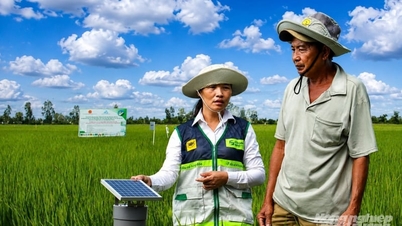
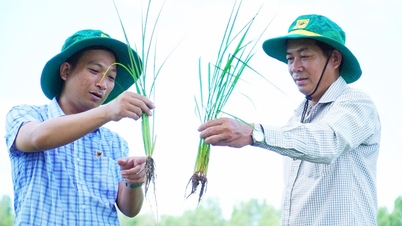
In the middle of the field, Ms. Doan Thi Hai, a grassroots agricultural extension officer from the Tan Hoi Commune General Service Center, observed the rice paddies while discussing with farmers about water regimes, fertilizer amounts, and the growth status of the rice plants.
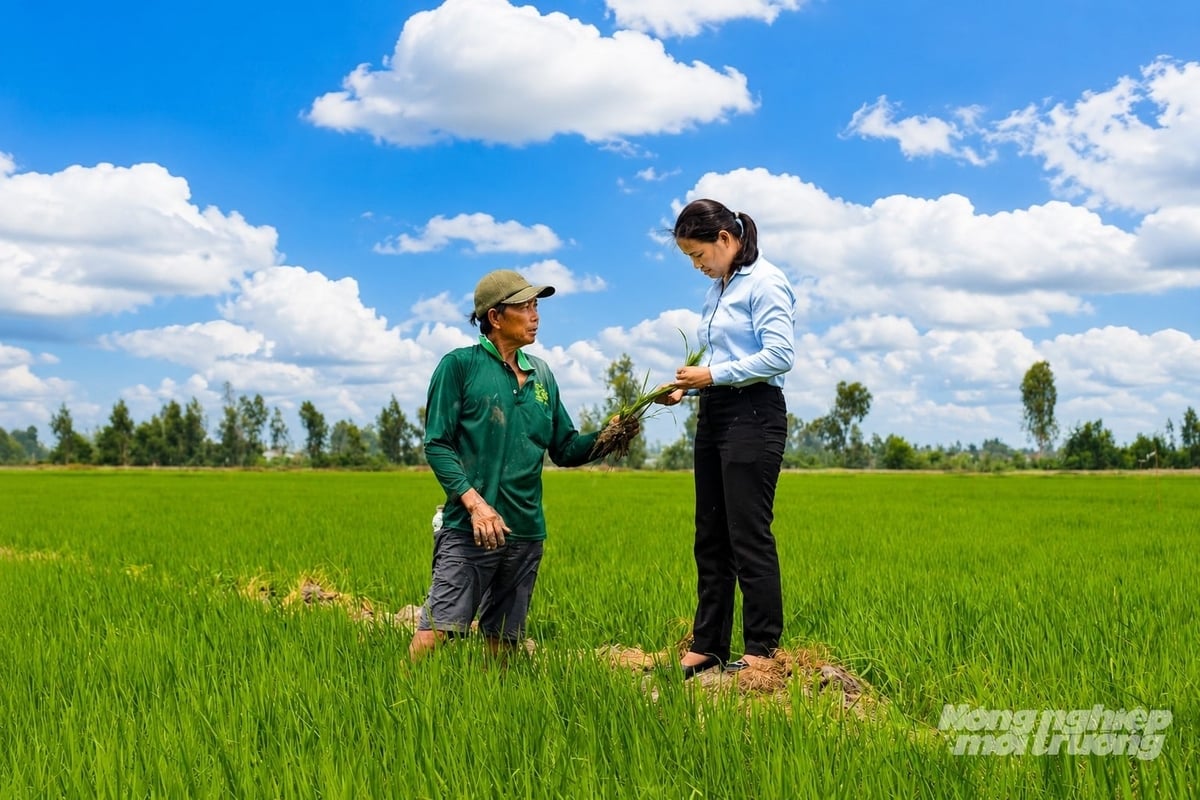
Agricultural extension officer Doan Thi Hai regularly visits farmers' fields to provide technical advice and guidance on production. Photo: Trung Chanh.
 Nearly 20 years of staying close to the people and the fields.
With over 20 years of experience in agricultural extension, Ms. Hai has held various positions, from a grassroots agricultural extension officer at the Agricultural Technical and Economic Team of the commune, to an agricultural extension officer at the Tan Hiep District Agricultural Service Center (formerly Kien Giang province), and currently a technical officer at the Tan Hoi Commune General Service Center specializing in agricultural extension. Throughout this journey, she has always worked alongside farmers and cooperatives to develop models, transfer technology, and create bountiful harvests.
Mr. Nguyen Van Huynh, Director of the Phu Hoa Youth Agricultural Service Cooperative, still vividly remembers the early days of implementing the model. Many cooperative members worried that reducing the amount of rice seeds would result in sparser planting and lower yields. However, agricultural extension officers persistently persuaded each household, visiting each field, monitoring each growth stage, and providing very specific guidance. After a few seasons, the farmers realized that sparse planting created a more airy environment, healthier rice plants, fewer pests and diseases, reduced costs, and still ensured yields.
 The man who 'gave wings' to Tuyen Hoa's agricultural products.
Just a few years ago, this area, like many other fields in the Mekong Delta, was accustomed to dense sowing, using multiple varieties, fertilizers, and pesticides based on traditional practices. When the "1 Must, 5 Reductions" program was implemented, many farmers were concerned about the changes that went against their long-standing farming habits.
Starting from a 50-hectare model under the Sustainable Agricultural Transformation Project (VnSAT) in 2021, the Phu Hoa Youth Agricultural Service Cooperative continued to participate in the high-quality rice production model adapted to climate change in the 2023-2024 winter-spring crop, and then became a pilot model for implementing An Giang province's 1 million hectare high-quality rice project.
 Sowing the seeds of knowledge in the Muong Thanh plain.
In the fields today, farmers are accustomed to managing water using alternating wet and dry irrigation methods, applying balanced fertilizers, reducing the amount of seeds sown, and collecting and processing straw after harvest instead of burning it.
According to Mr. Huynh, the greatest success of agricultural extension models lies in changing perceptions. Things that were once considered difficult have now become familiar production processes. “When people see that green production reduces costs, increases the value of rice, and protects the environment, they will voluntarily follow suit. To achieve this, agricultural extension officers must be present directly in the fields, not just provide theoretical guidance.”
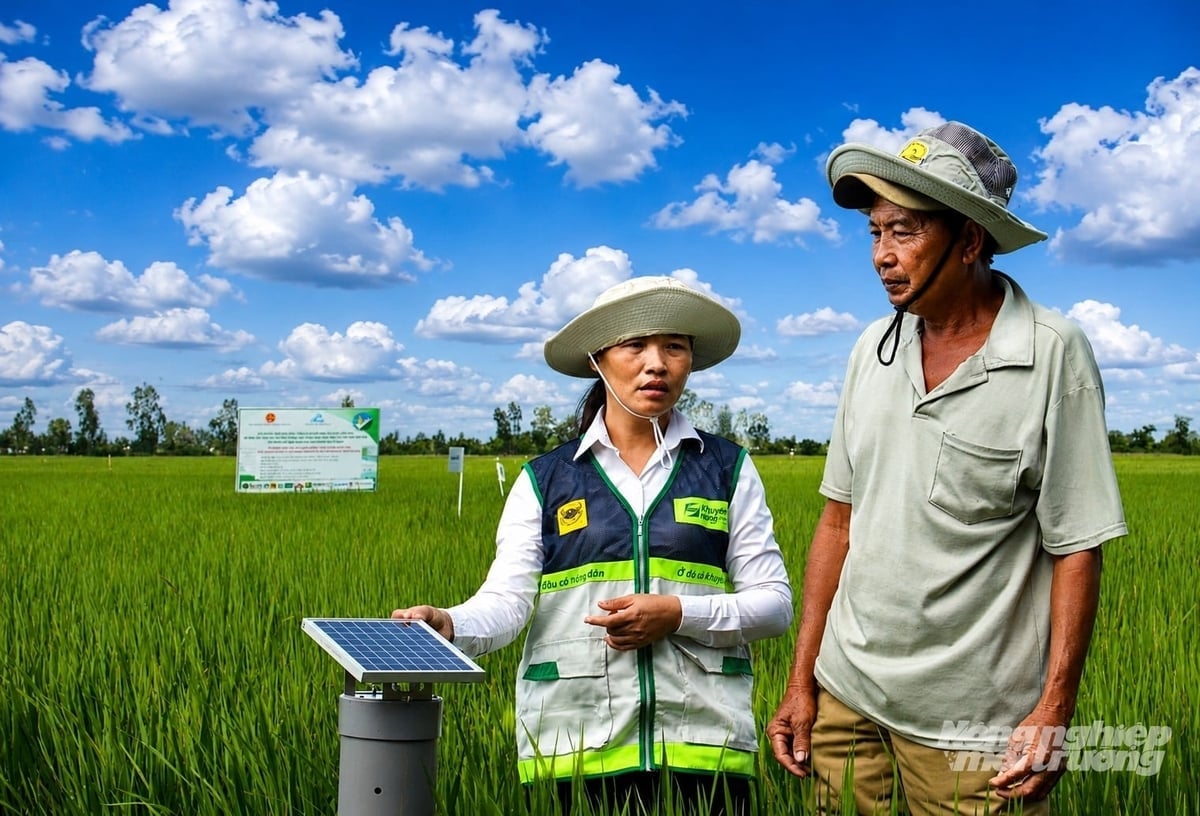
Agricultural extension worker Doan Thi Hai from the Tan Hoi Commune General Service Center, along with farmers, wades into the fields to check water level sensors in the alternating wet-dry irrigation model. Photo: Trung Chanh.



The 35-year development of An Giang's agricultural extension system has also been written from such quiet steps. Hundreds of thousands of farmers have received training, and numerous models such as "3 reductions, 3 increases," "1 must, 5 reductions," IPM, VietGAP, large-scale farming, mechanization, and rice-shrimp rotation all bear the mark of the agricultural extension team.
According to Mr. Le Van Dung, Deputy Director of the An Giang Agricultural Extension Center, 2026 marks the 35th anniversary of the formation and development of the An Giang agricultural extension system, inheriting the history of agricultural extension in Kien Giang since 1991 and continuing after the merger of An Giang and Kien Giang provinces (July 2025). From a force of only a few dozen staff members in conditions of limited infrastructure, agricultural extension has gradually grown stronger, becoming a bridge between managers, scientists, businesses, and farmers.
Throughout this process, agricultural extension officers are always present in the fields, working alongside farmers to monitor pests and diseases, guide fertilization, regulate water, calculate economic efficiency, and gradually change production practices. Today, when the goal is not only productivity but also reducing greenhouse gas emissions, that role becomes even more prominent.
Creating green agriculture
Previously, the main task of agricultural extension officers was technology transfer, but now they are becoming "production advisors" for farmers. From guiding farmers in keeping electronic logbooks, managing emissions, and tracing origins to connecting with businesses, building raw material areas, and advising on digital transformation, the scope of their work has expanded significantly.
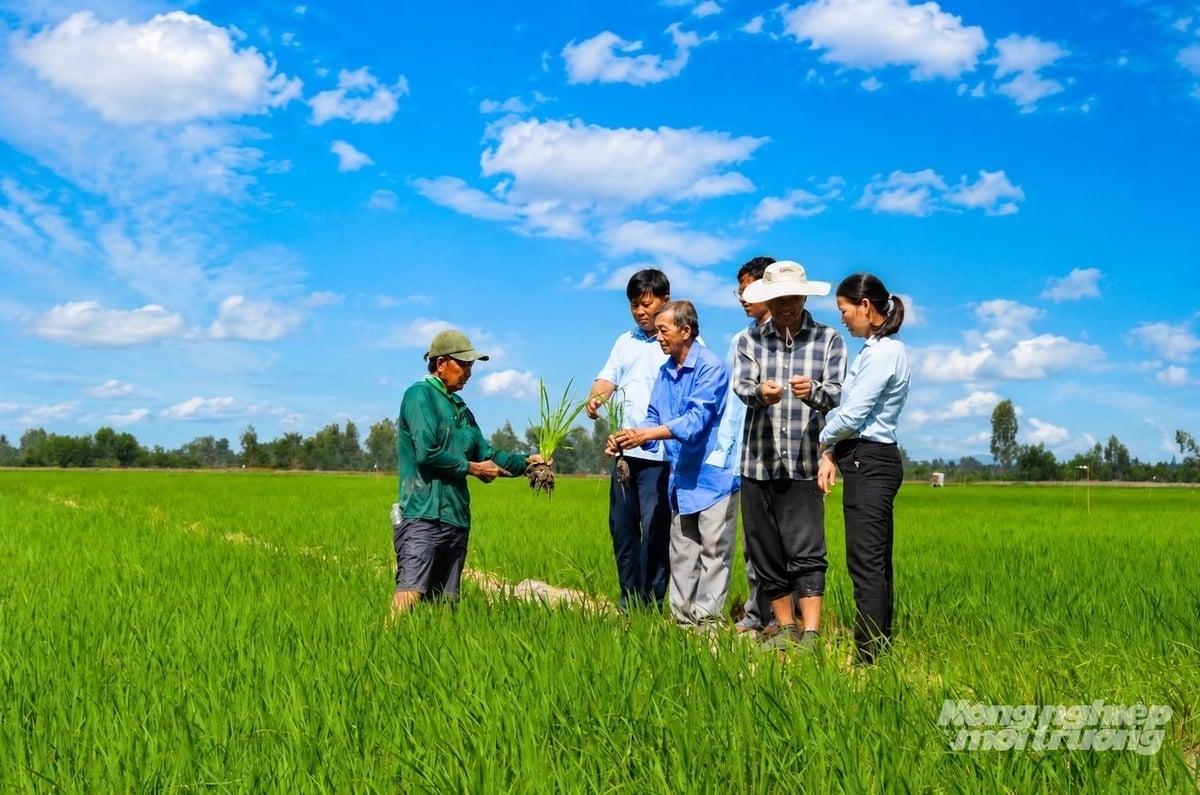
Ms. Hai and members of the Phu Hoa Youth Agricultural Service Cooperative visit the fields. Photo: Trung Chanh.
According to grassroots agricultural extension officer Doan Thi Hai, to successfully implement the 1 million hectare rice project, relying solely on sound policies is insufficient; there must also be models for farmers to learn from and follow. “To encourage farmers to change, we need technical staff who are present in the fields, working alongside them. We provide technical guidance, connect them with businesses, organize training, and resolve difficulties right in the fields. Only then will farmers feel confident in making the transition,” Ms. Hai shared.
In Tan Hoi commune, the Community Agricultural Extension Team has partnered with the cooperative to connect the consumption of thousands of hectares of high-quality rice over several consecutive seasons, creating a stable market for farmers. This represents a shift in agricultural extension from a "doing it for others" mindset to a "partnering" one, from simply transferring technology to supporting the development of agricultural value chains and the economy.
Following the establishment of An Giang province, the agricultural extension system continued to undergo a strong restructuring phase. According to the plan to reorganize the An Giang Agricultural Extension Center, the unit was further streamlined to focus on providing professional advice and guidance, coordinating, inspecting, and supporting agricultural extension work throughout the province.
Accordingly, nearly 800 agricultural extension staff positions have been transferred to the People's Committees of communes and to the commune's comprehensive service centers, aiming to bring technical personnel closer to farmers and strengthen community agricultural extension groups. This is not simply an organizational change, but a step towards having more technical personnel present in the fields, promptly addressing issues arising at the grassroots level.



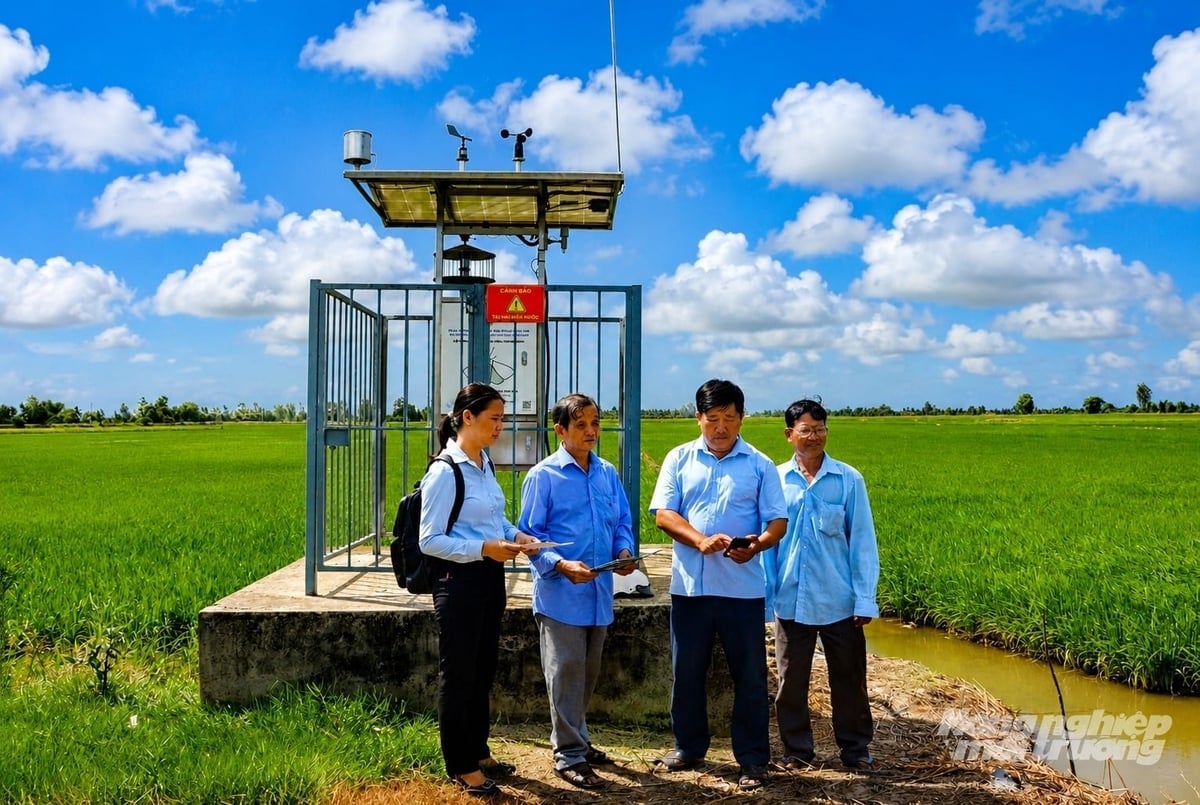
The smart insect monitoring station was invested in by the An Giang Agricultural Extension Center for the Phu Hoa Youth Agricultural Service Cooperative. Photo: Trung Chanh.
According to Le Huu Toan, Director of the Department of Agriculture and Environment of An Giang province, the province aims to achieve 183,600 hectares of rice fields participating in the "1 Million Hectares of High-Quality, Low-Emission Rice" project by 2026. In this effort, agricultural extension services play a crucial role in supporting farmers and cooperatives in applying emission-reducing and sustainable farming practices.
Today, low-emission rice fields stretch across An Giang province, the footprints of agricultural extension workers always visible on every embankment. Thirty-five years ago, An Giang's agricultural extension officers brought technical handbooks and old motorbikes to reach farmers. Today, that equipment includes smartphones, emission management software, digital data, knowledge of carbon credits, and agricultural value chains. Though the tools have changed, the goal remains the same: to help farmers produce more efficiently, improve their lives, and preserve the greenness of the fields for future generations.
In the context of agriculture facing increasing pressure from climate change, emission reduction requirements, traceability, and international standards, agricultural extension officers must also adapt. They must not only understand farming techniques but also be proficient in digital technology, the circular economy, carbon credits, cooperative management, and market linkages.
Source: https://nongnghiepmoitruong.vn/dan-dat-nong-dan-san-xuat-lua-giam-phat-thai-d819466.html