






The 2026 World Cup is not only a stage for stars on the pitch, but also a place where WAGs (wives and girlfriends of players) attract attention in the stands. It's not uncommon to see WAGs in the stands wearing jerseys with players' names printed on the back, accompanied by messages expressing affection or personalized details.
On social media, a series of photos of WAGs wearing jerseys with their husbands' or boyfriends' names printed on them quickly went viral, creating a distinctive fashion trend whenever the World Cup takes place.
The World Cup stands were covered with jerseys.
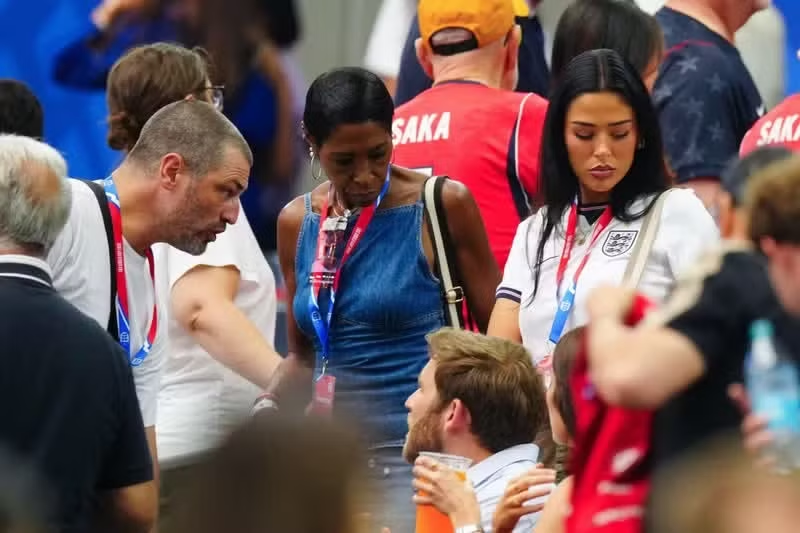
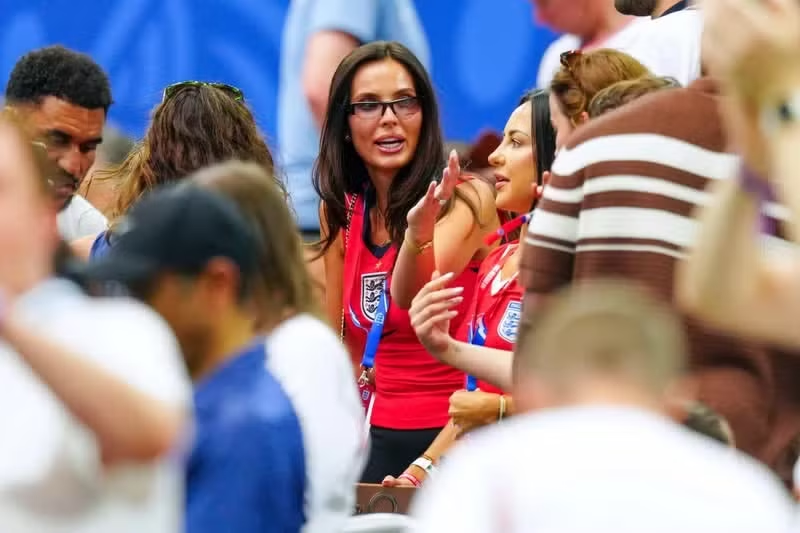


While about two decades ago, WAGs were often mentioned for their extravagant style or glamorous lifestyle, the current generation of WAGs is increasingly focusing on showing their support for their partners in their sporting careers.
The explosion of social media has given the meaning of a football jersey a completely different significance. A photo taken in the stands can now reach millions of people in just a few hours. Therefore, jerseys printed with players' names are not only seen at the stadium but have also become part of the personal image-building strategy for WAGs (wives and girlfriends of footballers).
Many fashion brands have even quickly embraced this trend by releasing jerseys designed specifically for players' family members. For many fans, this is a beautiful image. It creates a sense of closeness, allowing fans to see a more down-to-earth side of the football stars.



At the 2026 World Cup currently taking place in the US, the wives and girlfriends of England players continue the tradition of supporting their national team. Many familiar faces, such as Megan Pickford – wife of goalkeeper Jordan Pickford, and Ashlyn Castro – girlfriend of Jude Bellingham, have appeared in the stands wearing jerseys to cheer on Harry Kane and his teammates.
Tolami Benson, girlfriend of striker Bukayo Saka, always attracts attention whenever she appears in the stands wearing an England jersey. At England's matches in the 2026 World Cup, Benson consistently wore a jersey with Saka's name printed on the back. This detail was widely reported by the British media.
Besides the England WAGs, at matches involving Argentina, Portugal, and Brazil in the World Cup, the sight of women wearing jerseys with their husbands' or boyfriends' names and numbers printed on them has become familiar.
Controversial trend


In the podcast The Overlap , Manchester United legend Roy Keane drew attention by publicly criticizing WAGs (wives and girlfriends of footballers) for wearing jerseys with their husbands' or boyfriends' names on them in the World Cup stands. Roy Keane openly called this trend ridiculous and argued that wives and girlfriends don't need to wear jerseys with their partners' names on them to show their support.
"Every time the World Cup comes around, all the players' wives, children, and families flock to the stadium. The wives all wear shirts with their husbands' names on the back. It's fine for the kids to wear them, but it's really hard to understand why wives and girlfriends wear jerseys with players' names on the back," said Roy Keane.
Keane suggested that many people take photos with their partner's name on the back of their shirt, but they might break up a year later. This comment immediately sparked a heated debate in the football world and on social media.
Keane's views are actually not surprising. For many years, he has been known for his traditional approach to football, emphasizing simplicity and substance, and generally showing little sympathy for off-field displays.
However, also present on the show, former striker Ian Wright refuted Roy Keane's view. "I don't see anything wrong with it. Their husbands or boyfriends are playing. They are proud of that and want to wear the jersey of the person they love. It's as simple as that," Ian Wright said.



The debate between Roy Keane and Ian Wright revealed two completely different perspectives on the role of WAGs in modern football. Those who agreed with Keane argued that the World Cup should focus on the game itself rather than image-driven activities. They felt that wearing shirts with players' names on them sometimes felt ostentatious or turned the stands into a fashion show.
Conversely, many argue that this is simply a very normal act of affection. Given that players are away from their families for weeks at a time during the World Cup, it's perfectly natural and respectable for family members to wear their jerseys to show their support.
In fact, the majority of fans today tend to support Ian Wright's viewpoint. Because in a tournament lasting many weeks with immense pressure, the presence of family is often seen as a crucial source of moral support for the players.
Whether you agree or disagree, there's no denying that wearing a jersey with your husband's or boyfriend's name printed on it has become a part of modern World Cup culture. It reflects the shift in football in the age of social media, where off-field stories sometimes receive just as much attention as events on the pitch.
Source: https://tienphong.vn/dan-wags-bi-chi-trich-o-world-cup-post1853327.tpo



![[Photo] General Secretary and President To Lam receives Palestinian Ambassador Saadi Salama](https://vphoto.vietnam.vn/thumb/1200x675/vietnam/resource/IMAGE/2026/06/25/1782365384740_a1-bnd-9423-8322-jpg.webp)
![[Image] Ho Chi Minh City: Ma Lang area, Chicken-Rice Market about to change its appearance](https://vphoto.vietnam.vn/thumb/1200x675/vietnam/resource/IMAGE/2026/06/25/1782377698627_ndo_br_m1-jpg.webp)
![[Image] Schools organize meetings and introduce teaching models to students admitted to grade 10.](https://vphoto.vietnam.vn/thumb/1200x675/vietnam/resource/IMAGE/2026/06/25/1782368077271_ndo_br_z7970052192242-1ec8daeb77a6eed1a4e9f58c564ddd3e-jpg.webp)