


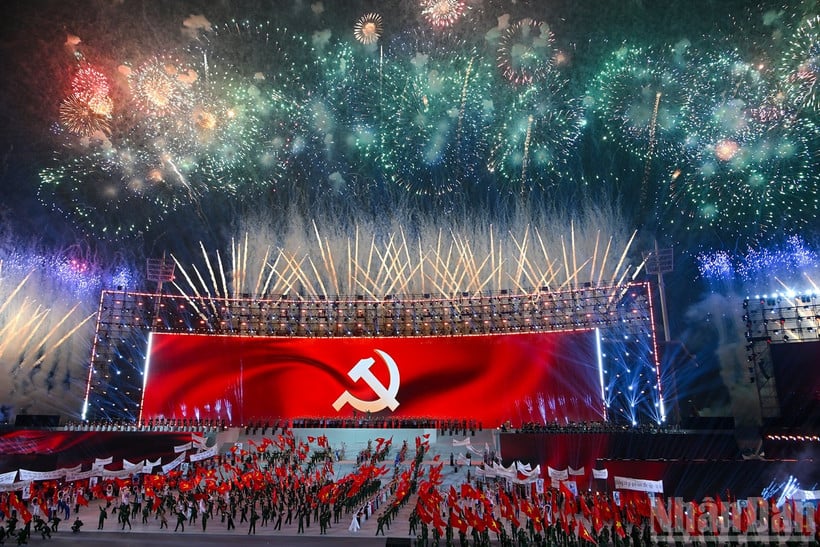
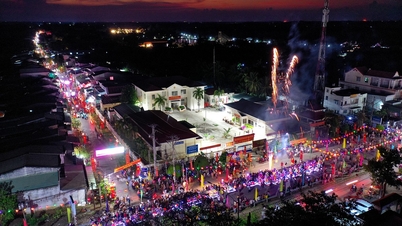
Fireworks lit up the sky over Hanoi, the capital city, to celebrate the successful conclusion of the 14th National Congress of the Communist Party of Vietnam . Photo: Dang Khoa
In the spring of 1930, when founding the Communist Party of Vietnam, leader Nguyen Ai Quoc - Ho Chi Minh clearly stated the ideal and strategic goals of the Party and the nation: To make Vietnam completely independent, to move towards a communist society. To achieve that lofty goal, the Party must rely on the strength of the people, lead the entire people. He wrote: "The Party is the vanguard of the proletariat class, it must win over the majority of its class, it must make its class lead the people" (1) .
Comrade Tran Phu, the first General Secretary of the Party, clearly stated the necessity of "having a Communist Party with a correct political line, discipline, concentration, close contact with the masses, and experience in struggle to grow" (2) .
The Party's close connection with the people from the very beginning has been an essential requirement and a principle in Party building and the fulfillment of the Party's leadership role. This is also the revolutionary essence, the source of strength, and the glorious tradition of our Party and our nation. The correct leadership of the Party, and the Party's genuine commitment to the people and the nation, is what wins over and unites the entire population. This, in turn, strengthens the people's unwavering trust in the Party's leadership, both during times of revolutionary prosperity and in times of hardship and challenge.
During the first revolutionary movement of 1930-1931, the Party led the workers and peasants in a tenacious struggle, achieving significant results, including land for the peasants and the establishment of a revolutionary form of government (the Nghe-Tinh Soviet). The French imperialists and their feudal collaborators brutally suppressed the movement in bloodshed, and the revolutionary movement suffered heavy losses. General Secretary Tran Phu was arrested on April 18, 1931. Leader Nguyen Ai Quoc was imprisoned on June 6, 1931. Despite these severe trials, the people remained steadfast in their belief that the Party and the revolution would recover and develop.
On January 28, 1941, leader Nguyen Ai Quoc - Ho Chi Minh returned to Vietnam with the Central Committee of the Party to directly lead the revolution. The Party united the entire people in the Viet Minh Front to advance and seize power and independence. The success of the August Revolution in 1945 was the result of the correct combination of the Party's leadership and the maximum utilization of the people's strength, with the nation "using its own strength to liberate itself".
The August Revolution was successful, the Democratic Republic of Vietnam was born (now the Socialist Republic of Vietnam), and the Party became the ruling party. Foreign enemies and internal enemies were trying to sabotage, and the country's situation was "hanging by a thread." The people believed in the leadership of the Party and Uncle Ho, and were certain that the Vietnamese revolutionary ship would overcome all obstacles and sail forward. The Party led and ruled through the State, the Government, the National Assembly, and the governments at all levels. The people exercised their right to participate in the National Assembly elections (the first general election to elect the Vietnamese National Assembly was held on January 6, 1946), built the government, and supported the Government politically and materially. Under the conditions of the ruling Party, the relationship between the Party, the Government, and the people was of decisive importance for success. "Without the people, the Government would not have enough strength. Without the Government, the people would have no one to lead them. Therefore, the Government and the people must unite as one bloc" (3) .
With the historic victory at Dien Bien Phu and the Geneva Accords, the North was liberated and advanced towards socialism; the South remained under the rule of the US-puppet regime. During the years 1954-1959, the people and comrades in the South endured suffering and losses, but remained steadfast in their faith in the Party's leadership. The Central Committee issued Resolution No. 15, enabling the South to "overcome the storm" and launch a historic uprising, opening a new era in the national salvation cause. In 1972, the invading forces relentlessly destroyed Quang Tri and the capital Hanoi. The people throughout the country maintained their faith in the Party's leadership, implementing President Ho Chi Minh's strategic ideology of "driving out the Americans and overthrowing the puppet regime," leading the cause of independence and reunification to complete victory.
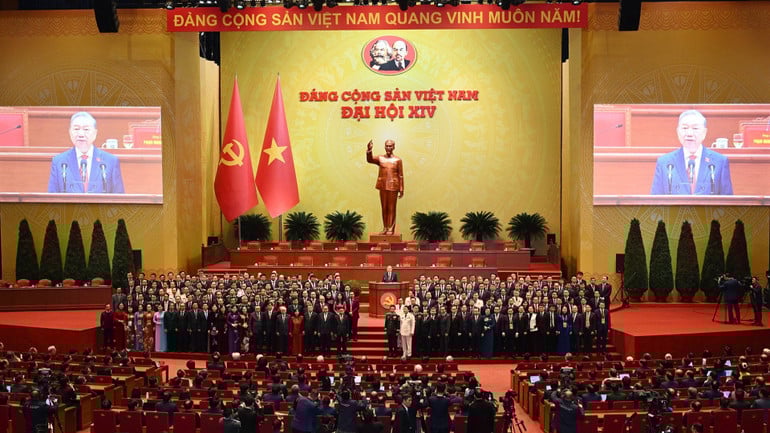
The 14th Central Executive Committee was introduced at the Congress.
With the country unified, the Party led the entire nation in building socialism. However, a grave challenge arose: "Floods in the north, floods in the south. Blood stained the border" (Tố Hữu). People and soldiers throughout the country mobilized their forces to the border, fighting and sacrificing for the integrity of the Fatherland and helping the Cambodian people escape genocide and rebuild their country. In the face of socio-economic crisis, the Party, together with the entire nation, utilized their intellect and creativity to find new directions for the country, for the sake of the people's lives.
The Sixth National Congress of the Party (December 1986) decided on a comprehensive national reform policy, meeting the aspirations, interests, and trust of the people. The Sixth Congress summarized the major lessons learned from the Party's leadership, the foremost of which was that in all its activities, the Party must adhere to the principle of "putting the people first," building and promoting the people's right to self-governance.
The Sixth Congress stated that the people's feelings and trust in the Party are very special both in times of victory, in times of difficulty, and even when the Party has shortcomings. "In the circumstances where the Party has mistakes and shortcomings, the people still earnestly expect the Party to overcome the mistakes and lead the country forward. Our Party cannot betray that expectation of the people" (4) .
The Sixth Congress emphasized: Our Party has no other purpose than to fight for the happiness of the people.
That is a lesson that has been passed throughout the Party's leadership from 1930 to the present, especially in the renovation process. It is also a profound guidance of President Ho Chi Minh: "The Party is not an organization for making money and gaining power. It must fulfill the task of liberating the nation, making the Fatherland rich and strong, and the people happy" (5) . Ho Chi Minh emphasized: "Besides the interests of the nation and the Fatherland, the Party has no other interests" (6) .
During the reform process, the Party and State focused on reforming economic mechanisms and policies, developing a socialist-oriented market economy, industrializing and modernizing the country, for a prosperous people and a strong nation. They also cared for the social security system and policies for war veterans, wounded soldiers, and families of martyrs. These included the poverty eradication program from the early 1990s; Program 135 from 1998 to build electricity, roads, schools, and health stations in mountainous and disadvantaged areas; Program 134 (2004) on supporting production land, housing, and clean water for poor ethnic minority households facing difficult living conditions; and the New Rural Development Program from 2009...
In 2015, the United Nations summarized the eight Millennium Development Goals implemented since 2000, and Vietnam was a prime example, achieving many goals ahead of schedule. The people's living standards have improved in all aspects. When Vietnam began its reforms in 1986, its per capita income was only about $150. By 2025, per capita income is projected to exceed $5,000. The Party and State led the people through the Covid-19 pandemic in 2020-2021 and unprecedented natural disasters in 2024 and 2025. The program to eliminate temporary and dilapidated housing nationwide, and the Quang Trung rapid construction campaign to build houses for people in flood-affected areas, all demonstrate the people-centered nature of the Party, State, and the socialist regime.
The consistent viewpoint of the Party and State is: people are at the center, placing national and ethnic interests above all else. All guidelines, policies, and laws are aimed at serving the people and ensuring their happiness. The best possible social security is guaranteed, and care is provided for policy beneficiary families, poor and near-poor households, vulnerable groups, the disabled, and the elderly. This includes implementing Resolution No. 71-NQ/TW of the Politburo on developing education and training, waiving tuition fees for primary and secondary school students, building schools in border areas, and providing meal subsidies for students in disadvantaged areas. It also includes implementing Resolution No. 72-NQ/TW of the Politburo on healthcare and health protection, health insurance, fee waivers and reductions, regular medical check-ups, and disease prevention. All policies are for the people, ensuring that no one is left behind.
The people have unwavering faith in the Party because it possesses a correct platform, policies, strategies, tactics, and revolutionary methods, which have led the entire nation and the revolutionary cause from one victory to another, for independence and freedom, for socialism, and for the happiness of the people. That is fundamental.
President Ho Chi Minh affirmed: Since the founding of the Party, our people have always followed the Party and been very loyal to it. That is a precious asset of our Party and our people. The Party has always demonstrated unwavering resolve in the face of domestic difficulties and challenges, as well as global changes, remaining steadfast in its communist ideals and the revolutionary path chosen by the Party and President Ho Chi Minh. The Party's resilience strengthens the people's trust. The people trust the Party because its cadres and members are staunch communists who uphold the spirit of sacrifice for the revolutionary ideal, for the people, and for the nation. The Party has the great leader Ho Chi Minh and many other highly respected leaders.
In building and developing the country along the socialist path, the leaders of the Party and State have always been at the forefront of innovative thinking, decisiveness, and creativity. Cadres and Party members uphold the responsibility of setting an example, with many shining examples for the people to follow. The people trust the Party also because the Party is determined to fight against the decline in political ideology, morality, and lifestyle, and against "self-evolution" and "self-transformation" of a segment of cadres and Party members. The Party has achieved many successes in the fight against corruption, waste, and negative phenomena. The increasingly strong relationship between the Party and the people is the source of strength for the regime and the country.
The 14th National Congress of the Party ushered in a new era for the nation, aiming for a strong, prosperous, and civilized country, and an increasingly happy life for its people. The goal is to achieve a high-middle income by 2030 and a high-income status by 2045. The 14th National Congress also decided to summarize 100 years of the Party's leadership and 40 years of implementing the Platform for National Construction during the transitional period to socialism. These important summaries aim to clarify the theory and practice of the Communist Party of Vietnam's leadership and governance, its revolutionary and scientific nature, and to develop an understanding of the role of the masses in history, clarifying the laws of development of the Vietnamese revolution and nation under the leadership of the Communist Party of Vietnam.
-------------------------------------------------
(1) Communist Party of Vietnam: Complete Party Documents, National Political Publishing House, Hanoi, 1998, volume 2, page 4.
(2) Communist Party of Vietnam: Ibid., volume 2, page 100.
(3) Ho Chi Minh: Complete Works, National Political Publishing House, Hanoi, 2011, volume 4, page 64.
(4) Communist Party of Vietnam: Complete Party Documents, National Political Publishing House, Hanoi, 2006, volume 47, pages 362-363.
(5) Ho Chi Minh: Ibid., volume 5, page 289.
(6) Ho Chi Minh: Ibid., volume 5, page 290.
Associate Professor, PhD NGUYEN TRONG PHUC
Source: https://nhandan.vn/dang-that-su-vi-dan-dan-ben-long-tin-dang-post940419.html

![[Photo] Prime Minister Pham Minh Chinh receives the Minister of Emergency Situations of the Russian Federation.](https://vphoto.vietnam.vn/thumb/1200x675/vietnam/resource/IMAGE/2026/03/05/1772712011395_ndo_br_thiet-ke-chua-co-ten-76-png.webp)


![[Photo] General Secretary To Lam working with the Central Inspection Committee](https://vphoto.vietnam.vn/thumb/1200x675/vietnam/resource/IMAGE/2026/03/05/1772718314670_a1-bnd-8682-5192-jpg.webp)





![[Video] Comrade Nguyen Anh Tuan elected as Chairman of the Vietnam General Confederation of Labor](https://vphoto.vietnam.vn/thumb/402x226/vietnam/resource/IMAGE/2026/03/05/1772717115405_dung00-33-31-10still007-png.webp)
![[Video] General Secretary To Lam: Improving the quality of grassroots cadres is urgent, strategic, and of long-term significance.](https://vphoto.vietnam.vn/thumb/402x226/vietnam/resource/IMAGE/2026/03/05/1772717120031_dung00-20-46-14still005-png.webp)

![[Photo] General Secretary To Lam working with the Central Inspection Committee](https://vphoto.vietnam.vn/thumb/402x226/vietnam/resource/IMAGE/2026/03/05/1772718314670_a1-bnd-8682-5192-jpg.webp)
![[Video] Announcement of the decision to inspect and supervise the Standing Committee of the Da Nang City Party Committee](https://vphoto.vietnam.vn/thumb/402x226/vietnam/resource/IMAGE/2026/03/05/1772717114745_dung00-28-12-12still006-png.webp)
![[Video] 244 cultural and tourism events in Gia Lai province in 2026](https://vphoto.vietnam.vn/thumb/402x226/vietnam/resource/IMAGE/2026/03/05/1772717113702_img-2961-7606-jpg.webp)



































Comment (0)