

 |
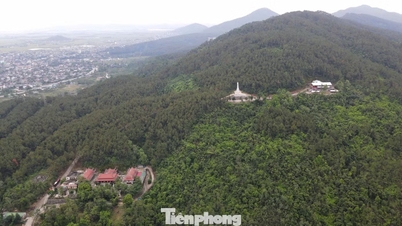
| La Chử village was renowned as a center of learning during the Nguyen dynasty. Photo: Ngoc Hoa |
During the 143-year reign of the Nguyen Dynasty, Huong Tra district had 105 graduates, including 5 doctorates and 13 associate doctorates. Thanh Luong and La Chu villages alone each had 17 graduates, accounting for one-third of the district's total number of successful candidates. If we include the Dang Huy Tru family, including uncles, nephews, and brothers residing in Thanh Luong but registered under the name of Bac Vong Dong, the number in Thanh Luong village reaches 22. In Thanh Luong, the family of Mr. Nguyen Van Tuong (also known as Luan) had 5 graduates.
In La Chử, the Hà Thúc and Lê Đình families were prominent. At the beginning of the 20th century, Cao Xuân Dục, in his work "Đại Nam địa dư chí ước biên," mentioned four famous families of the capital city: "Nguyễn, Đặng, Thân, Hà - renowned families." The Hà family mentioned here refers to the Hà Thúc family in La Chử, beginning with Hà Thúc Trương, who passed the cử nhân examination in the Tân Tỵ year (1821), served as the governor of Hưng Yên , and was later demoted to Thị độc học sĩ (a scholar). He had four grandsons and one nephew who all passed the examinations. His nephew, Hà Thúc Hỗ, passed the giải nguyên examination in the Mậu Thân year (1848), the first year of Tự Đức's reign, and became the head of education in Quảng Nam. Notably, three of his grandsons, brothers Hà Thúc Du, Hà Thúc Huyên, and Hà Thúc Tuân, all passed the same examination – the Bính Ngọ year (1906), the 18th year of Thành Thái's reign – gaining widespread fame throughout the region. Another grandson, Mr. Ha Thuc Ngoan, passed the imperial examination in 1912 but did not have time to become an official.
Regarding the Lê Đình family, one branch had four graduates: Lê Hoàn and his son, his nephew Lê Đạm, and Lê Đức Hinh. Lê Phúc Khiêm, also known as Lê Đình Soạn, passed the exam in 1864 and served as the Governor of Khánh Hòa . His son, Lê Hoàn, took the exam several times, finally passing in 1906 at the age of 34. This stemmed from resentment towards his nephew (Lê Đạm) who had passed the exam in 1900, with the villagers often saying, "If Ng. passed, what chance do I have!" Lê Hoàn passed the Đình exam in 1907 as the second-highest-ranking graduate and was one of the two Hoàng Giáp (highest-ranking graduates) of Thừa Thiên province.
La Chử also has two second-highest-ranking scholars, both from the Nguyễn family, while Thanh Lương has three. One of La Chử's second-highest-ranking scholars was Mr. Nguyễn Đĩnh, born in 1857. He worked in Phú Lộc, established the La Chử village, and registered there. In 1884, he returned to the village to take the Hương examination. At that time, the imperial court moved the Thừa Thiên Hương examination center to La Chử, and he passed, ranking 9th out of 31. In the 1892 examination, he passed as a second-highest-ranking scholar. Currently, his tomb is in the village, and his descendants live there, tending to his graves and offering incense because he has no descendants.
We are somewhat puzzled that the Ha Thuc family genealogy records that the first person to pass the imperial examinations in the family was Mr. Ha Thuc Giao, who passed the provincial examination (later called the bachelor's degree) during the Minh Mang dynasty and served as an official up to the position of An Sat (judicial officer). However, in the book " Education and the Confucian Examination System of the Nguyen Dynasty (1802 - 1919)" by Huynh Cong Ba (Thuan Hoa Publishing House, 2018), in the section summarizing the list of bachelors from various examination schools throughout the 47 examinations and analyzing the number of successful candidates in each province and city, we do not find his name.
A significant mark of the scholarly tradition of La Chử was the 1906 Bính Ngọ examination, where all five people from the village passed. The first and only person from the Huỳnh family to pass that year was Mr. Hà Xuân Hải, a high-ranking official in the Ministry of Finance during the Bảo Đại era, who later rose to the rank of Minister. Before taking the exam, he changed his middle name from "Văn" to "Xuân". Seeing this, the entire family followed suit, thus transforming the Hà Văn family name into the Hà Xuân family name as it is today.
Although time has passed, I firmly believe that the aspiration to excel in studies and achieve high scores in examinations remains intact in the bloodline not only of the children of La Chu but of all Vietnamese people. Because the country is on the path of development, prosperity, and stability, moving towards the noble goal of "a wealthy people, a strong nation, a democratic, just, and civilized society," it needs many talented individuals.
Source: https://huengaynay.vn/chinh-polit-xa-hoi/dat-hoc-161895.html


![[Photo] General Secretary and President To Lam presides over a meeting on assessing national development resources.](https://vphoto.vietnam.vn/thumb/1200x675/vietnam/resource/IMAGE/2026/05/20/1779253785852_a1-bnd-2943-8519-jpg.webp)
![[Photo] National Assembly Chairman Tran Thanh Man working with the Standing Committee of the Economic and Financial Committee](https://vphoto.vietnam.vn/thumb/1200x675/vietnam/resource/IMAGE/2026/05/20/1779249584387_ndo_br_1-jpg.webp)






































































Comment (0)