Speaking at the conference, Dr. Truong Minh Huy Vu stated that July 2nd, 2026 marks the 50th anniversary of the city of Saigon-Gia Dinh officially being honored with the name of President Ho Chi Minh . Over the past 50 years, the city has overcome difficulties and challenges, achieving many accomplishments along with many expectations.
In particular, in the new context, from July 1, 2025, after the merger and with the issuance of Resolution 09-NQ/TW on building and developing Ho Chi Minh City in the new era by the Politburo , Ho Chi Minh City is in a new position, with a new mindset, a new vision, and new momentum.
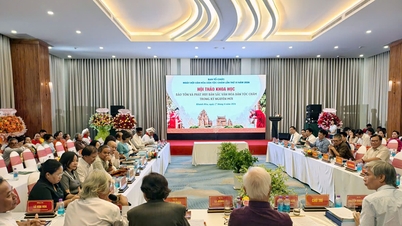
The seminar "50 Years of Ho Chi Minh City: Historical Milestones, Development Aspirations, and Institutional Breakthroughs" not only looked back at the city's 50-year development journey, but more importantly, it aimed to exchange ideas, design, and establish scientific and practical arguments for a new phase of development.

The workshop focused on discussing four major groups of issues, including: the achievements, strengths, and lessons learned of Ho Chi Minh City over the past 50 years; identifying the characteristics of its culture, people, and generous spirit, and explaining why it is the cradle of innovation, science, and technology, and always a pioneer; sharing experiences regarding the material and spiritual lives of its people; and groundbreaking proposals on institutions and policies, as well as recommendations and initiatives for Ho Chi Minh City to continue its leading role in the economy, culture, society, and human development in the new context.
Dr. Truong Minh Huy Vu also shared that the opinions expressed at today's seminar are very important, especially in the context of Ho Chi Minh City being in the final stages of preparing the dossier for the Special Urban Law project, expected at the next National Assembly session. The new law for Ho Chi Minh City is expected to encompass the dreams, aspirations, and vision of the city and be concretized into provisions within the law.

In his introductory report, Pham Binh An, Deputy Director of the Ho Chi Minh City Institute for Development Research, emphasized that Ho Chi Minh City is facing new opportunities and development demands, requiring the construction of a governance model suitable for a megacity with expanding development space and increasingly deep regional connectivity.
The city needs to effectively transform its resources in culture, human capital, science and technology, and innovation into genuine drivers of development; and build a modern, inclusive social security system that adapts to trends such as population aging, digital transformation, and climate change.
According to the Deputy Director of the Institute for Development Studies, Ho Chi Minh City is still facing many challenges regarding urban infrastructure, human resource quality, public administration efficiency, and institutional reform. The workshop is not only an opportunity to look back on 50 years of development but also aims to establish scientific and practical arguments for the city's development strategy in the new phase.

At the workshop, delegates focused their discussions on key issues.


Firstly, the historical significance and 50-year development journey of the city are highlighted, clarifying the political and historical meaning of renaming Saigon - Gia Dinh to Ho Chi Minh City in 1976, as well as the remarkable economic, social, and urban transformations over the past half-century.
Secondly, the aspiration is to rise together with the country with the goal of building Ho Chi Minh City into a smart, green, modern, and livable megacity; playing the role of a core urban center and the main growth pole of the whole country, while also being a financial, logistics, education, healthcare, and cultural center of regional and international stature.
Thirdly, institutional impetus for breakthrough development in the new era. This focuses on clarifying the need to build a specific legal framework for a multi-centered megacity with increasingly large scale and economic linkages; proposing breakthrough mechanisms, policies, and legal solutions through a Special Urban Law to remove bottlenecks, improve governance efficiency, and enhance the quality of life for citizens.
According to Associate Professor Dr. Ha Minh Hong, Vice President of the Ho Chi Minh City Historical Science Association: Exactly 80 years ago, on August 25, 1946, to commemorate the first anniversary of the revolutionary government, in Hanoi, prominent intellectuals and scholars from Southern Vietnam, represented by Dr. Tran Huu Nghiep, along with people nationwide, gathered and unanimously signed a petition to the National Assembly and the Government requesting that Saigon be officially renamed Ho Chi Minh City.

This petition, representing the entire nation, bore the signatures of 57 revolutionaries and intellectuals from all over the country, including Ton Duc Thang, Hoang Quoc Viet, and lawyer Tran Cong Tuong. This aspiration was prominently featured on the front page of the Cuu Quoc newspaper on August 27, 1946, perfectly reflecting the unwavering affection and determination that President Ho Chi Minh held for his compatriots in the South.
Dr. Tran Du Lich, former Deputy Head of the Ho Chi Minh City National Assembly Delegation, recalled the historical period of development when the city was named after President Ho Chi Minh. During the economic crisis before the Doi Moi (Renovation) period (1977-1979), facing intense pressure for food for millions of people and raw materials for state-owned enterprises, Ho Chi Minh City proactively explored and decided to "break the rules" to unleash productive forces.
The city demonstrated innovation by flexibly allowing the private sector to develop through cooperative and production group models even before the 1986 Doi Moi (Renovation) period, fostering the formation of large private economic groups later on.
Following the Doi Moi (Renovation) period, Ho Chi Minh City continued to lead the way in experimenting with a socialist-oriented market economy, such as: piloting the establishment of export processing zones, privatizing state-owned enterprises, developing the stock market, and applying the "land for infrastructure" mechanism to build model urban areas like Phu My Hung.

Those initial, challenging steps paved the way for the formation of popular investment methods such as BT and BOT today. Beyond its economic breakthroughs, the city is also the birthplace of deeply humane programs such as poverty alleviation and the construction of charitable and compassionate housing.
In this new phase of development, Dr. Tran Du Lich proposed four key groups of solutions to elevate Ho Chi Minh City to become a competitive urban center in the region.
That is, the city needs to strengthen decentralization and delegation of power in the Law on Special Urban Areas; focus resources on developing strategic infrastructure, especially transportation and urban rail infrastructure; promote the development of digital infrastructure, green growth and digital transformation; and at the same time restructure the economic space and develop high-quality human resources to create a foundation for a new growth model.



Ho Chi Minh City needs to continue to play its leading role, pioneering the achievement of double-digit growth, contributing to the nation's development aspirations in the new era. If Vietnam does not achieve double-digit growth before entering the aging population phase, it will be very difficult to overcome the middle-income trap.
From the perspective of developing an international financial center, Nguyen Huu Huan, Vice Chairman of the Vietnam International Financial Center in Ho Chi Minh City, believes that the city's finance and banking sector in the future should not only provide capital for the local economy but also become a vital system connecting domestic and international resources.
Accordingly, the city needs to strongly develop its capital market, investment funds, asset management, green finance, digital finance, fintech, insurance, and specialized financial services to meet the growing capital needs for infrastructure, green transformation, digital transformation, and innovation.
“In the context of increasing capital needs for infrastructure, green transformation, digital transformation, and innovation, the city must become a place for designing, structuring, and distributing long-term capital flows for the real economy. Finance should not only be a place for lending and payments but must become a tool for creating development,” said Mr. Nguyen Huu Huan.
The Organizing Committee received over 100 papers focusing on clarifying the historical significance of the event of naming Ho Chi Minh City after President Ho Chi Minh; identifying the identity and leading role of the city in the economy; evaluating the work of caring for the material and spiritual lives of the people; and proposing solutions to remove institutional bottlenecks, improve urban governance capacity, and promote the role of the city as a growth pole in the new phase. The Organizing Committee stated that it will incorporate and synthesize the opinions from the conference as a basis for research and proposing solutions to realize the goal of rapid and sustainable development of Ho Chi Minh City in the coming time.
Source: https://baovanhoa.vn/doi-song/dau-an-lich-su-khat-vong-phat-trien-va-dot-pha-the-che-240244.html





































































![[INFOGRAPHICS] Can Tho implements the Strategy for Ethnic Affairs until 2030, with a vision to 2045](https://vphoto.vietnam.vn/thumb/402x226/vietnam/resource/IMAGE/2026/06/28/1782658308447_1782658217.webp)