

Persistent back pain may indicate kidney cancer.
Recently, doctors at An Binh Hospital received a male patient, TVH (45 years old, residing in Ho Chi Minh City), who came for examination due to persistent dull pain in the right lower back for two months.
According to the patient, he initially thought he only had muscle pain or was experiencing discomfort from strenuous work or poor posture, so he bought painkillers to take at home. However, the pain did not subside but became more frequent.
- Persistent back pain may indicate kidney cancer.
- Kidney cancer often progresses silently.
- Why is kidney cancer dangerous?
- Methods to detect kidney cancer
- Who is at high risk of developing kidney cancer?
- Doctor's advice
After the examination, the doctors ordered an ultrasound and an abdominal CT scan. The results showed that the patient had a kidney tumor approximately 3cm in size. Fortunately, the tumor was still confined within the renal capsule and had not invaded or metastasized to neighboring organs. The patient was diagnosed with early-stage kidney cancer.
According to urologists, this is the "golden" stage for treatment, as the chances of a complete cure are very high if detected early.
In Mr. H.'s case, the doctors consulted and decided to perform a laparoscopic partial nephrectomy, also known as kidney-preserving surgery. This method removes only the tumor and a portion of the surrounding healthy tissue, while preserving as much healthy kidney parenchyma as possible to maintain future excretory function.
According to the doctors, this is a difficult technique requiring highly experienced surgeons. During the surgery, the doctor must control the renal blood vessels, remove the tumor, and suture the renal parenchyma in a short period of time, usually under 30 minutes, to minimize the risk of kidney damage due to ischemia. Four days after the surgery, the patient's health recovered well, kidney function stabilized, and they were discharged from the hospital.
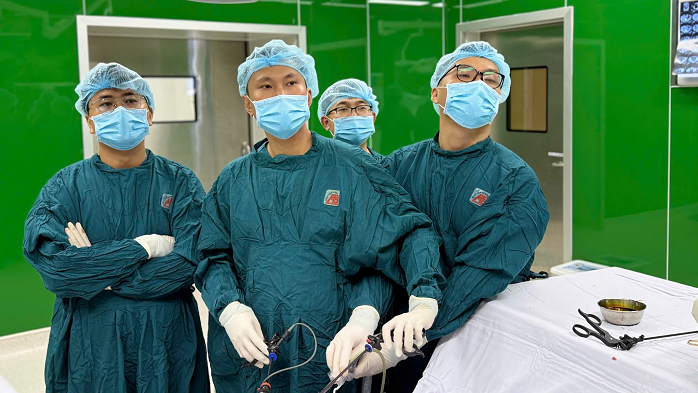
Doctors performed laparoscopic partial nephrectomy on a patient with kidney cancer.
Kidney cancer often progresses silently.
According to Dr. Nguyen Minh Duat, Head of the Urology Unit at An Binh Hospital, back pain caused by kidney cancer is usually dull and persistent, affecting one side of the flank or lower back.
Unlike typical mechanical back pain—which usually subsides with rest or changes in posture—pain from kidney tumors is often persistent, posture-independent, and tends to worsen over time. As the tumor grows larger, the strain on the renal capsule causes more pronounced pain.
It's worth noting that in its early stages, kidney cancer rarely presents with severe symptoms. Many patients only experience vague symptoms, leading them to underestimate the condition or self-treat at home.
In addition to persistent back pain, people should pay special attention to the following signs:
- Hematuria, which may be visible to the naked eye or only detectable through testing.
- Persistent fatigue of unknown origin.
- Unusual weight loss.
- Persistent mild fever.
- Anemia.
- A feeling of heaviness or pressure in the lower back and hips.
Doctors say that in many cases, kidney cancer is only discovered incidentally during routine health checkups or abdominal ultrasounds performed for other reasons.
Why is kidney cancer dangerous?
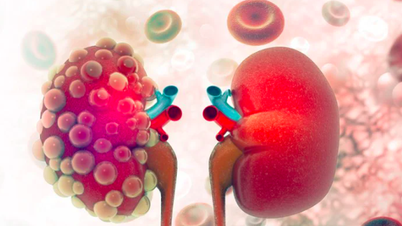
Kidney cancer is one of the malignant diseases of the urinary system. If not detected early, cancer cells can invade outside the kidney and metastasize to many organs such as the lungs, liver, bones, or brain.
In the later stages, treatment becomes more complex, and patients may require a combination of methods such as surgery, targeted therapy, immunotherapy, or radiation therapy. The prognosis for survival also decreases significantly compared to the early stages.
However, if detected when the tumor is small and has not metastasized, the chances of a cure are very high. In many cases, only kidney-preserving surgery is needed, without the need for additional chemotherapy or radiation therapy.
Methods to detect kidney cancer
To diagnose kidney cancer, doctors may order various diagnostic tests.
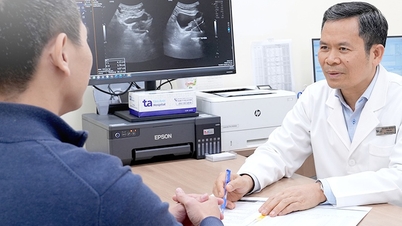
Abdominal ultrasound is highly valuable in the early detection of kidney tumors, even when the patient has no clinical symptoms. Doctors can assess the size and location of the tumor, as well as detect signs of invasion or metastasis to the liver, lymph nodes, or renal veins.
CT scans help accurately assess tumor characteristics, extent of spread, and aid in disease staging. They are a crucial tool in the diagnosis and treatment planning of kidney cancer.
X-ray imaging of the urinary system provides a preliminary assessment of the kidneys and urinary tract, as well as detecting abnormalities such as stones, calcifications, or compression of the renal pelvis.
In some cases, X-ray imaging with contrast injection also allows for the assessment of the excretory function of each kidney.
Who is at high risk of developing kidney cancer?
According to experts, certain groups of people are at a higher-than-normal risk of developing kidney cancer, including:
- People over 55 years old.
- Long-time smokers.
- Obese people.
- People with high blood pressure.
- People with a family history of kidney cancer.
- People who are frequently exposed to toxic chemicals such as asbestos.
- People with chronic kidney disease.
In addition, an unhealthy lifestyle and lack of exercise can also increase the risk of developing the disease.
Doctor's advice
Doctors advise people to maintain a healthy diet, get enough sleep, and exercise regularly to boost their immune system and protect their overall health.
In particular, regular health checkups play a crucial role in the early detection of kidney cancer as well as many other dangerous diseases.
People over 55 or in high-risk groups should have a health check-up at least every 6 months to 1 year. Simple methods such as abdominal ultrasound, urine tests, and blood tests can help detect abnormalities early.
In addition, people need to quit smoking, limit exposure to harmful chemicals, maintain a healthy weight, and increase physical activity.
Experts emphasize that if you experience persistent back pain of unknown origin, especially if accompanied by blood in the urine, weight loss, or persistent fatigue, you should not ignore it but should seek timely medical attention. The earlier the diagnosis, the higher the chance of successful treatment.
Source: https://suckhoedoisong.vn/dau-lung-coi-chung-ung-thu-than-giai-doan-som-169260518071320085.htm



































































































Comment (0)